
Newly released documents from crash investigators show that UPS never mandated the in-depth inspections that could have detected the defect responsible for an engine breaking away from one of its aircraft before it went down — even though Boeing had recommended those inspections years before the accident.
However, UPS pushed back in its own filing with the National Transportation Safety Board, arguing that the reason it never required those enhanced inspections of bearings inside the pylons — the structures that attach engines to the wings of its MD-11 freighters — was because Boeing had incorrectly told the company that a failure of those bearings would not pose a threat to flight safety.
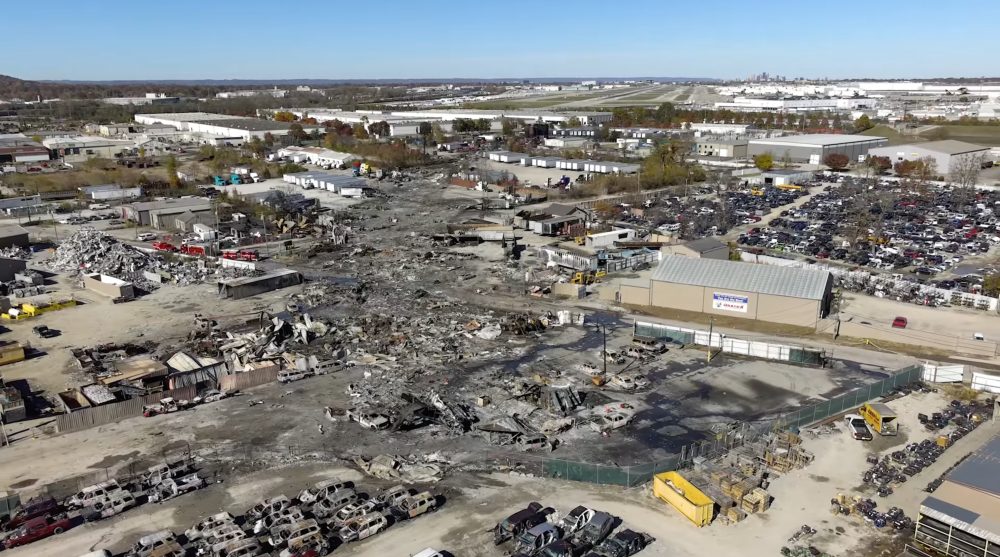
The aircraft went down last fall while picking up speed on the runway at Louisville’s Muhammad Ali International Airport. Three pilots and 12 people on the ground were killed, and 23 others were hurt.
The inspection failures that prevented mechanics from closely examining the critical components holding the engines to the wings were brought to light during two days of investigative hearings in May. However, the documents made public Wednesday added new layers of detail to what was already known.
The NTSB may not release its final report on the deadly crash — which occurred as the UPS aircraft attempted to take off in Louisville, Kentucky, last November — until late this year or possibly into early next year. Still, UPS stated it is already evident that “once the pylon separated from the aircraft, the crash was inevitable.”
During the hearings, officials from both Boeing and the Federal Aviation Administration admitted they had misjudged the dangers tied to a potential failure of a steel bearing and metal sheath in the engine mount. They had not recognized that such a failure could cause the fasteners securing engines to the MD-11’s wings to break apart. Because the bearings are buried deep near the pylons, spotting problems requires removing each engine for thorough inspections.
Aviation safety expert Jeff Guzzetti said that the actions of Boeing, UPS, the FAA, and maintenance company STE San Antonio Aerospace all played a role in causing the crash.
“There’s just lots of subtleties and semantics that these four entities are using. But in the end, this got missed and to some degree, all four have some role to play in that,” said Guzzetti, who previously investigated crashes for both the NTSB and the FAA. “Safety is a shared responsibility, and I think the NTSB’s task now is to apportion that responsibility.”
Chris Hentz, Vice President of STE San Antonio Aerospace, said UPS only required its mechanics to look for corrosion, not for evidence of bearing failure. Both Hentz and UPS pointed out that even when Boeing acknowledged that changes to the bearing inspection requirements were warranted, the manufacturer stated in the same correspondence that the existing inspection requirements were already sufficient.
Hentz noted in his letter that Boeing “stated that while the MD-11 inspection intervals and requirements for an inspection of the aft bulkhead were sufficient, changes to the inspection requirements of the spherical bearing were warranted to ensure that the migration of the outer race would be reliably detected and identified during inspection.”
UPS also noted that while Boeing developed an improved inspection procedure and added it to the MD-11 maintenance manual, the company never incorporated that procedure into its federally approved maintenance schedule.
“Relying on Boeing’s representations that the issue was not safety-of-flight and that existing MPD inspections were sufficient, UPS determined that no additional changes to its maintenance program were necessary beyond what was already being performed,” the package delivery company said.
At one point, Boeing successfully lobbied the FAA to stretch the required inspection interval from once every 19,900 takeoff-and-landing cycles to once every 29,260, allowing airlines to bundle major maintenance tasks together and reduce downtime.
Boeing sought that extension even after it had already received reports of seven instances of bearing defects — all discovered well before the planes had reached the original inspection thresholds. In the years following the loosened schedule, three additional cases were found before the crash occurred.
The UPS plane that went down after losing its engine had completed 21,043 cycles, meaning it should have undergone a thorough inspection under the original schedule. Only one other crash involving a similar aircraft losing an engine has been recorded, and that incident, which happened decades ago, was attributed to improper maintenance rather than the same type of defect.
FedEx and other MD-11 operators reported at least 10 additional instances of bearing failures or failures of the surrounding components in the years leading up to the UPS crash. It remains unclear whether those other carriers were following different maintenance practices.
FedEx resumed flying its MD-11 fleet in May after the FAA signed off on Boeing’s safety plan. Engine mounts were thoroughly inspected following the November crash, and going forward, the spherical bearings will be swapped out on a regular basis — after every 4,000 takeoff-and-landing cycles. UPS, meanwhile, chose to retire its entire MD-11 fleet early in the wake of the disaster.