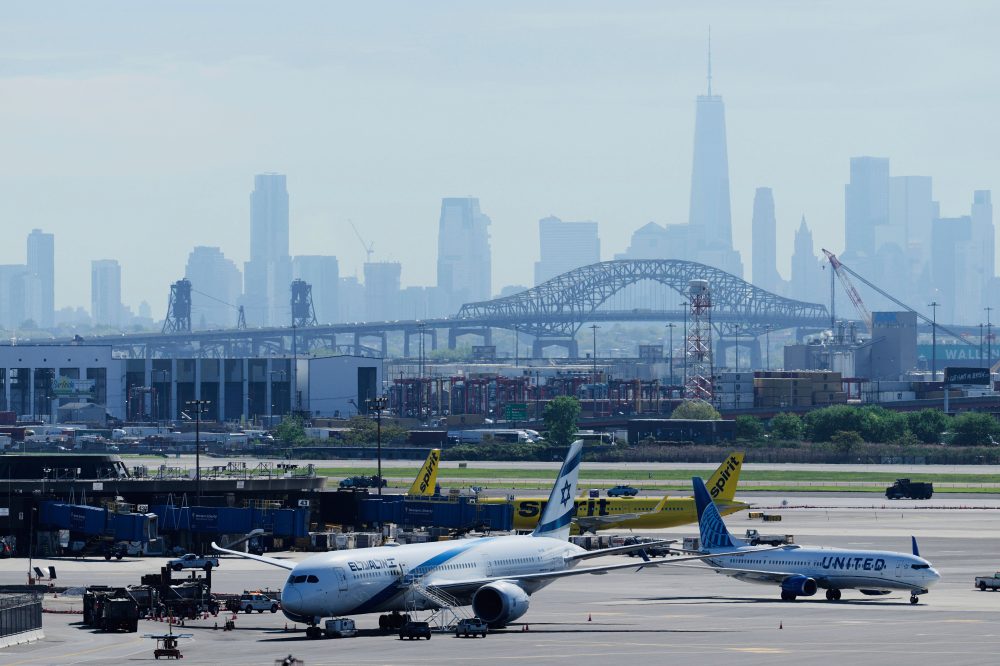

A United Airlines flight carrying 231 passengers came within feet of a major disaster Sunday when the aircraft collided with a delivery truck and light pole while approaching Newark Liberty International Airport in New Jersey.
The Boeing 767, arriving from Venice, Italy, managed to strike the semitrailer on the New Jersey Turnpike during its final approach before successfully completing its landing. The truck driver, who was operating a bakery delivery vehicle, received treatment at a local hospital for minor injuries, while all passengers and crew members remained unharmed.
Aviation safety specialist Steve Arroyo, a former United pilot with extensive experience on the same runway, emphasized how close the situation came to tragedy. “A major catastrophe was avoided by feet,” Arroyo explained. “Had it been another five feet lower, eight feet, I mean, no more than 10 feet, that plane would have been all over the New Jersey Turnpike.”
The National Transportation Safety Board announced Monday that officials have upgraded their classification of the event from an incident to an accident due to the severity of aircraft damage, though specific details about the damage remain undisclosed.
Audio recordings from air traffic control suggest the collision may have created an opening in the aircraft’s fuselage, though neither United Airlines nor federal investigators have verified this information. The flight crew chose to contact the control tower by telephone after landing rather than discussing damage details over radio communications.
More than thirty minutes following the collision, air traffic control recordings captured a conversation between a controller and ground personnel. “They felt something over the threshold and there’s a hole in the side of the airplane,” the controller stated.
Dashboard camera footage from the delivery truck captured the moment of impact and shows the vehicle appearing to roll onto its side. Given that commercial trucks typically measure 13.5 feet in height, the aircraft was flying extremely low during its approach.
Federal investigators arrived Monday to conduct interviews with the flight crew and begin their investigation into the circumstances surrounding the collision. The NTSB typically releases preliminary findings approximately one month after such incidents and has announced no plans for press briefings regarding this accident.
The aircraft utilized Runway 29 for landing, which spans 6,726 feet and represents the airport’s shortest landing strip. This runway typically sees use only during periods of strong winds, such as the conditions present Sunday afternoon when gusts reached 31 mph. Newark’s two other runways extend 11,000 feet in length.
Arroyo noted that investigators will examine the crew’s preparation for landing on the shorter runway, including their use of flight control systems and cockpit navigation equipment. These systems assist pilots in maintaining proper approach angles before transitioning to visual landing procedures.
“It’s one of the most challenging approaches in the world,” Arroyo observed. “The margin of error is extremely low.”
Former federal crash investigator Jeff Guzzetti, who previously worked with both the NTSB and Federal Aviation Administration, said he cannot recall another incident involving a commercial airliner striking a vehicle. While similar collisions have occurred with smaller aircraft, airline jets have not been involved in comparable accidents. Guzzetti suggested investigators may also consider whether crew fatigue from the transatlantic flight contributed to the incident.
Federal officials have instructed United Airlines to preserve both cockpit voice recordings and flight data recorders for examination. The airline has placed the flight crew on administrative leave pending completion of the investigation.