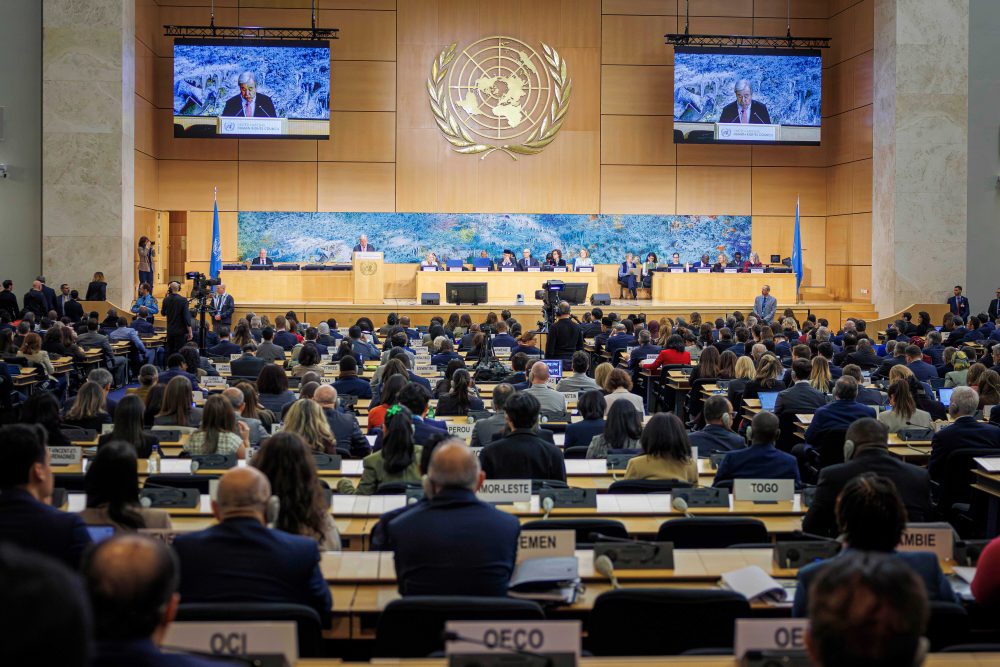

NEW YORK — The United Nations will host auditions this week for its next leader, with only four candidates seeking the secretary-general position — a dramatic decline from the 13 hopefuls who competed a decade ago when António Guterres secured the role.
Former Chilean President Michelle Bachelet will kick off the selection process Tuesday, facing a three-hour grilling from representatives of the UN’s 193 member countries. She’s joined by Argentina’s Rafael Mariano Grossi, who currently heads the UN’s nuclear agency.
Wednesday will feature UN trade leader Rebeca Grynspan, followed by former Senegalese President Macky Sall.
The significantly smaller candidate pool reflects dramatic changes in global politics since 2016, when the world was more stable and peaceful — the same year Donald Trump first won the presidency.
The UN itself has lost considerable influence over the past decade. While the organization celebrated major achievements in 2016, including the Paris climate accord and ambitious development goals, today’s deeply divided world powers have left the UN unable to address its core mission of maintaining international peace.
Major conflicts in Ukraine, Gaza, and Iran have paralyzed the Security Council, pushing the UN to the margins of critical global crises.
Richard Gowan, who monitors UN affairs for the International Crisis Group, explained how current tensions have shaped this leadership race differently than Guterres’ selection process.
A decade ago, many long-shot candidates joined the competition simply to boost their public profiles, Gowan noted.
“There was no real cost associated with losing,” Gowan said. “This time around, potential candidates and the governments who sponsor them are much more cautious. There is a feeling that if a candidate puts a foot wrong and offends Washington or Beijing, it could cause real diplomatic damage.”
The 2016 race generated significant momentum for selecting the first female UN leader, with women comprising seven of the 13 candidates. However, Guterres ultimately prevailed after delivering the strongest performance in member nation questioning sessions.
The UN Charter provides minimal guidance on selecting its top official, stating only that the General Assembly should choose based on Security Council recommendations. This arrangement gives the five permanent Security Council members — the United States, Russia, China, Britain, and France — decisive authority and veto power.
Traditionally, the secretary-general position rotates among global regions. Guterres, a former Portuguese prime minister and refugee agency chief representing Europe, succeeded South Korea’s Ban Ki-moon from Asia, who followed Ghana’s Kofi Annan from Africa.
Latin America should claim the position next, though Eastern Europe has never held the role despite losing out in 2016.
Member nations must nominate candidates under UN procedures, though countries need not nominate their own citizens. While nominations remain open indefinitely, the Security Council typically begins informal polling in late July, effectively establishing a deadline.
This week’s candidates will likely address their leadership vision, global crisis management, and the UN’s future direction, though questioning can cover any topic.
The 74-year-old Bachelet previously served as UN human rights chief after two separate terms leading Chile. Initially backed by Chile, Brazil, and Mexico, she lost Chilean support when far-right leader José Antonio Kast assumed the presidency in March and withdrew backing for the leftist former president. Brazil and Mexico continue supporting her candidacy.
Grossi, 65, has directed the International Atomic Energy Agency since 2019 following his diplomatic career and received nomination from Argentina.
The 70-year-old Grynspan, Costa Rica’s former vice president, has led the UN Trade and Development agency since 2021 and earned her home country’s nomination.
Sall, 64, received nomination from Burundi, though his native Senegal declined to endorse him, as did the fractured 55-member African Union.
A fifth candidate, Argentine diplomat Virginia Gamba, who previously represented the UN on children in warfare, was nominated by the Maldives but withdrawn in late March without explanation.
Despite having only two female candidates, pressure continues for selecting the first woman secretary-general, including from Guterres, who has prioritized gender equality in his administration. Britain and France have also expressed support for female leadership.
The advocacy groups 1 for 8 Billion and GWL Voices, representing nearly 80 global female leaders, are campaigning for a woman candidate. GWL’s president Susana Malcorra, a former Argentine foreign minister and senior UN official, competed for secretary-general in 2016.
Twenty-eight Republican lawmakers sent a March 25 letter to Secretary of State Marco Rubio urging the United States to block Bachelet’s candidacy, describing her as “a pro-abortion zealot intent on using political authority to override state sovereignty in favor of extreme agendas.”
During a recent Senate Foreign Relations Committee hearing, US Ambassador to the UN Mike Waltz was questioned about Bachelet by Republican Senator Pete Ricketts of Nebraska, who signed the opposition letter. While Waltz avoided stating whether America would support or oppose her candidacy, he acknowledged sharing Ricketts’ concerns.
Gowan observed that prospects for female leadership shifted significantly with Trump’s return to office.
“Before that, there was a feeling that this time a woman had to win, but now a lot of diplomats assume that Washington will insist on a male secretary-general on principle,” he said. “I am not sure that is necessarily correct.”