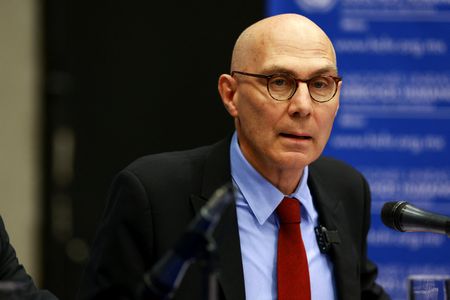

GENEVA — The head of the United Nations Human Rights office is facing a tough road to reappointment, with opposition from Russia and Israel threatening to derail what many expected would be a straightforward second term, according to diplomats who spoke with Reuters.
High Commissioner Volker Turk, an Austrian lawyer with decades of experience working for the United Nations in locations ranging from Geneva to field postings such as Kosovo, is set to complete his first four-year term this October. U.N. Secretary-General Antonio Guterres has put forward a proposal to extend his tenure through October 2030.
But Russia has countered with a proposal that would only extend Turk’s term by just over two months — through the end of 2026 — according to documents reviewed by Reuters. Three diplomats indicated that Israel also objects to a full four-year extension, and that Washington has raised concerns. Together, those positions have transformed what was expected to be a consensus-driven reappointment into a potentially divisive vote scheduled for Friday.
Some diplomats have privately argued that the decision on a full term should be left to whoever succeeds Guterres, whose decade-long leadership of the United Nations concludes in December. “It’s up to the next SG,” one diplomat told Reuters.
Russia’s and Israel’s diplomatic missions did not respond to requests for comment. The U.S. State Department also did not respond.
Earlier this week, a spokesperson for Turk’s office, Thameen Al-Kheetan, declined to comment directly on the reappointment question but noted: “I believe the High Commissioner is ready to serve.”
The role of U.N. High Commissioner for Human Rights, a position established in 1993, is considered a critical voice for defending freedoms globally at a time when authoritarian governments are growing in influence.
When Turk was first appointed, some observers expected him to take a more reserved approach. Instead, he has been outspoken in criticizing governments across the political spectrum — including Russia, Israel, and the United States.
Turk has accused Russia of serious violations of human rights and international humanitarian law since its full-scale invasion of Ukraine began in 2022 — allegations that Moscow denies. He has also called for investigations into deaths that occurred in U.S. immigration detention facilities and condemned tensions between the United States and Iran. Washington has defended its treatment of individuals in custody.
Regarding the conflict in Gaza, Turk has condemned what he described as Israel’s “mass killing,” though some observers — including members of his own staff — have expressed disappointment that he stopped short of declaring it a genocide. Israel categorically denies that characterization.
None of the three countries — Israel, Russia, or the United States — responded to questions about whether their opposition to Turk’s reappointment is connected to his criticism of their respective human rights records.
Despite that opposition, Turk retains significant support. Diplomats say European nations and many Latin American countries back him. A diplomatic memo from the African Union, reviewed by Reuters, showed “no objection” to the proposed four-year renewal. No other candidates for the position are known to be under consideration.
Guterres has spent months consulting with member governments in an effort to build consensus — a process intended to avoid exactly the kind of last-minute challenge Russia’s counter-proposal represents.
U.N. spokesperson Stephane Dujarric addressed the situation Thursday in New York, saying, “The Secretary-General is following the resolution and following the rules.” He added: “I will add, of course, that the Secretary-General has very much appreciated the work that Volker Turk has done in his term as High Commissioner for Human Rights.”