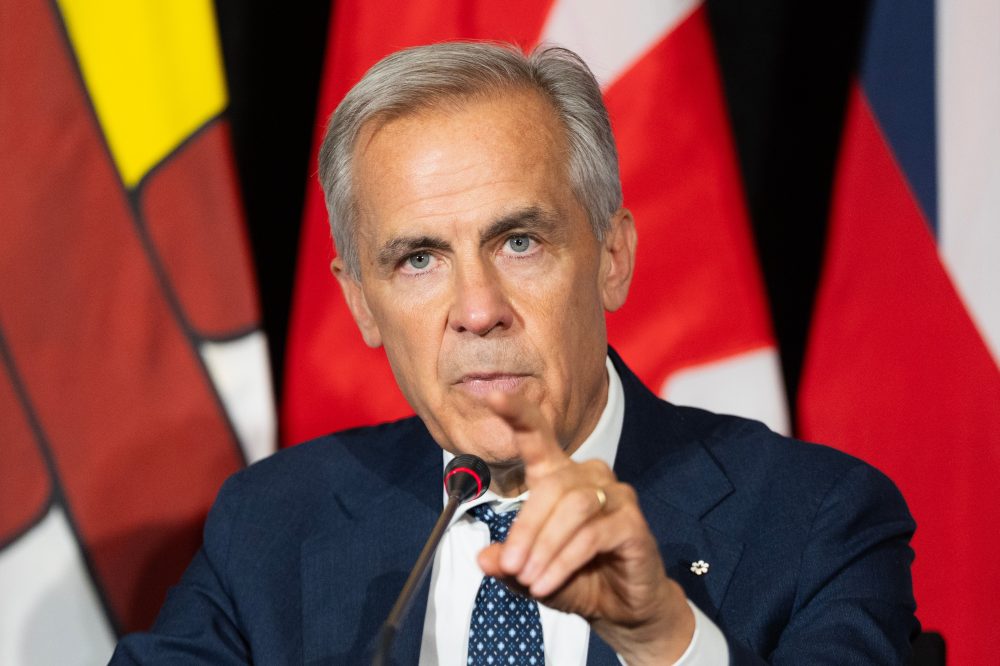

Canadian Prime Minister Mark Carney announced Thursday that Canada is stepping up trade negotiations with the United States while also preparing for the possibility that President Donald Trump’s threatened 50% tariffs on Canadian goods could become reality.
Those tariffs, which Trump unveiled on Monday, are set to kick in on August 19 and would cover a broad range of products — including honey, liquor, cement, dairy, certain wood products, and even hockey sticks. Energy products, potash, fish, and critical minerals would be left out. Notably, the tariffs would apply to goods that had previously been shielded under the United States-Mexico-Canada Agreement, or USMCA — a 2020 trade pact that the U.S. did not renew, opening the door to a new round of negotiations that could stretch as far as 2036.
Speaking after a meeting with Canada’s premiers and territorial leaders in Charlottetown, Prince Edward Island, Carney made clear his government has options.
“If these tariffs, or other measures come into force, there’s a full range of things that we can do in that regard,” he said.
Carney added that “everything’s on the table” should a deal fail to come together before the deadline — but he cautioned against acting prematurely.
“We don’t need to respond in advance,” he said. “In fact, I think it would be counterproductive at this stage to respond in advance.”
Carney suggested the tariff threat may be a bargaining tool, noting a familiar pattern in U.S. trade negotiations. “We’ve seen a series of trade negotiations that the U.S. has undertaken, and normally there’s a deadline,” he said. “Normally there’s an outsized tariff associated with that deadline.” He also expressed belief that U.S. officials are genuinely interested in reaching a deal.
Prince Edward Island Premier Rob Lantz emphasized that Canada’s provinces and federal government are presenting a united front. “We need to have a united Team Canada approach,” he said. “Canada is at its best when provinces and territories and the federal government work together.”
Ontario Premier Doug Ford, speaking before the gathering, called for a strong and aggressive stance. “We need a strong plan,” Ford said. “Be on offense. Put everything on the table.” When asked whether Ontario might place a surcharge on electricity it sells to the U.S., Ford left the door open. “It depends where we go with the U.S.,” he said. “Ontario has the most to lose right now. I will do everything to protect the people of Ontario.”
Carney also addressed Canada’s longer-term economic strategy, saying the country will continue to strengthen itself regardless of how negotiations unfold. “In all circumstances, irrespective of the outcome of these negotiations, Canada will do whatever it takes to build our strength at home and to support Canadian families, workers, our farmers, our businesses,” he said. He added that Canada is actively expanding trade relationships beyond the U.S.: “We’re diversifying our partnerships abroad.”
A financial analysis from Desjardins, one of Canada’s largest financial institutions, estimates the tariffs would affect roughly $28 billion Canadian — about $19.8 billion U.S. — in annual Canadian exports to the United States. That represents approximately 5% of total U.S. imports from Canada each year. The analysis also warned that “beyond the direct trade effects, heightened uncertainty could dampen business confidence and curb investment plans.” The provinces expected to feel the greatest impact are Ontario, Quebec, and British Columbia.
When pressed on whether any trade deal with the Trump administration could be trusted to hold, Carney was direct. “I have to be convinced, the (negotiating) team has to be convinced, the premiers have to be convinced that an agreement is worth the paper it’s written on,” he said.