
OGUNQUIT, Maine — What started as a neighborhood zoning disagreement in a small southern Maine coastal town has blossomed into a community-wide show of support for a 6-year-old autistic girl and her beloved giant metal roosters.
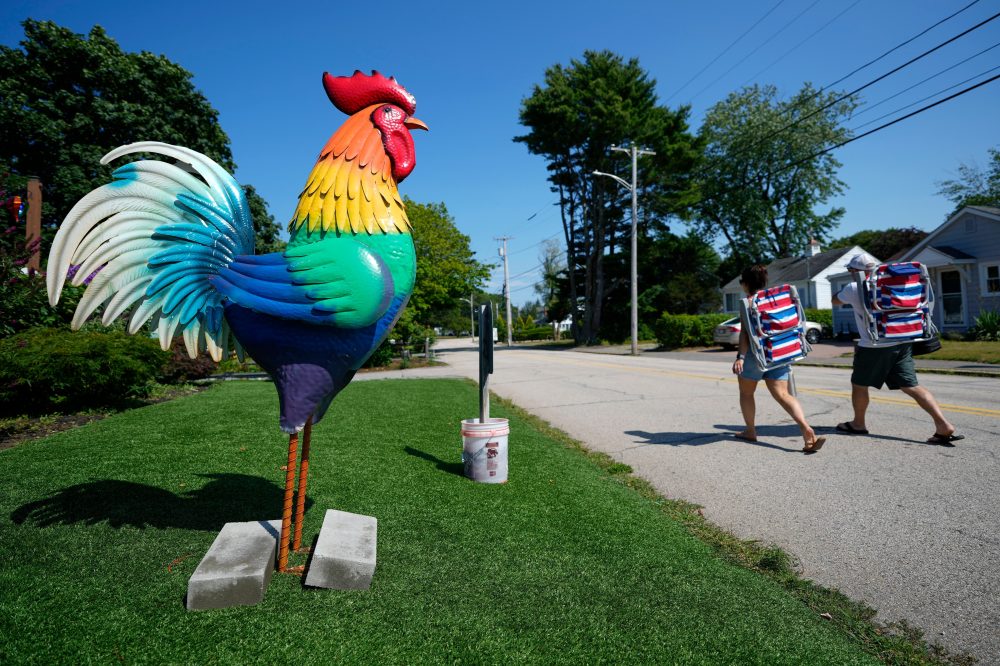
David and Sara LeBlanc had been displaying a rotating collection of roughly 6-foot-tall metal rooster sculptures on the lawn of their Ogunquit home, which is connected to their restaurant, The Omelette Factory. Town officials stepped in, ruling that the colorful statues amounted to unauthorized advertising for the business.
The couple pushed back, arguing the roosters were there for their daughter Pyper — not to draw customers. “Roosters don’t lay eggs,” David LeBlanc told the Associated Press on Wednesday.
Ultimately, the family and the town reached a compromise allowing two roosters to remain on the property.
The story of Pyper and her roosters began when the LeBlancs took her in as a foster child and later adopted her. She arrived with a stuffed rooster, and the bird became her favorite animal. On a trip to a Tractor Supply Store last year, Pyper spotted a large rooster sculpture and asked her father what it was saying. “I think he wants to come home,” David LeBlanc recalled telling her.
Over time, the family’s collection grew to more than two dozen roosters, displayed in rotating seasonal and holiday arrangements. Each morning, Pyper would hide behind one of the statues while waiting for her school bus — a routine her parents say helps her manage her emotions and handle daily transitions.
Trouble began when the LeBlancs incorporated a rooster into their restaurant’s logo, which appeared on shirts and other merchandise. While the family described the image as a “family crest,” town officials viewed the lawn statues as advertising signs.
Code enforcement officer Tyler McOsker issued the family $450 in fines and ordered them in April to “remove all unpermitted signage, including but not limited to rooster statues.” McOsker did not respond to a request for comment, but told the Zoning Board of Appeals in June that he was unaware the roosters were connected to Pyper’s autism until the family appealed. He also referenced a May 2025 article in a local weekly paper that described the roosters as a “fun and unconventional way to announce that The Omelette Factory is officially open for business.”
“That, to me, is the definition of a sign. You’re announcing you’re opening,” McOsker told the board.
David LeBlanc said a customer’s joke about the roosters acting as an “Open” sign was taken out of context by the reporter. “We never said that,” he said.
When the zoning board took up the matter last month, member Jay Smith expressed skepticism about the number of statues, saying he lacked medical documentation to support their necessity. “I’m inclined to think there may be some merit to a comfort animal on the front lawn … but the point is, how many does it take?” he said.
Beverley Cush Evans, a professor of special education at Lesley University, explained to the AP that comfort objects are commonly used in therapy for autistic children to ease transitions, support emotional regulation, and provide a sense of familiarity. “It’s part of who they are and what they need,” she said.
The board ultimately determined it did not have authority to cancel the fines, but it granted a disability variance recognizing two roosters as necessary for Pyper’s access to the home. “I want to emphasize we’re talking about two roosters. If they have babies or multiply in the night — no,” another board member said.
The variance requires the roosters to be incorporated into a railing, but for now they are simply bolted to the steps. The family has since been fined an additional $500 for not meeting that requirement.
Rather than dwelling on the dispute, David LeBlanc said he is focusing on the positive impact the story has generated. The family has been giving roosters to others to “foster” as a symbol of support for autism acceptance, beginning with a neighbor named Sam who lives nearby. Though Pyper was sad to part with them, she grasped the silver lining her father described. “She understands that the roosters being taken away were the lemons, and Sam and his friends, fostering them, are the lemonade,” LeBlanc said. “It’s a beautiful thing.”
Media coverage and a Facebook page called Roosters of Ogunquit have helped the story reach far beyond Maine. One supporter from New Zealand sent in photos of his children posing with a rooster statue in their yard.
Hetal Patel, who owns a motel in nearby Wells and has a relative with autism, wanted to buy a rooster after learning about Pyper. When she found them sold out in the Ogunquit area, she and her son traveled to New Hampshire last week to track one down. “We found the last one,” she said. “We couldn’t wait to put it out. People were so supportive, they were honking. It was so nice to see all the love for Pyper.”