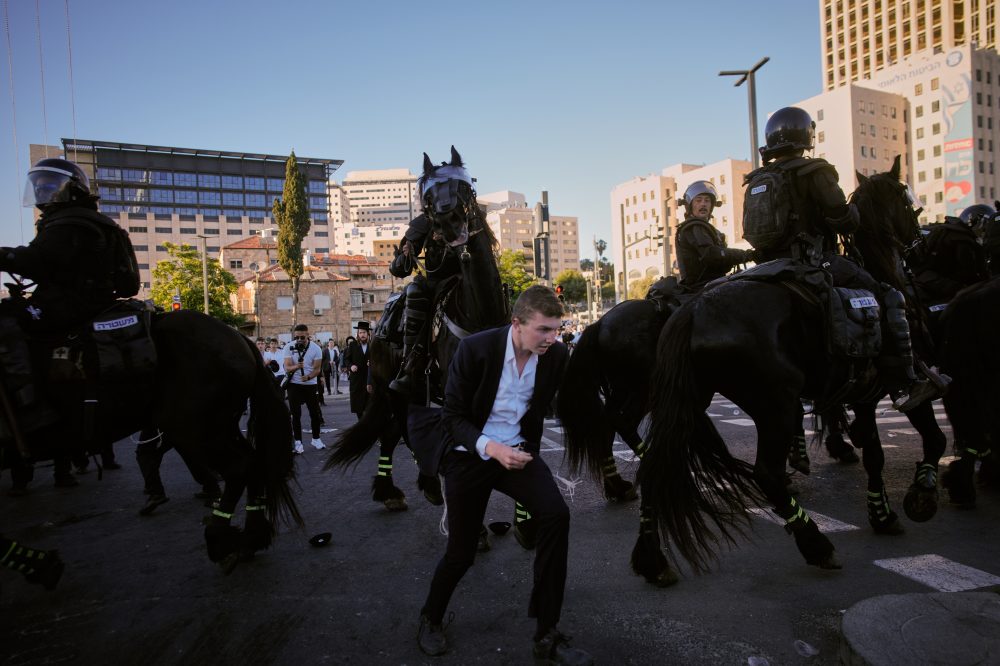

Massive demonstrations by ultra-Orthodox Jews brought Israel to a virtual standstill Monday as tens of thousands took to the streets opposing compulsory military service, shutting down major roadways and rail lines while setting vehicles ablaze.
Israeli police reported that demonstrators occupied key traffic intersections and assaulted a military member who got off a bus near the demonstration site. Authorities deployed water cannons and mounted officers in attempts to manage the unruly crowds.
The demonstrations effectively paralyzed Israel’s central region, forcing highway closures and suspending public transit services as massive crowds gathered in Jerusalem and throughout the Tel Aviv metropolitan region.
While military service remains mandatory for most Jewish citizens in Israel, ultra-Orthodox political factions have secured religious exemptions allowing their members to avoid military duty in favor of religious seminary education. However, these exemptions now face potential elimination.
Growing numbers of Israelis express frustration with the existing arrangement that permits ultra-Orthodox men to avoid military obligations while the armed forces face severe personnel shortages and many citizens complete multiple reserve deployments. This controversy threatens Prime Minister Benjamin Netanyahu’s coalition government, potentially accelerating fall elections after ultra-Orthodox parties removed their backing for Netanyahu.
Annual statistics show approximately 13,000 ultra-Orthodox men reach the draft age of 18, yet fewer than 10% actually enlist, parliamentary committee data reveals.
Confronting acute personnel deficits, military leadership considers extending mandatory service periods. Most Jewish men must complete nearly three years of active duty plus additional reserve obligations, while Jewish women serve two mandatory years.
“This public is determined, they see this as a war for their lives,” said Israel Tropper, a demonstrator in Jerusalem. “From their perspective, going into the Israeli army means giving up religion … we don’t want to give up our religion, so from our perspective it’s a war for our lives.” He added that there is no way to force tens of thousands of people vehemently opposed to the idea to serve in the military.
Protest signs displayed strong opposition to Israel, reading “We would rather die as Jews than live as Zionists” and “We refuse to serve an army for the sake of the Zionist religion.”
The ultra-Orthodox community, representing approximately 13% of Israeli population and its most rapidly expanding demographic, has historically obtained exemptions for full-time religious seminary students. These exemptions originated with Israel’s establishment in 1948, when limited numbers of students aimed to rebuild Jewish educational institutions devastated by the Holocaust.
These exemptions, along with government financial support for seminary students until age 26, have angered many Israelis. Israel currently maintains simultaneous military operations in Gaza, Lebanon and Syria while confronting Iran, severely straining its capable but overstretched armed forces.
Israel’s Supreme Court declared these exemptions unlawful in 2017, though repeated postponements and government stalling tactics have maintained their existence.
Within Israel’s Jewish population, mandatory military service functions as both a unifying experience and traditional milestone. Many within the isolated ultra-Orthodox community worry that military service would subject young people to secular cultural influences.