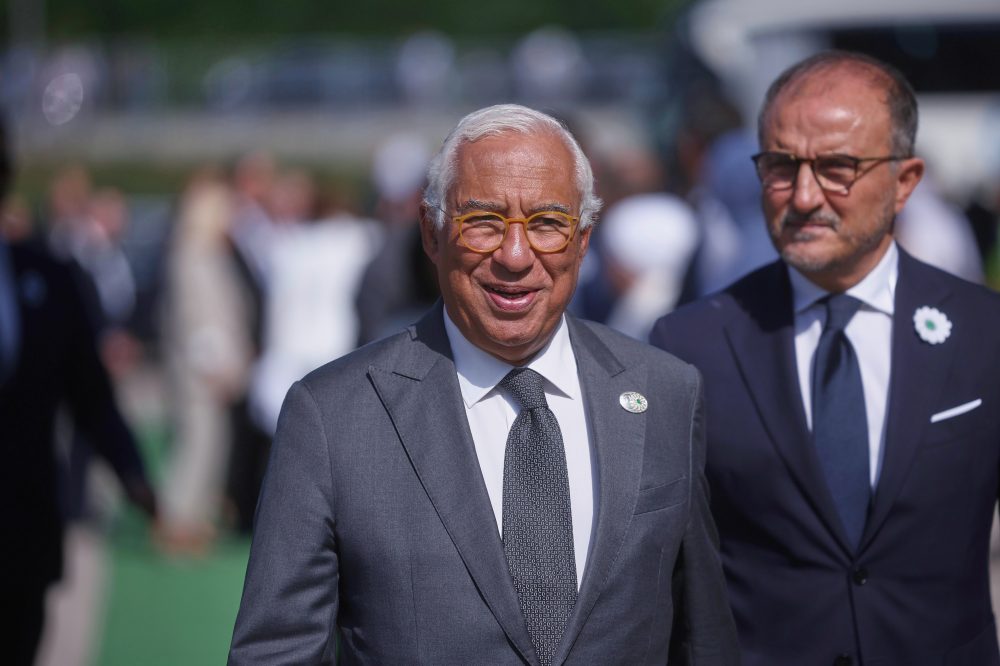

SARAJEVO, Bosnia-Herzegovina (AP) — The president of the European Council, António Costa, declared Monday that this week’s summit between European Union officials and Western Balkan hopeful member states is designed to demonstrate that expansion opportunities are genuine.
During remarks in Bosnia as he began a regional tour ahead of the summit, Costa emphasized that given current worldwide geopolitical tensions and economic uncertainty, “enlargement is a geostrategic interest for Europe.”
“It (enlargement) is an investment in the peace, stability and security of our continent,” Costa stated. “This tour is a clear sign that the commitment of the European Union to the Western Balkans is real. As real as the opportunity for enlargement.”
Costa will serve as co-chair for Friday’s summit taking place in Montenegro, bringing together EU leadership with senior officials from Albania, Bosnia-Herzegovina, North Macedonia, Kosovo, Serbia and Montenegro.
Each of the six countries finds itself at varying points in the membership application process, with Montenegro and Albania currently in the lead positions. The EU has recently intensified efforts to promote reforms among these hopeful nations due to concerns about expanding Russian and Chinese influence.
Ukraine and Moldova also number among roughly ten countries seeking to become part of the bloc.
Nations seeking membership must align their legislation across 35 policy areas, known as “chapters,” covering everything from judicial standards to agricultural and fishing regulations. All 27 existing EU members must reach consensus before any chapter can begin, and again before completion.
Friday’s gathering at the Adriatic Sea resort of Tivat will serve as “a clear demonstration of our determination to bring forward our cooperation and build on the momentum of the European Union’s enlargement,” Costa explained.
Bosnia has fallen behind other candidates, remaining significantly fractured along ethnic divisions decades after the 1992-95 conflict that claimed over 100,000 lives and forced millions from their homes. Bosnian Serb separatist leadership with pro-Russia leanings continues advocating for maximum autonomy — the same approach that originally triggered the ethnic warfare following the dissolution of the former Yugoslav federation.
Costa’s visit occurs as an international organization responsible for monitoring peace in Bosnia, created through a U.S.-mediated peace accord, prepares to select a new High Representative this week after German diplomat Christian Schmidt stepped down.
The High Representative possesses authority to modify legislation and remove officials who threaten post-conflict reconciliation efforts. Bosnian media outlets have indicated that Peace Implementation Council member nations remain split regarding the replacement choice.
“If the future of the country is in the European Union it’s important that the new high representative … embodies Bosnia and Herzegovina choice to pursue European Union accession,” Costa remarked.
He advised Bosnian leadership that “now is the time to focus on your goal and accelerate the pace of reforms.”