
KRYVYI RIH, Ukraine — When a Russian missile strike cost Iryna Nakonechna her left leg and claimed her husband’s life last year, the Ukrainian woman made a drastic decision to eliminate all connections to her past existence.
She chopped off her flowing dark hair and cleared out furniture, clothing, keepsakes and photos from her residence. Only one memento from her earlier life stayed: a picture showing her with her husband, Serhii Nakonechnyi.
Abandoning her former identity became essential, she explained, to survive the difficult transformation needed to create a new existence with an artificial limb.
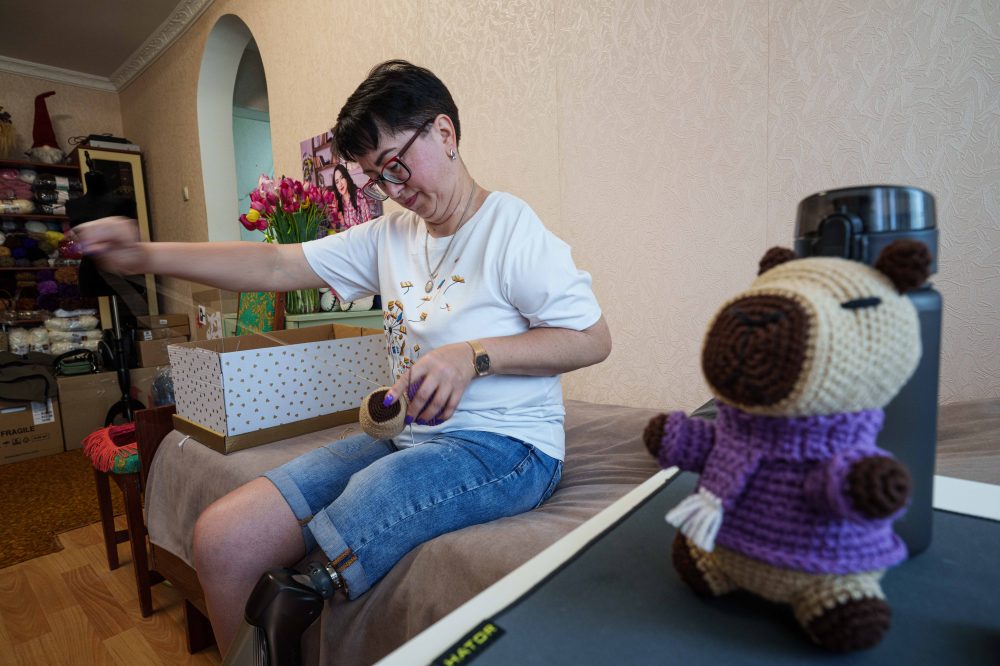
Now, Nakonechna displays sharp wit and bubbly energy, with sudden bursts of loud laughter. She sports a short pixie cut and striking red cat-eye glasses, and creates small knitted toy capybaras — creatures that have emerged as an unofficial emblem among Ukraine’s amputee community. However, behind the brightness in her gaze exists sorrow intertwined with the challenging journey of becoming a different person. This represents a frequently unmentioned truth behind the stories of strength surrounding Ukraine’s tens of thousands of limb-loss survivors from the conflict that started over four years ago with Russia’s comprehensive invasion.
“The most challenging aspect was learning to accept myself with these injuries, wounds that extend beyond the physical,” she explained. “Understanding how dramatically my existence has transformed has been extremely hard.”
Ukraine’s precise count of war amputees remains unclear, but the figure keeps climbing as explosive devices, artillery fire, and missile and drone attacks cause devastating injuries to military personnel and civilians alike. This growth has sparked an expansion of rehabilitation and prosthetic care, while simultaneously transforming Ukrainian society. Artificial limbs have become increasingly prominent and meaningful symbols of endurance and resistance.
Nakonechna, 50, continues walking with an uneven gait and relies on a walking stick while adapting to the prosthetic that extends to her upper thigh. The air attack also restricted movement in her arms, creating challenges when lifting heavy items.
The following phase in Nakonechna’s recovery involves mastering walking without assistance from a cane, according to her physical therapist, Anastasiia Stetsenko.
She needs to develop not just physical strength, but mental confidence as well. She must learn to trust herself during movements most individuals consider automatic: ascending stairs, bending down to retrieve objects, walking on uneven pavement, or keeping up with her 2-year-old grandson during playground visits.
Nakonechna’s weekly hour-long appointments with Stetsenko start by detaching her prosthetic and placing it against the wall.
Next, Stetsenko instructs Nakonechna to raise a plastic bar while sitting, coordinating the motion with her breathing pattern.
“You are a demon,” Nakonechna tells Stetsenko, when the workouts become challenging.
Subsequently, Stetsenko positions Nakonechna on her back to rotate her amputated limb in gentle circles, evaluating her movement capabilities.
“This feels like an extreme sport,” Nakonechna remarks.
Eventually, Stetsenko recommends she perform squats while holding a ballet barre, among the most difficult movements for her to master again.
“I will respond as my grandson would,” Nakonechna declares. “Just no.”
Both women burst into fits of laughter, resembling longtime companions rather than therapist and client.
The assault occurred on March 5, 2025. Following their evening meal, Nakonechna and her husband decided to take advantage of unusually mild spring temperatures with a nighttime walk.
They were positioned near a hotel entrance in downtown Kryvyi Rih when a Russian missile ripped through the structure, throwing them in different directions.
Her ears buzzed as her husband, now meters away, cried out in pain.
She lifted herself up and felt her left shoulder grinding. The bones had shattered. She reached toward her left leg but felt nothing.
The pair were transported to separate medical facilities. Her husband passed away the following day.
“I never got to say goodbye,” Nakonechna stated. “I wasn’t even at the funeral.”
During the following two months, time became a haze as Nakonechna endured twice-weekly surgical procedures.
By May of that year, she could finally sit upright once more.
She experienced relief, she noted, but it marked just the start.
The residence Nakonechna previously shared with her husband now appears completely different.
“I had to get rid of everything from the past,” she stated. “And focus on living my life, even if it was half the life I had before.”
Nakonechna asked her 77-year-old mother, who suffers from dementia, to come live with her. During lunch, her mother cautiously places a pot of borscht on the table. Nakonechna mentioned such activities are no longer simple for her.
She expresses sadness that she still cannot pick up her grandson, Tymofii. One day, the child attached a sticker showing a cartoon capybara with a prosthetic leg onto her own artificial limb. She kept it there.
A precise craftsperson, she subsequently started creating knitted toy capybaras through Superhumans, a contemporary war-trauma facility focused on prosthetics and rehabilitation. Throughout the conflict, veterans began placing these toys and stickers of the gentle, cheerful animals on their limbs to help strangers feel comfortable. The capybara has since become a symbol of strength and the drive to find happiness again after tragedy.
Nakonechna’s creations rapidly gained popularity, and she dedicates hours to knitting them. Her preferred moment comes when putting together the final pieces, transforming the creation into a complete toy.
“When I count the stitches, I think only about the stitches, not about the life that could have been and unfortunately is not,” Nakonechna explained.
Recently, she achieved a personal milestone: For the first time following her injury, she put on shorts.
This simple action represented a significant transformation.
“I accepted myself as I am,” she declared.