
KYIV, Ukraine (AP) — Ukraine has transformed from having a weak defense industry to becoming a major producer of affordable drone interceptors, now seeking to leverage this wartime breakthrough for international partnerships as Middle Eastern conflicts deplete expensive missile stockpiles.
Ukrainian President Volodymyr Zelenskyy is proposing an exchange with American and Gulf nation partners: Ukraine’s battle-tested anti-drone technology in return for advanced Patriot missile systems that the country desperately needs but cannot produce domestically.
The transformation began when Russia initiated its comprehensive invasion four years ago, forcing Ukraine’s previously underdeveloped arms sector to rapidly innovate. The nation has since constructed a thriving defense industry focused on affordable drone technology, including specialized systems designed to neutralize Iranian-style Shahed drones that Russia now deploys in massive numbers.
Washington recently sought “specific support” against Iranian-designed Shaheds operating in Middle Eastern theaters, leading Zelenskyy to authorize the deployment of Ukrainian equipment and specialists, though operational details remain confidential.
Ukraine implemented a weapons export prohibition when the 2022 conflict commenced. However, Ukrainian manufacturers of budget-friendly interceptor drones report growing inquiries from American and Gulf state officials.
According to Oleh Katkov, editor-in-chief of Defense Express, Ukraine possesses the only mass-manufactured system with actual combat verification. “There is a huge difference between a mass-produced system proven to work in real combat and something others only promise to develop … It’s like selling the house, not just the bricks,” Katkov explained.
Should international partnerships prove successful, Ukraine could establish itself as a significant force in contemporary warfare, though questions remain about the industry’s ability to expand globally while maintaining national defense capabilities.
Middle Eastern interest has intensified as Gulf nations exhaust their expensive Patriot missile inventories, which they’ve been deploying against considerably cheaper Iranian Shaheds.
Iranian-designed Shahed drones carry price tags of approximately $30,000, while individual interceptor missiles for American-manufactured Patriot defense systems cost millions.
Lockheed Martin announced record production of 600 PAC-3 MSE interceptors for Patriot systems throughout 2025. Zelenskyy stated Thursday that Middle Eastern countries consumed over 800 such missiles within just three days — exceeding Ukraine’s total reserves accumulated during the entire four-year conflict.
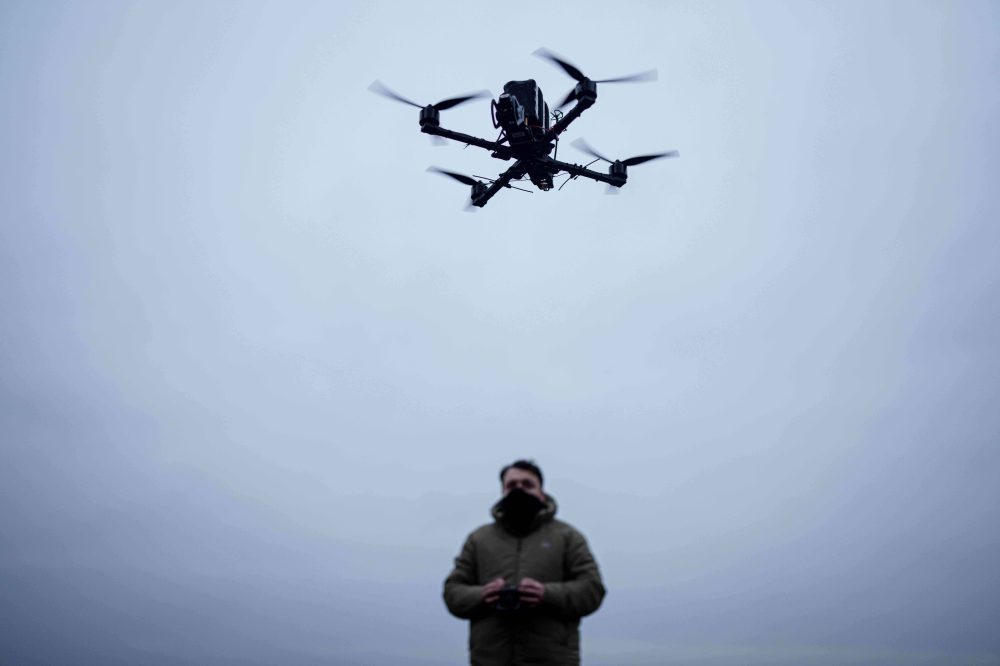
To combat Shaheds, Kyiv created budget interceptor drones priced between $1,000 and $2,000, advancing these systems from experimental stages to full-scale production within months during 2025.
However, Ukraine lacks ballistic missile defense capabilities, making Patriot missile acquisition a critical survival issue for Kyiv.
Within this context, Zelenskyy advocates for a “swap” arrangement with allies. “Our message is very simple,” he stated. “We’d like to quietly … receive the Patriot missiles we have a deficit of, and give them a corresponding number of interceptors.”
Despite Zelenskyy’s confidence, some experts caution that global arms market entry involves more complexity than contract negotiations.
“Weapon trading is an incredibly subtle and sensitive issue,” said Yevhen Mahda, executive director of the Kyiv-based Institute of World Policy. He noted American market dominance and warned against “naive” expectations that markets will open based solely on Ukraine’s compelling narrative. “It requires a tough, calculated diplomatic game.”
Ukrainian leadership has only recently started serious discussions about transitioning from wartime export freezes to government-regulated markets, with implementation timelines and methods still undefined.
“We need more than just presidential statements. We need action,” Mahda emphasized. “How can we talk about exports if we officially aren’t selling anything yet?”
The United States and Gulf nations, including the United Arab Emirates, Bahrain, Saudi Arabia, and Qatar, have repeatedly requested Ukraine’s domestically manufactured interceptor drones, according to three Ukrainian weapons producers.
Neither American nor Gulf country officials immediately responded to Associated Press requests for comment.
“We are ready to share them, and we want to share them,” said Marco Kushnir, spokesperson for General Cherry, a Ukrainian manufacturer producing top-performing interceptor drones that successfully target Shaheds domestically.
Kushnir indicated that final decisions rest with government leadership and Zelenskyy, but the company stands prepared to assist partners within days. He added their production capacity could reach “tens of thousands” of interceptors monthly.
Ukraine currently maintains surplus interceptor drone inventory, with manufacturers claiming they could produce tens of thousands more without compromising national defense. The greater challenge involves training personnel and integrating drones with long-range radar detection systems.
Multiple Ukrainian companies have deployed effective systems. General Cherry’s “Bullet” interceptor, developed in late 2025, has eliminated several hundred Shahed drones, according to Kushnir. Another design, Skyfall’s 3D-printed P1-Sun, costs approximately $1,000 and achieves speeds exceeding 300 kilometers (186 miles) per hour, with manufacturing capacity reaching 50,000 drones monthly, company representatives reported.
While hardware export legal frameworks remain uncertain, Ukraine’s most valuable resource is human knowledge. Zelenskyy has repeatedly emphasized his country’s readiness to provide instructors capable of teaching interceptor operation.
Drone supply won’t present difficulties, said Andrii Taganskyi, director of Camera Business at Odd Systems, which provides cameras for interceptor drones manufactured by Ukrainian company Wild Hornets. However, training foreign operators and adapting tactical approaches will be crucial, he noted.
Interceptor drones require integration with comprehensive radar systems for incoming target detection and tracking, Taganskyi explained. While some models feature partial automation, manufacturers emphasize that crews need proper training for effective operation.
“This is a tool that requires training,” Katkov stated. “And the real, proven expertise — not just on paper — exists only in Ukraine.”
Kyiv’s commitment to deploying specialists internationally represents a substantial strategic sacrifice due to potential impacts on Ukraine’s domestic air defense capabilities. Given constant Russian drone bombardments, every trained soldier remains invaluable.
“We do not have a surplus of military personnel at the front,” Katkov acknowledged. “However, there is a clear understanding that the benefits of such cooperation might far outweigh the risks.”