
KYIV, April 29 – Ukrainian President Volodymyr Zelenskyy has transformed his nation’s battlefield innovations in unmanned aircraft technology into powerful diplomatic leverage, securing defense partnerships across Europe and the Middle East as he works to expand Ukraine’s global influence.
Following Russia’s 2022 invasion, Zelenskyy has worked to expand Kyiv’s international partnerships beyond traditional Western supporters to include nations from the “global south,” aiming to limit Moscow’s diplomatic influence worldwide.
The ongoing conflict has demonstrated the critical role of unmanned aircraft in contemporary military operations, providing Zelenskyy with significant diplomatic advantages during a period when American backing for Ukraine appears uncertain, according to defense analysts.
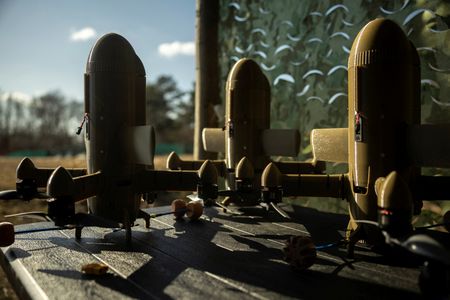
Throughout the conflict, Ukraine has developed cost-effective methods to defend against drone strikes rather than depending solely on advanced missile defense systems like the expensive U.S. Patriot systems deployed in the Gulf region. Kiev has additionally created long-distance attack capabilities using unmanned aircraft to target Russian energy facilities.
This month, Ukraine has finalized defense and drone agreements with Germany, Norway and the Netherlands, building on long-term security partnerships established with Saudi Arabia, Qatar and the United Arab Emirates in March.
Zelenskyy has recently established security cooperation frameworks with Turkey and Syria, and completed agreements over the weekend with Azerbaijani President Ilham Aliyev covering defense and energy sectors.
“Zelenskyy is really trying hard to show that Ukraine is an asset and not a liability and that it has an answer to the changing nature of war,” said Orysia Lutsevych, head of the Ukraine Forum at Chatham House, a London-based think tank. “Ukraine now needs to organize itself to actually deliver.”
EXPORT RESTRICTIONS LIMIT UKRAINE’S DEFENSE DEALS
Ukrainian drone producers report substantial unused manufacturing capacity, yet government officials have authorized only limited defense export permits.
Ukraine has established drone production facilities abroad, including operations in Germany and Britain, though this overseas manufacturing is designated for Ukrainian military requirements.
“In Ukraine, the choke point is the export control: basically it’s an export ban,” Lutsevych said, adding that Ukraine needed to streamline the rules. “It needs to find a balance between its war needs and exports.”
During his Tuesday evening remarks, Zelenskyy announced that Ukraine’s defense manufacturing sector maintains 50% unused capacity in certain areas and will soon commence weapons exports. Officials plan to reduce bureaucratic export procedures, he stated, while implementing safeguards to prevent Ukrainian technology and weaponry from reaching Russian forces.
Ukraine faces an additional obstacle as its achievements have primarily involved creating effective integrated systems – including coordinated networks of interceptor drones, automatic weapons and electronic jamming equipment for aerial defense – rather than revolutionary technology breakthroughs.
To demonstrate these capabilities, Ukraine has stationed approximately 200 specialists in Gulf nations to assist with defense against Iran’s Shahed long-range drones.
Kurt Volker, a former U.S. NATO ambassador and Ukraine envoy during President Donald Trump’s first administration, said Kyiv was rightly cautious about sharing its wartime systems too widely.
“Much of what the Ukrainians have done is develop process and mentality,” Volker said, adding Ukraine was concerned about Russia learning how its systems operate. “What any business would do is protect your IP for as long as possible. That’s what makes it valuable. So of course they’re doing that.”
DEPENDENCE ON SKILLED OPERATORS
Ukraine’s budget-friendly air defense systems depend heavily on the expertise and training of personnel operating interceptor drones, according to Fabian Hoffmann, a senior researcher at the Norwegian Defence University College.
This approach has proven highly successful against propeller-driven aircraft, including Russia’s Geran-2, though the gradual deployment of jet-powered variants capable of 400 kilometer per hour speeds presents greater challenges for human operators.
“Ukraine has been moving towards autonomously guided interceptor drones but, so far, the operators have done a lot of the heavy lifting,” Hoffmann said, adding that European companies such as Tytan in Germany and Frankenburg in Estonia were developing autonomous systems that might erode Ukraine’s advantage.
Defense exports would provide significant economic advantages for Ukraine, specialists indicate. Approximately 400,000 individuals currently work in Ukraine’s defense manufacturing sector, according to UCDI, a manufacturers’ association. Enhanced funding for the defense industry could decrease dependence on Western financial and military assistance while driving economic expansion following an eventual ceasefire.
Zelenskyy anticipates that drone diplomacy will help secure energy supply agreements with Middle Eastern nations and create markets for Ukrainian agricultural exports.
He also seeks to enhance Ukraine’s missile defense capabilities. The U.S.-Israel conflict with Iran has generated concerns in Ukraine that Patriot system supplies – essential for intercepting Russian ballistic missiles – might become scarce as Washington prioritizes domestic requirements.
Ukraine’s $4-billion defense agreement with Germany this month included Patriot system deliveries and commitments for collaboration on European ballistic missile defense development. Zelenskyy has stated Ukraine requires independent anti-ballistic missile defenses within twelve months.
Hoffmann noted the enormous challenges in developing interceptors capable of destroying modern maneuvering ballistic missiles: the Patriot PAC-3, achieving perhaps 60% success rates, represents decades of development work.
Behind Ukraine’s diplomatic initiative, analysts suggest, lies uncertainty about Washington’s dependability as a partner.
“He (Zelenskyy) understands that America stopped being an ally,” Lutsevych said. “The Ukrainians also understand that they need to walk a fine line by keeping America on side as long as possible.”