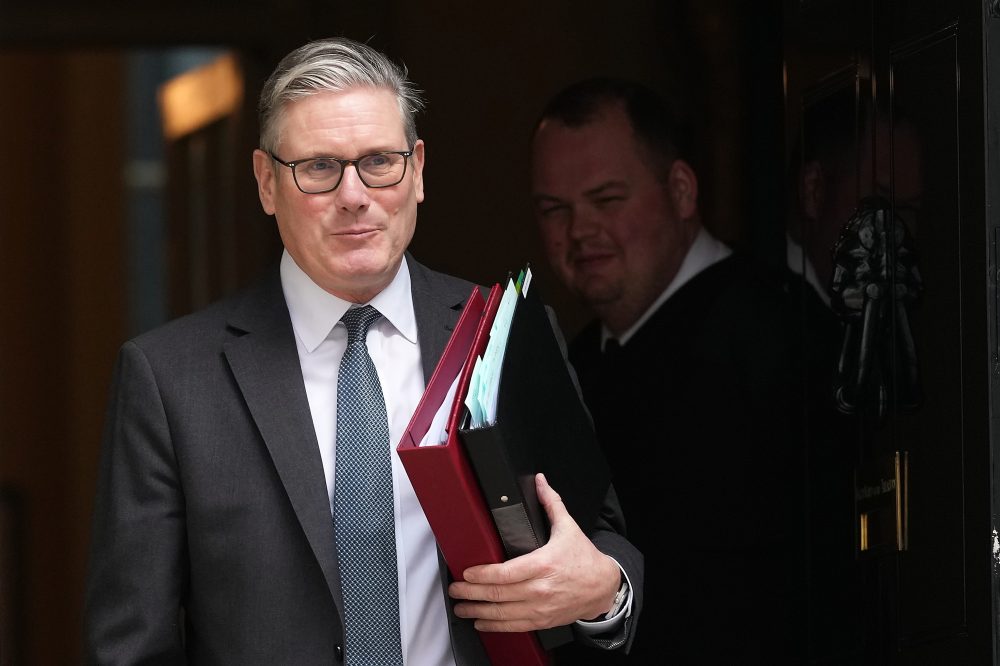

LONDON — British Prime Minister Keir Starmer finds himself in deepening political trouble after government documents revealed he disregarded senior advisers’ concerns when selecting Peter Mandelson, who had connections to Jeffrey Epstein, as Britain’s U.S. ambassador.
The embattled leader continues facing criticism over Mandelson’s selection and subsequent dismissal, with Wednesday’s release of nearly 150 pages of government records representing just a small portion of thousands more documents yet to be disclosed.
“It’s hard to believe that later releases are going to persuade anybody to see the PM’s decision in a better light,” said Tim Bale, politics professor at Queen Mary University of London. “It’s damning stuff and, if the country weren’t preoccupied with rather more important Middle Eastern matters at the moment, it might even have hastened Starmer’s departure.”
The released materials verified what had been previously reported: Starmer selected the experienced political operative despite his tarnished reputation from past controversies and connections to Epstein.
Mandelson’s background check documentation highlighted in bold text the warning signs Starmer overlooked, detailing how his association with Epstein could create “reputational risk” for the government.
The paperwork also outlined separate reputation concerns regarding Mandelson’s service in a former Labour administration — where he resigned twice due to financial controversies — and his role at Global Counsel, a lobbying company he helped establish.
One document cautioned Starmer that selecting a political figure for the position carried greater risks than appointing a career diplomat, which is Britain’s usual practice.
“If anything goes wrong, you could be more exposed as the individual is more connected to you personally,” then-Cabinet Secretary Simon Case advised.
Starmer dismissed Mandelson in September following revelations that he stayed in touch with Epstein — whom he previously described as his “best pal” — even after the financier’s 2008 conviction on sexual offenses involving a minor.
Starmer maintains Mandelson deceived him regarding the scope and nature of his relationship with the convicted sex offender. He expressed regret about appointing him to the diplomatic position.
“It was me that made a mistake, and it’s me that makes the apology to the victims of Epstein, and I do that,” Starmer said Thursday.
The documents disclosed thus far haven’t provided proof supporting Starmer’s assertion that he was deceived, partly because investigators examining Mandelson requested that communications between the prime minister and Mandelson remain sealed to preserve the investigation’s integrity.
Mandelson faced a brief arrest last month on accusations he shared classified government details with Epstein fifteen years ago. He has rejected any wrongdoing and faces no charges. No allegations of sexual impropriety have been made against him.
Defense attorney Marcus Johnstone, who isn’t involved in Mandelson’s case, suggested civil servants, government attorneys and law enforcement likely engaged in intense discussions behind the scenes before determining which documents to make public. He predicted this struggle will persist as additional batches containing thousands of pages are released over the coming weeks and months.
“We need to remember that the files we are seeing today are only the thin end of the wedge on Mandelson,” Johnstone said. “But we should be under no illusions that what we are currently seeing is anything like the full picture.”
Even after removing Mandelson in September, Starmer encountered fresh questions about his decision-making when extensive files released by the U.S. Justice Department in January revealed additional information about Mandelson’s relationship with Epstein. Opposition figures and some Labour Party members demanded the prime minister step down.
Starmer weathered the immediate crisis, though his standing remains precarious, despite having no personal meetings with Epstein and no involvement in his criminal activities.
Conservative leader Kemi Badenoch accused Starmer Thursday of deceiving Parliament regarding the appointment and urged Labour lawmakers to reconsider his leadership.
“It is very clear that he told lie after lie after lie about the appointment of Peter Mandelson,” Badenoch said. “He wanted to make this all about Peter Mandelson. This is about his judgments.”
Prime ministerial spokesperson Tom Wells stated Thursday that appropriate procedures were followed in evaluating Mandelson, though the screening process requires enhancement.
Starmer has frequently appeared more confident in international affairs than domestic politics, which might offer the political protection he currently needs.
He took a measured approach to the U.S.-Israeli conflict with Iran — declining to participate in airstrikes, which he suggested violated international law, and initially denying American aircraft access to British bases.
Following Iran’s retaliation with missile and drone attacks on neighboring nations, Starmer agreed to allow U.S. planes to use U.K. facilities for strikes against Iran’s missile capabilities, but not other targets.
Starmer’s cautious stance frustrated Trump, who criticized last week that Starmer was “not Winston Churchill.” However, polling indicates his war response generally matches public opinion, which opposes deeper conflict involvement.
“The whole affair, while certainly doing nothing to help him, seems — rightly or wrongly — pretty inconsequential in the grand scheme of things,” Bale said about the Mandelson documents.