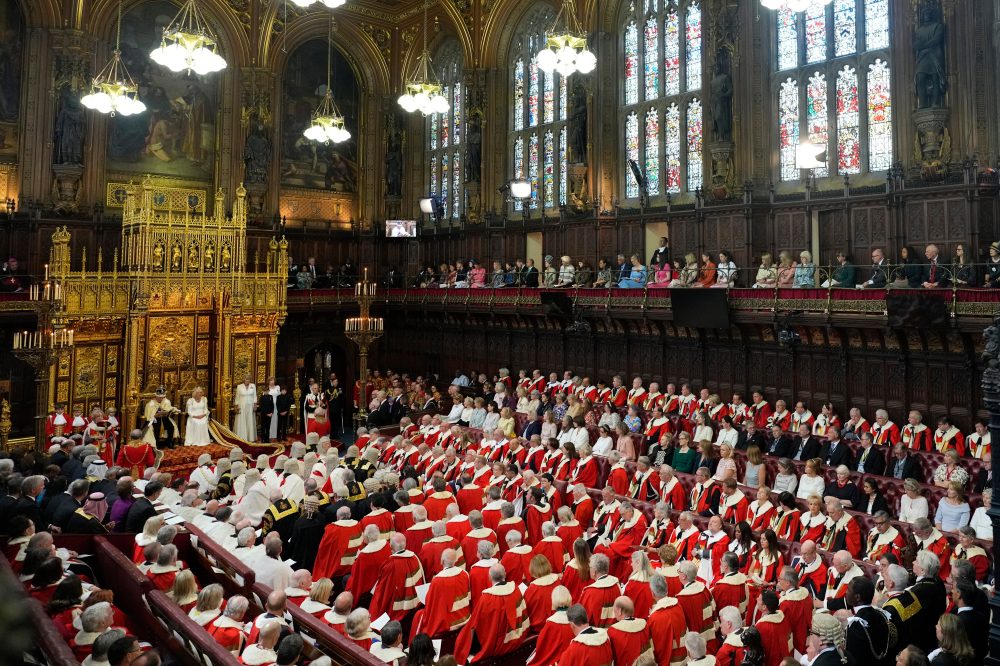

LONDON — A centuries-old tradition in British politics will come to an end in the coming weeks after lawmakers voted to eliminate hereditary aristocrats from the House of Lords.
Members of Britain’s upper legislative chamber withdrew their opposition Tuesday evening to a measure previously approved by the House of Commons that will force out dozens of dukes, earls and viscounts who received their parliamentary positions through inheritance alongside their noble titles.
Government minister Nick Thomas-Symonds described the reform as ending “an archaic and undemocratic principle.”
“Our parliament should always be a place where talents are recognized and merit counts,” he stated. “It should never be a gallery of old boys’ networks, nor a place where titles, many of which were handed out centuries ago, hold power over the will of the people.”
While the House of Lords serves a crucial function in Britain’s democratic system by reviewing laws approved by the elected House of Commons, opponents have consistently criticized it as unwieldy and lacking democratic legitimacy.
Recent scrutiny of the upper chamber intensified following the Peter Mandelson situation, who stepped down from the Lords in February following revelations about his connections to deceased sex offender Jeffrey Epstein, highlighting ongoing concerns about misconduct among members.
With more than 800 current members, the chamber ranks as the world’s second-largest legislative body, trailing only China’s National People’s Congress.
Throughout most of its seven-century existence, the chamber consisted primarily of noblemen — rarely women — who inherited their positions, along with some bishops. The 1950s brought the addition of “life peers” — former politicians, community leaders and other distinguished individuals chosen by the government, who now constitute the chamber’s majority. Hereditary peers currently represent about one-tenth of the membership.
Tony Blair’s Labour administration removed most of the 750 hereditary peers in 1999, though 92 remained temporarily to prevent an aristocratic uprising.
Another 25 years passed before current Prime Minister Keir Starmer’s Labour government introduced measures to eliminate the remaining hereditary members.
The nobles resisted the change, forcing a deal that will allow an unspecified number of hereditary members to remain by converting them into life peers.
The legislation will take effect once King Charles III provides royal assent — a ceremonial requirement — and the hereditary peers will depart when the current parliamentary session concludes this spring, finishing a political transformation started 25 years ago. By House of Lords standards, this represents rapid change.
Labour maintains its commitment to eventually replacing the House of Lords with an alternative second chamber that better “represents the U.K.” Based on historical precedent, such changes will likely occur gradually.
“So, here we are at the end of well over seven centuries of service by hereditary peers in this Parliament,” stated Nicholas True, the Conservative Party’s leader in the Lords.
“Many thousands of peers served their nation here and thousands of improvements to law were made,” he continued. “It wasn’t all a stereotypical history of reaction in ermine. Many of those people, no doubt, were flawed but for the most part, they served their nation faithfully and well.”