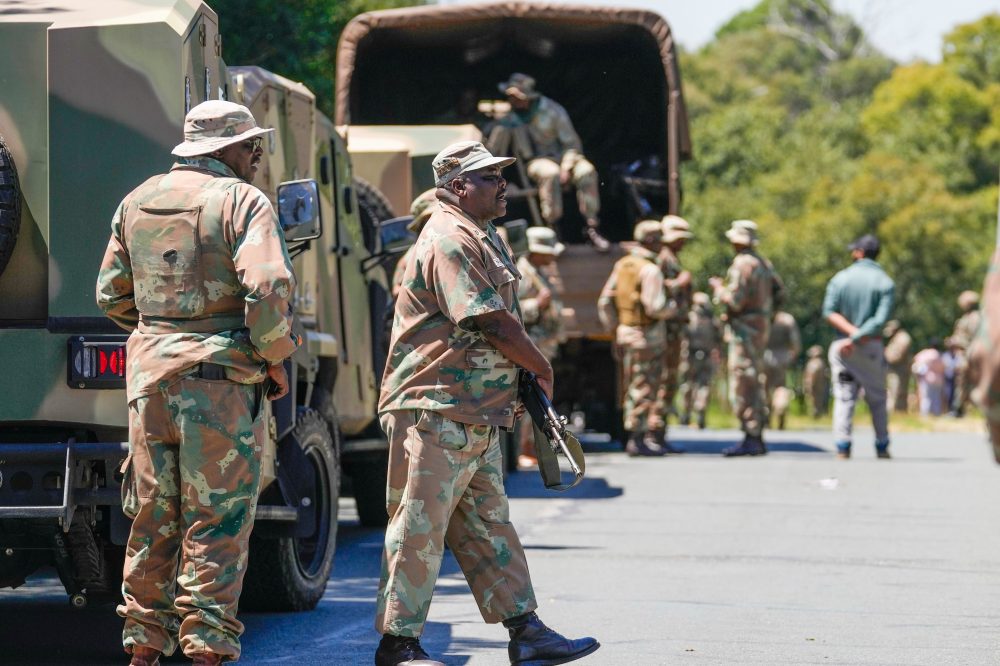

Military personnel took to the streets of Johannesburg Wednesday as South Africa’s government launched a major offensive against organized criminal activity, deploying army units to assist law enforcement in the nation’s largest metropolitan area.
The deployment marks the first significant military action since President Cyril Ramaphosa declared during his recent state address that armed forces would be utilized to combat organized crime networks, which he described as the most serious threat facing the country’s democratic institutions and economic progress.
An Associated Press correspondent witnessed more than a dozen military vehicles moving through Johannesburg’s Riverlea neighborhood, where soldiers exited their transports to search residential buildings. This particular area has experienced significant problems with both criminal gang activity and unauthorized mining operations.
Neither the South African Police Service nor the Defense Department offered immediate details regarding the scope of the military operation.
Officials had initially scheduled the nationwide military intervention to begin March 1, but the timeline was pushed back to provide soldiers with additional instruction on civilian law enforcement procedures. During these operations, military units will function under police supervision and authority.
According to parliamentary notification from Ramaphosa, the initial phase will involve 550 military personnel operating throughout Gauteng province, which encompasses Johannesburg, with their mission extending through the end of April to support crime reduction and public safety efforts.
The broader military strategy encompasses operations across five of the country’s nine provinces, based on documentation provided to Parliament by police leadership. These expanded operations will target unauthorized mining activities in Gauteng, North West, and Free State provinces, while addressing gang-related violence in Western Cape and Eastern Cape regions.
Law enforcement officials indicated that certain aspects of the national deployment could continue for more than twelve months.
The nation struggles with exceptionally high violent crime statistics. Official police data shows 6,351 murders occurred between October and December 2025, averaging nearly 70 homicides daily in a population of approximately 62 million, alongside elevated rates of attempted murder and violent assault incidents.
Ramaphosa has specifically highlighted gang violence and illegal mining as particularly serious concerns, linking both issues to broader organized criminal enterprises. Several targeted areas include neighborhoods surrounding Cape Town, South Africa’s premier tourist destination, which has faced persistent gang violence problems for many years.
Wednesday’s initial deployment did not immediately clarify whether operations had commenced in other regions identified by the president.
The country has previously utilized military assistance during periods of criminal activity and civil unrest, including 2021 deployments when rioting and widespread looting across two provinces—triggered by former President Jacob Zuma’s imprisonment and public frustration over COVID-19 restrictions—resulted in over 350 deaths.
Ramaphosa acknowledged the sensitive nature of deploying military forces, given the army’s historical role in suppressing pro-democracy movements during the apartheid era of racial segregation that concluded in 1994.
“The deployment had become necessary due to a surge in violent organized crime that threatens the safety of our people and the authority of the state,” he stated.
While the military deployment has received broad public support, some political opposition groups have characterized it as evidence that police forces have been ineffective in controlling criminal activity.