
Asian financial markets displayed mixed performance Wednesday following the United Arab Emirates’ announcement that it will withdraw from OPEC, a decision that sent crude oil prices tumbling despite broader geopolitical concerns.
Futures contracts for U.S. markets pointed to a higher opening.
Japanese markets remained shuttered for a national holiday.
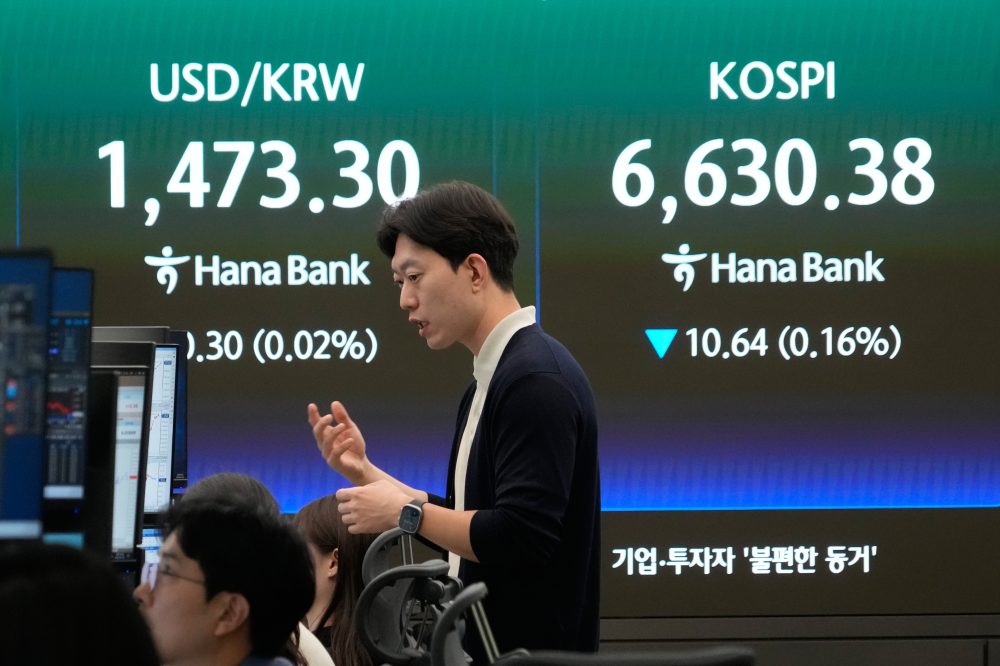
Across other Asian trading centers, South Korea’s Kospi index climbed 0.3% to reach 6,657.40, while Hong Kong’s Hang Seng surged 1.4% to 26,029.02. China’s Shanghai Composite index posted a 0.3% increase to 4,091.01.
However, Australia’s S&P/ASX 200 declined 0.3% to 8,689.50.
Taiwan’s Taiex dropped 0.6%, while India’s Sensex managed a 0.4% gain.
Crude oil prices retreated following the UAE’s OPEC withdrawal announcement. June delivery Brent crude fell 0.5% to $110.71 per barrel in early Wednesday trading, while July Brent dropped 0.6% to $103.74. For perspective, Brent crude traded around $70 per barrel before the Iran conflict escalated in late February.
U.S. benchmark crude oil declined 0.6% to $99.32 per barrel.
The UAE’s scheduled Friday exit from OPEC has drawn significant attention from energy markets. The organization controls approximately 40% of worldwide oil production, with the UAE ranking among OPEC’s top producers. The nation has increasingly challenged OPEC’s production limits in recent years, seeking to expand its oil sales globally.
“The UAE’s exit will increase (oil) output,” ING Bank strategists Warren Patterson and Ewa Manthey wrote in a research note on Wednesday. “The UAE has been increasingly frustrated over recent years by its output being constrained by OPEC production quotas, which have kept it well below its potential.”
However, with U.S.-Iran diplomatic efforts for a lasting resolution to the Iran conflict remaining stalled and the Strait of Hormuz – through which approximately one-fifth of global oil previously flowed – still largely blocked, analysts suggest near-term oil price movements will primarily depend on prospects for reopening this crucial shipping route.
Before the Iran conflict began, the UAE held the position of OPEC’s third-largest oil producer. ING analysts noted that its withdrawal “will reduce OPEC’s effectiveness in managing and influencing the global oil market through supply measures.”
Market participants continue monitoring developments in U.S.-Iran diplomatic discussions, though meaningful advancement remains limited. Iran has proposed reopening the Strait of Hormuz in exchange for the United States ending its port blockade. However, the U.S. appears unwilling to consider any agreement that doesn’t address the Islamic Republic’s nuclear activities.
The Federal Reserve is scheduled to announce its interest rate decision later Wednesday.
Tuesday saw Wall Street pull back from recent peak levels. The S&P 500 benchmark index dropped 0.5% from its latest record to close at 7,138.80. The Dow Jones Industrial Average slipped 0.1% to 49,141.93, while the tech-focused Nasdaq composite fell 0.9% to 24,663.80.
Technology and artificial intelligence stocks drove the decline. Broadcom shares tumbled 4.4%, Nvidia decreased 1.6%, and Micron Technology lost 3.9%. Major tech companies including Alphabet, Amazon, Microsoft, and Meta Platforms are scheduled to release quarterly earnings Wednesday.
In early Wednesday currency trading, the U.S. dollar strengthened slightly to 159.63 Japanese yen from 159.62 yen. The euro weakened to $1.1708 from $1.1712.
The yield on 10-year U.S. Treasury bonds held steady at 4.35%.