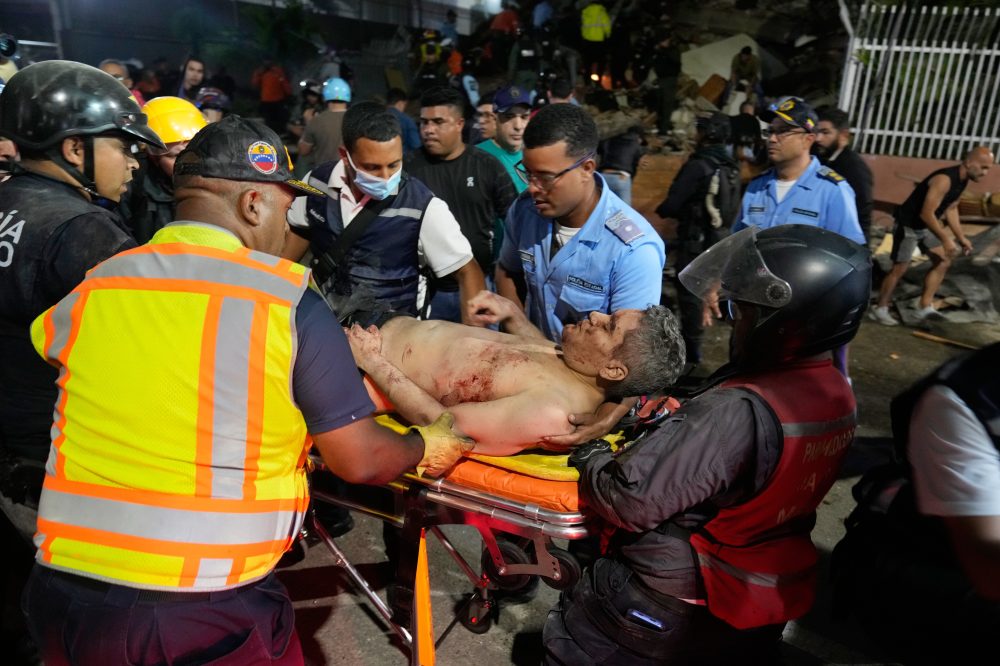

CARACAS, Venezuela — A pair of devastating earthquakes struck Venezuela on Wednesday evening, leaving at least 32 dead and more than 700 injured, according to the country’s acting president. Officials expect those numbers to grow as rescue teams continue searching through rubble across the nation.
Acting President Delcy Rodríguez addressed the country late Wednesday, declaring a state of emergency and confirming that multiple states suffered damage. She noted that the early casualty figures did not even include the state of La Guaira, which she described as a “disaster zone” and the hardest-hit area in the disaster.
“Dozens of buildings have collapsed there, about 30 kilometers (19 miles) north of Caracas, and we are currently carrying out intensive rescue operations to save lives,” Rodríguez said.
The two earthquakes — measuring 7.2 and 7.5 in magnitude — are considered among the most powerful to hit Venezuela in over a century. The shaking was felt as far away as Brazil’s Amazon region, roughly 1,700 kilometers (1,050 miles) from Venezuela’s capital of Caracas.
According to the U.S. Geological Survey, the first quake initially registered at a 7.1 magnitude before being revised upward to 7.2. Its epicenter was located west of Morón along Venezuela’s Caribbean coast, about 168 kilometers (104 miles) west of Caracas, at a depth of 22 kilometers (13.6 miles). Just one minute later, a second and larger 7.5-magnitude quake struck with its epicenter 16 kilometers (10 miles) southwest of Morón at a depth of 10 kilometers (6.2 miles).
Both quakes hit shortly after 6 p.m. local time.
Rodríguez said the country’s main airport, Simón Bolívar International Airport near Caracas, sustained damage and was forced to close. Subway service and natural gas operations in Caracas were also suspended. She called on Venezuelans to report any damage through a government app and urged healthcare workers to report to hospitals to help treat the injured.
“We urge our population to remain calm,” Rodríguez said. “We urge unity.”
School classes were canceled for several days, and the Ministry of Education announced that some school buildings would serve as shelters and donation centers.
In the coastal state of Falcon, Gov. Víctor Clark reported that 32 people had been hospitalized and 15 individuals were trapped in the hours immediately following the quakes.
Eyewitnesses in Caracas described frightening scenes as buildings swayed and walls crumbled, exposing furniture to the street. Dust clouds rose over at least two neighborhoods in the capital. Many residents fled into the streets, some sitting on the ground holding their pets as debris settled around them. Collapsed structures, downed power poles, and rubble blocked roads throughout the city, and parts of Caracas lost electricity and cellphone service.
“It started off gently and then gradually grew, and in the end, we all had to leave our houses, go outside and gather together,” said Caracas resident Hector Ricci.
Roberto Gamas, another resident of the capital, described the experience: the building he was in “really shook from side to side. Unreal. The force was incredibly strong.”
Venezuela Interior Minister Diosdado Cabello confirmed the quake was felt across several states and asked drivers to yield to ambulances and emergency vehicles. He reported collapsed homes and buildings in the Altamira neighborhood and urged people to stay outside due to the risk of aftershocks causing further structural damage.
“We understand that some people may be desperate, but we are acting according to protocols to activate aid and rescue efforts to help those who need it most,” Cabello said on state television. “Be very careful with children and the elderly. Call each other and check that no one has been harmed.”
The loss of cellphone signal in parts of the country added to the anxiety of many families, especially among the more than 7.7 million Venezuelans who have left the country during its prolonged crisis and were unable to reach loved ones.
Venezuela opposition leader María Corina Machado, currently in exile after departing Venezuela in December, used social media to send her support. “May strength, serenity, and solidarity prevail among us in the face of this difficult time,” she wrote.
Aid offers poured in from numerous governments, including the United States, Argentina, Bolivia, Brazil, Chile, Ecuador, El Salvador, Mexico, Panama, and Uruguay.
Jeremy P. Lewin, the U.S. undersecretary of state for foreign assistance, announced that the State Department had activated a disaster assistance team and task force to coordinate support — including search-and-rescue personnel, medical supplies, humanitarian resources, and other assistance — in coordination with the interim Venezuelan government.
El Salvador President Nayib Bukele, who has historically been at odds with Venezuela’s government, posted on X Wednesday night that he had offered help. “We send you all our solidarity and our prayers. Stay strong, Venezuela,” he wrote.
Ecuadorian President Daniel Noboa announced he had ordered the immediate dispatch of humanitarian aid. “Ecuador will respond with the speed and commitment this moment demands because, despite our enormous differences, humanity must always guide the actions of a leader,” Noboa wrote.
Bolivian President Rodrigo Paz — who declared his own state of emergency less than a week ago following weeks of anti-government protests — said Bolivia stood ready to provide whatever assistance was needed. Brazil’s government expressed solidarity and confirmed no Brazilians had been reported injured.
Buildings in the Brazilian Amazon cities of Manaus, Belem, and Macapá were evacuated, according to reports from TV Globo. The earthquakes were also felt in Colombia’s Caribbean and northeastern regions, though no injuries or damage were reported there.
The U.S. Pacific Tsunami Warning Center briefly issued tsunami alerts following the earthquakes before lifting them shortly afterward.
Strong earthquakes are rare in Venezuela. Although the country sits near several fault lines and straddles the South American and Caribbean tectonic plates, major seismic events are far less frequent there than in other parts of Latin America. Countries along the Pacific coast, such as Mexico and Chile, experience far more frequent earthquakes due to their location along the Ring of Fire — a seismically active belt that the USGS says accounts for 90% of all earthquakes worldwide.