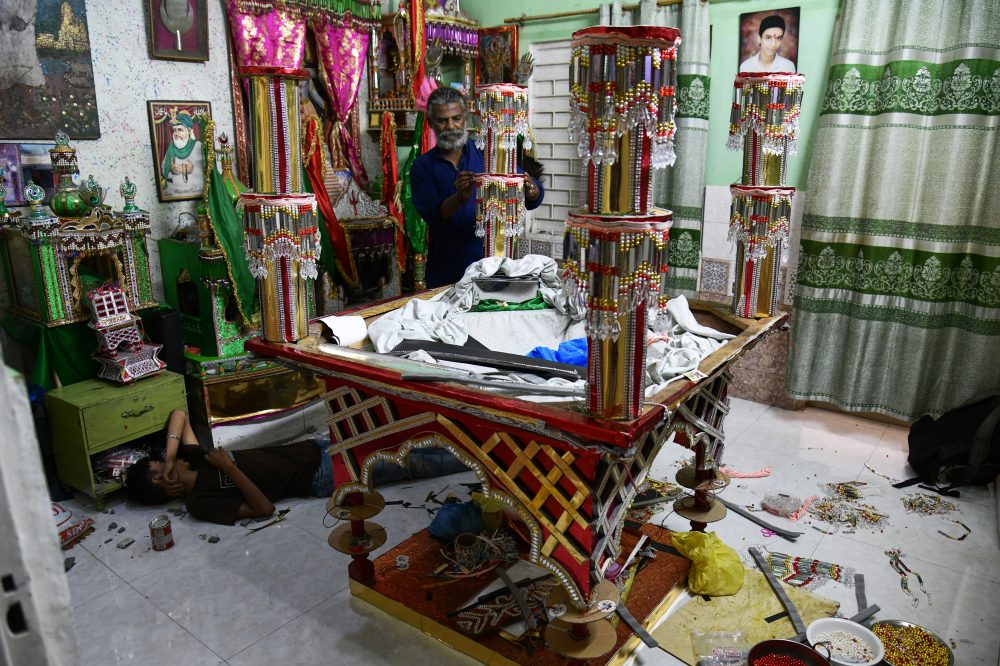

KARACHI, Pakistan — For Raju Rathore, his Hindu faith and his deep reverence for Imam Hussein come together each year in the Pakistani port city of Karachi during the sacred Islamic month of Muharram.
While Muharram observances are primarily a Shiite Muslim tradition, Rathore is among a number of Hindus in his city who also take part in commemorating the martyrdom of the Prophet Muhammad’s grandson, Imam Hussein.
“Muharram is very important to me and I want to keep participating in it for as long as I live,” said Rathore, whose parents relocated from India’s Gujarat state following the Partition of India in 1947. “I go there in devotion to Imam Hussein.”
Hussein died alongside family members at the Battle of Karbala, in what is now Iraq, during the seventh century. That event became a pivotal moment in the historical divide between Sunni and Shiite Islam.
The period of mourning for Hussein and his companions reaches its highest point on Ashoura — the 10th day of Muharram — which is observed by millions of people around the world.
Rathore’s connection to Hussein traces back to his parents. He explained that his mother was unable to conceive until she made a personal vow at the shrine of Masoom Shah Bukhari. She pledged that if she became pregnant, her child would honor Hussein’s martyrdom by constructing tazias — temporary replicas of his mausoleum that are carried through the streets during Muharram processions.
“This is our passion,” said Rathore, who has been crafting these structures for decades in honor of his mother’s vow. “Our devotion to Imam Hussein is such that even giving our lives would feel insufficient.”
The participation of non-Shiite communities in Muharram rituals has a long-documented history throughout South Asia, including among groups known as Hussaini Brahmins, whose customs have blended elements of both Hinduism and Shiite Islam.
“There are many reasons for this, but one is that, historically, many ruling dynasties in South Asia were Shi’a,” said Justin Jones, a professor of religious studies at the University of Oxford.
Jones explained that Shiite rulers across various South Asian kingdoms sponsored processions and other events honoring Hussein’s martyrdom, gradually transforming them into public occasions that attracted broader participation.
Over generations, Muharram observances became embedded in the civic and cultural fabric of parts of the region, with some Hindus serving as musicians in processions and others building tazias.
Jones noted that while such traditions continue across the region, they have become increasingly rare over the past century as religious communities have moved toward observing Muharram separately.
Pakistan’s 2023 census recorded nearly 3.9 million Hindus living in the country, making them its largest religious minority group.
Organizations such as Minority Rights Group have highlighted cases where Pakistani Hindus have faced violations of their religious freedoms. Even so, Rathore said he has been able to practice his beliefs without interference.
“Yes, I am Hindu, but this is not about religion,” Rathore said. “Many of my fellow Hindus also hold Imam Hussein in great respect.”
Rathore said he attends Shiite congregation halls during Muharram alongside other members of Karachi’s Hindu community, where they offer prayers and take part in rituals tied to the holy month — including chest beating — before joining the processions.
“Our religion has never taught us that because we are Hindus we should not participate in or respect others’ traditions,” said Bharat Kumar, another Pakistani Hindu who holds Imam Hussein in high regard. “We celebrate our own festivals with great enthusiasm and grandeur and we approach this in the same way.”
Both Kumar and Rathore build tazias in the days leading up to Ashoura. Rathore constructs his from paper, glass, cardboard, and other materials at his own cost, with family members collecting supplies over time for use in the structures.
The tradition is now being passed on to his son, who has also begun taking part in honoring Hussein’s martyrdom through the creation of the mausoleum replicas.
“I have been doing this not just for a few years but for about 45,” Rathore said. “I am now 52 years old, and as long as I have the strength to continue, I will keep making them.”