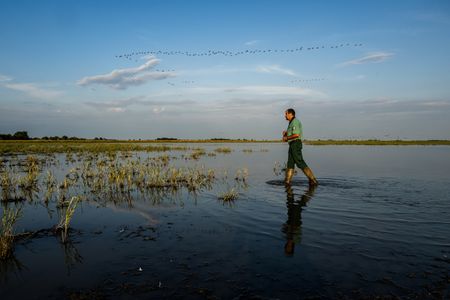

HORTOBAGY NATIONAL PARK, Hungary — Hungarian officials are working to save a UNESCO World Heritage site by redirecting water into its drying marshlands, as a severe drought threatens to wipe out one of Europe’s most important habitats for migratory birds.
The Hortobagy National Park, known as the “Puszta,” stretches across the plains and wetlands of eastern Hungary and draws visitors from around the world. Each year, tens of thousands of migratory birds stop here to nest and breed before making their journey to Africa as autumn approaches.
At the heart of the concern is a large marshland known as “Fekete ret,” or Black Meadow — once part of the natural floodplains of the Tisza river. The area first dried out in 2013, and during the last major drought in 2022, it went completely dry and more than 800 hectares burned.
Lajos Gal, a regional unit manager with the Hortobagy National Park Directorate who has spent more than three decades working in the marshes, described the ongoing challenge.
“Unfortunately, the groundwater level in the area has been continuously decreasing,” he said.
He noted that this year has been particularly difficult. “This is a very special year because the heat arrived very early, and we started the year with a very large water deficit. The spring was not rainy… and the swamp beds could not fill up. This year we managed to get water from the water department for ecological water replenishment.”
Gal said roughly 2 million cubic meters of water have already been directed into the marshes through the Nyugati irrigation canal, and the flow is still ongoing. He noted that without this effort, the entire area would have dried up completely by now.
The effects of climate change are also reshaping the behavior of the birds that depend on the park. Gal said migration patterns have shifted noticeably over the years.
“The spring migrations are starting earlier… Since there are no really cold winters, we don’t really have to wait for a warming after the long winter and then the spring migration begins, but the birds come back over a prolonged period, not all at once,” he explained.
He added that several species he remembered from his childhood have virtually vanished from the area. However, he pointed to one unexpected development: “Also, there are species, for example the little pygmy cormorant, which we almost never saw when I was a child, and nowadays there is a quite nice population here in the Black Meadow.”
Gal stressed that a lasting solution is needed — one that focuses on retaining as much water as possible as it flows into Hungary. He said preserving the wetlands is critical not only for wildlife, but also because they generate a local microclimate and help maintain groundwater levels in the region.