
A controversial Turkish appeals court decision has removed opposition leader Ozgur Ozel from his leadership role, creating a significant political upheaval that has disrupted financial markets and may extend President Tayyip Erdogan’s 23-year tenure in power.
The May 21 court decision represents the latest development in an ongoing government offensive targeting the opposition Republican People’s Party (CHP), which has resulted in the arrest or imprisonment of hundreds of party members and multiple mayors.
Opposition Response and Street Protests
The CHP has denounced the appeals court decision as a “judicial coup,” with Ozel pledging to challenge the ruling through legal channels.
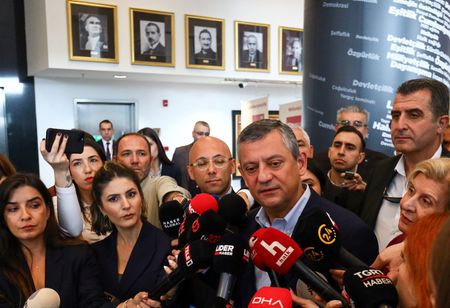
Following a police action involving tear gas that forced him from party headquarters on May 24, Ozel proceeded to parliament and declared that the CHP would now be “on the streets, in the squares, marching towards power.”
Other opposition groups have also criticized the decision as undemocratic, though Erdogan ally Devlet Bahceli suggested courts should avoid interfering in party internal affairs.
The pro-Kurdish DEM, which holds the third-largest parliamentary presence, condemned the ruling and called the police action at CHP headquarters a “disgrace to democracy.”
Justice Minister Akin Gurlek defended the court’s action, stating it showed democracy’s self-correcting mechanisms and rule of law were working properly, a position supported by a spokesperson for Erdogan’s ruling AK Party (AKP).
The European Union expressed concerns about rule of law, judicial independence and democratic pluralism in Turkey, an EU membership candidate, emphasizing that opposition parties must operate freely without facing repression.
Political analysts consider the ruling a critical test of the democratic-autocratic balance in NATO member Turkey and believe it could extend Erdogan’s time in office.
The political crisis caused market turbulence, weakening the lira and other Turkish investments and forcing the central bank to sell billions in foreign reserves, though markets recovered the following day.
Central Political Figures
Ozel assumed the CHP chairmanship through a party congress in 2023, succeeding Kemal Kilicdaroglu. He has organized anti-Erdogan demonstrations since the detention of Erdogan’s primary political opponent, Istanbul Mayor Ekrem Imamoglu.
The court ruling has restored Kilicdaroglu to CHP leadership. The controversial figure headed the party for 13 years and lost his leadership position after his 2023 presidential election loss to Erdogan.
Imamoglu was imprisoned in March 2025 facing corruption and additional charges including espionage and terrorism, all of which he firmly denies. His university credentials were also invalidated, making him ineligible under Turkish law to seek the presidency.
Erdogan has reached his constitutional term limits and can only seek reelection if an early election occurs or the constitution is modified. He currently lacks the required 360 members in the 600-seat parliament needed for a referendum. The next presidential election is scheduled for 2028.
Timeline of Government Actions
The crackdown began on October 31, 2024, when Ahmet Ozer, the CHP mayor of Istanbul’s Esenyurt district, was imprisoned pending trial over suspected connections to the banned Kurdistan Workers Party (PKK) militant organization, before his release on November 12, 2025 with proceedings still ongoing.
Hundreds of party members and elected officials have faced detention since 2024 on corruption and other allegations, which the CHP rejects. Imamoglu’s March 2025 arrest triggered significant market decline and Turkey’s biggest demonstrations in ten years.
The CHP, fellow opposition parties, rights organizations and some European officials characterize the crackdown as a politically motivated effort to silence opposition under Erdogan’s increasingly authoritarian governance. Government officials reject these claims, maintaining Turkey’s judicial system operates independently.
Imamoglu, whose legal proceedings continue, confronts additional allegations of espionage and insulting chief prosecutor Gurlek, whom Erdogan appointed as justice minister earlier this year.
Gurlek has previously sought a prison term exceeding 2,000 years for Imamoglu, claiming he directed an extensive corruption scheme that cost the government billions of lira, allegations the Istanbul mayor categorically denies.