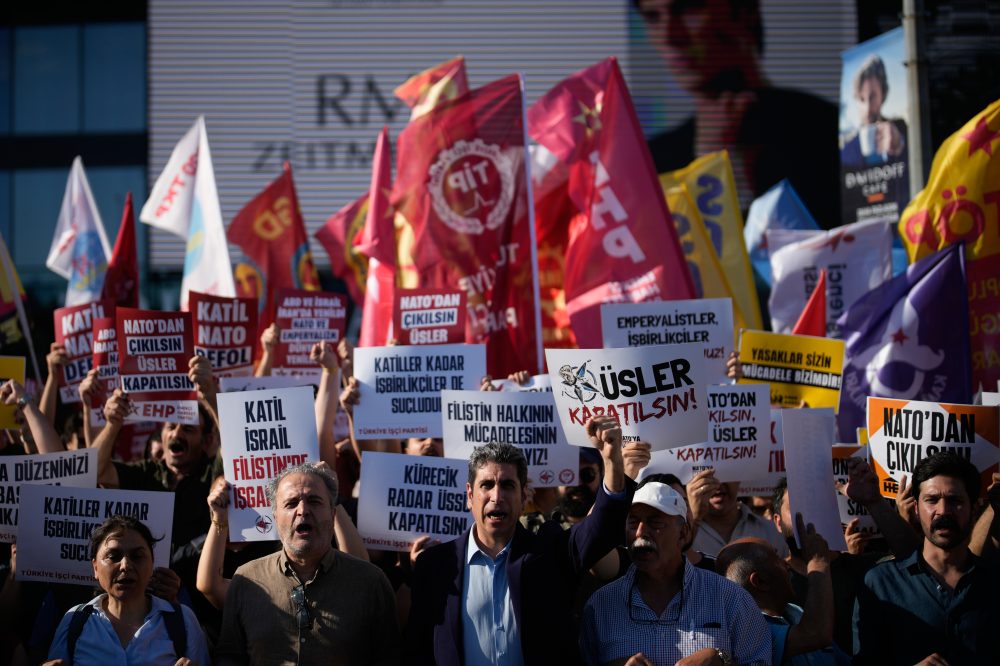

ANKARA, Turkey — Turkey is pulling out all the stops ahead of next month’s NATO summit, flooding its capital with tens of thousands of police officers, activating air defense systems, and banning public events — all while critics raise concerns about restrictions on free speech and the right to assemble.
The sweeping preparations are designed not only to protect the gathering but also to signal Turkey’s strength and reaffirm its dedication to the alliance, even as the country has frequently been viewed as a difficult partner within NATO.
On July 7 and 8, heads of state from all 32 NATO member countries are set to meet in the Turkish capital, including U.S. President Donald Trump. Trump’s past threats to pull the United States out of NATO and reduce American troop deployments have raised serious questions about the alliance’s direction going forward.
As part of its preparations, Turkey has opened a brand-new VIP airport — converted from a former military airfield — built specifically to receive NATO leaders arriving for the summit.
Key topics on the agenda include how much member nations are spending on defense and what role the U.S. will play in the alliance moving forward. Much of the conversation is expected to focus on rebuilding unity after Trump criticized allies for not backing U.S.-led military action against Iran and efforts to reopen the Strait of Hormuz.
Fatih Ceylan, a former Turkish ambassador to NATO and security analyst at the Ankara Policy Center, offered a measured outlook on what the summit might accomplish. “The important aspect of the meeting is to what extent the rift between the United States and Europe can be healed or narrowed during the summit,” he said. “We should not expect miracles, but nonetheless if there is a convergence of ideas emphasizing the importance of NATO, that should be seen as a success.”
Turkey’s position as the host nation appears to have been a deciding factor in getting Trump to attend. The U.S. president has a well-known personal relationship with Turkish President Recep Tayyip Erdogan. Speaking to reporters after a meeting with NATO Secretary General Mark Rutte at the White House, Trump put it plainly: “Well, except for the fact that it was being held in Turkey by President Erdogan, I don’t think I would have gone to it.”
In the lead-up to the summit, Erdogan has portrayed Turkey as a dependable ally that consistently takes on responsibility along NATO’s southeastern flank. He has said Turkey is working to make sure the Ankara Summit “will stand as a reference point in NATO’s history.”
Turkey has been a NATO member since 1952 and fields the alliance’s second-largest military force after the United States. The country also has a rapidly expanding defense industry and sits at a strategically vital crossroads between Europe, the Middle East, the Black Sea, and the Caucasus region.
Despite that, Turkey has frequently charted its own course, frustrating fellow alliance members. It has refused to join sanctions against Russia, clashed with Greece, and purchased Russian missile defense systems — a decision that got Turkey kicked out of the U.S.-led F-35 fighter jet program in 2019. Turkey also held up Finland and Sweden’s bids to join NATO until it received concessions on counterterrorism cooperation and arms export restrictions, and it previously blocked the appointments of NATO chiefs in 2009 and 2024 until its demands were met.
At the same time, Turkey’s willingness to act independently has allowed it to serve as a mediator in international conflicts — most notably by brokering a 2022 agreement to move grain through the Black Sea between Ukraine and Russia, and by supporting recent efforts to bring the war in Iran to an end.
Turkey has also had its own frustrations with NATO allies, particularly over what it viewed as a lack of solidarity from the alliance following a failed coup attempt in 2016, and over arms sales restrictions placed on Turkey after it intervened militarily in Syria.
Murat Aslan, an analyst at the Ankara-based SETA think tank, said Turkey developed a habit of acting on its own due to its complicated history with both the United States and Europe — and noted that Europe itself is now discussing its own “strategic autonomy” from the U.S. He said Turkey could serve as a model for how to balance independence with alliance commitments as NATO navigates tensions between Washington and European capitals.
More recently, Turkey has moved closer to the NATO fold. During the war with Iran, alliance missile defenses intercepted four Iranian missiles that struck Turkish territory, highlighting the value of NATO membership. In the weeks before the summit, Italy and Germany each deployed air defense systems to Turkey in response to rising threats.
Hamish Kinnear, principal Middle East and North Africa analyst at risk intelligence firm Verisk Maplecroft, described Turkey’s current position in a written analysis: “Turkey wishes to distinguish itself as a foreign policy actor that is independent of NATO and the West. While Turkey is not abandoning its balancing approach, it is tilting closer to the West, primarily because of NATO.”
Inside Ankara, residents are bracing for major disruptions. Strict access controls will be placed on several of the city’s main roads, around airports, the presidential complex where the summit will be held, and around hotels housing foreign delegations. The restrictions will significantly affect daily life in a city of nearly 6 million people.
The newly opened Ankara Airport — built from a former military airfield with expanded runways — is expected to continue operating as a VIP facility after the summit wraps up and will not be open to the general public, officials have said. According to the newspaper Cumhuriyet, building facades along the route from the new airport have been freshly painted as part of a city beautification effort.
While Ankara has dealt with terrorist attacks in the past and is accustomed to heightened security, the measures being put in place for this summit appear to go well beyond what is typical. Authorities have banned demonstrations, concerts, and graduation ceremonies during the summit period, and non-essential government workers have been given leave to help reduce congestion in the city.
More than 200 people suspected of ties to extremist organizations — including the Islamic State — have been detained, authorities confirmed. Media reports indicated that some activists, lawyers, and at least one academic were swept up in the detentions.
A Turkish court has also ordered websites critical of NATO and the summit to be blocked, citing security and public order concerns, according to Engelli Web, a site that monitors internet censorship in Turkey. Additionally, several journalists from Turkish opposition-leaning news outlets were denied press credentials to cover the summit, drawing sharp criticism from media freedom organizations.
Namik Tan, a former Turkish ambassador who now serves as a legislator with Turkey’s main opposition party, was blunt in his assessment: “In the history of the organization, we have never witnessed security measures as stringent and suffocating in a host city for a summit as we are seeing this time in Ankara.”
For some Ankara residents, the restrictions are hitting close to home — literally. Personal trainer Selin Karakoc said she was relieved to learn her July 5 wedding falls just before the restrictions take effect. “Ours could be one of the last weddings in Ankara that week,” she joked.