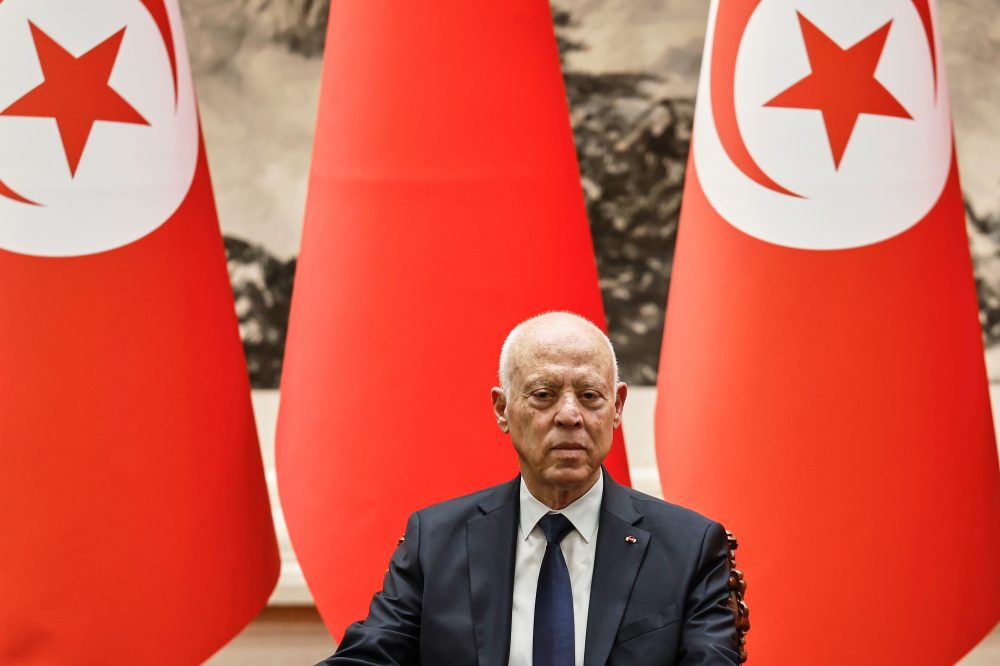

TUNIS, Tunisia — The Tunisian government has imposed a month-long closure on the Tunisian League for Human Rights, marking another escalation in what critics describe as an expanding assault on civil liberties organizations throughout the North African nation.
The targeted organization represents one of Africa and the Arab world’s most established human rights advocacy groups and was a member of the National Dialogue Quartet that received the 2015 Nobel Peace Prize.
In a Friday evening statement, the league acknowledged the government action and condemned it as “a serious and arbitrary violation of freedom of association” and “a direct assault” on fundamental democratic principles that Tunisia has achieved.
Under President Kais Saied’s leadership, foreign financial support for advocacy organizations has become a frequent target of criticism. The president regularly characterizes such funding as dangerous to Tunisia’s sovereignty and uses this narrative to brand political adversaries and social justice advocates as foreign operatives working to create domestic instability.
The organization emphasized that the suspension represents part of a larger pattern. “This measure cannot be seen in isolation from a broader context in the country marked by increasing systematic pressure on civil society and independent voices,” the group stated, announcing plans to contest the ruling through legal channels while maintaining their commitment to protecting human rights victims regardless of background.
This latest action continues a series of government moves against advocacy organizations across Tunisia, where judicial authorities previously forced several prominent non-governmental organizations to cease operations for month-long periods, including groups dedicated to protecting migrants and advancing women’s rights.
The suspension coincides with the 48-hour detention of journalist Zied El-Heni related to content he posted on Facebook, reflecting a wider campaign of arrests and legal actions targeting government critics.
During a Friday demonstration in Tunis, Mohamed Yassine Jlassi, who previously led the Tunisian journalists union SNJT, spoke with The Associated Press about the deteriorating situation. He reported that hundreds of individuals currently face detention on speech-related accusations, including charges stemming from social media activity.
“Repression has come to affect everyone. Journalism has become a crime, civil society work has become a crime, political opposition has been criminalized,” Jlassi explained.
“People now increasingly find themselves facing arbitrary prosecutions without the bare minimum guarantees of a fair trial.”
The investigative publication Inkyfada also faces legal challenges, with a May 11 court date scheduled as authorities seek to dissolve Al Khatt, the organization responsible for publishing the outlet.
According to the group’s statement, they reject the government’s legal justification for the case and maintain that the allegations have not undergone proper examination by Tunisian courts since 2024.
These recent actions have intensified worries among human rights advocates regarding restrictions on independent journalism, civil society organizations, and dissenting perspectives under Saied’s rule. The president has concentrated authority since 2021 and continues to target groups he consistently claims accept foreign money to create unrest and undermine Tunisia’s national security.