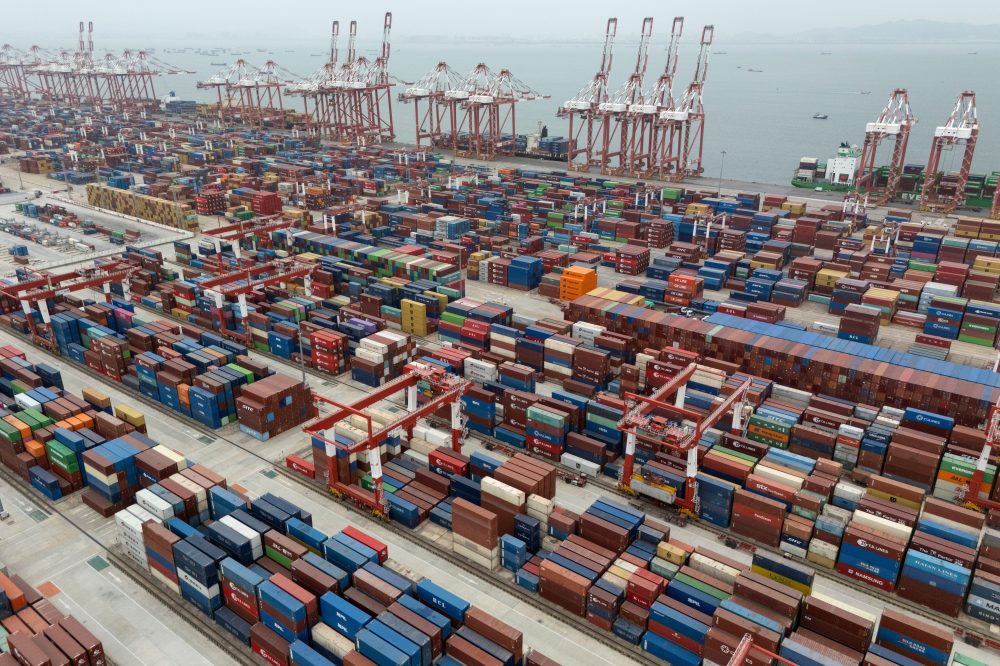

WASHINGTON — The U.S. Treasury was flush with cash last year as President Donald Trump’s sweeping import taxes brought in billions of dollars from goods arriving from nearly every nation on earth.
That revenue stream came to an abrupt halt after the Supreme Court struck down the largest of those tariffs back in February, leaving the administration scrambling to plug a massive financial hole.
The central question now facing Trump’s trade team: Can they replace that lost income before the clock runs out?
Time is running short. Following the Supreme Court defeat, the president turned to Section 122 of the Trade Act of 1974, which allowed him to impose a 10% global tariff. The problem is that Section 122 only authorizes tariffs for 150 days — and Trump’s authority under that provision expires on July 24. Getting Congress to extend those tariffs is considered unlikely, especially with the November 3 midterm elections on the horizon and voters already frustrated by the rising cost of living.
However, the administration has a more lasting tool available. Section 301 of the same 1974 law allows the president to impose tariffs and other trade penalties against countries found to engage in unfair, unreasonable, or discriminatory trade practices. Trump used this authority during his first term to hit China with heavy tariffs, and he’s already deploying it again. As recently as late Wednesday, he announced 25% tariffs on certain Brazilian imports, accusing the world’s 11th-largest economy of a range of unfair trade behaviors.
Trade lawyers and analysts say they believe the administration will find a way to swap out the expiring Section 122 tariffs for the more durable Section 301 tariffs before the July 24 cutoff. “They’re going to raise the tariff wall again,” said trade attorney Ryan Majerus, a partner at King & Spalding who served as a trade official in both Trump’s first administration and in President Joe Biden’s.
Trump had previously pushed the boundaries of presidential authority over import taxes — a power the Constitution grants to Congress. He invoked the 1977 International Emergency Economic Powers Act, known as IEEPA, to impose large tariffs on most of the world, justifying the move by declaring America’s longstanding trade deficits a national emergency. That represented a dramatic break from decades of U.S. trade policy favoring lower tariffs and open markets.
The Supreme Court rejected that approach entirely in February, ruling that the emergency powers law could not be used to impose tariffs. That decision forced the administration to issue refunds to importers who had already paid the levies, turning what had been a major source of government income into a net drain.
Tariff revenue had peaked at more than $31.4 billion in October. After the court ruling, collections fell to $22 billion in both March and April. By the time refund checks were going out faster than new tariff revenue was coming in, the numbers went negative — a modest $42 million shortfall in May ballooned into a staggering $25.6 billion loss in June.
Trump and Treasury Secretary Scott Bessent have both pledged to use other legal tools to recover the lost income.
Section 301 is now the administration’s primary vehicle. Unlike the IEEPA tariffs, Section 301 tariffs require the administration to go through a formal process — gathering public comments and holding hearings — before they can take effect. They carry no cap on their size, last for four years, and can be renewed. While the president has less ability to adjust them on the fly, they offer a more legally stable foundation than the IEEPA approach.
A shift to these rule-based tariffs would mean “there’s less uncertainty but not no uncertainty,” said Sarah Bianchi, a former U.S. trade official who now serves as chief strategist of international political affairs at the investment research firm Evercore ISI.
The administration has launched two major Section 301 investigations as part of its effort to restore tariff revenue. The first accuses 60 countries — representing 99% of U.S. imports — of not doing enough to stop goods made with forced labor from entering the market. The second is examining whether 16 trading partners, including China, the European Union, and Japan, are flooding the global market with overproduced goods, driving down prices and harming American manufacturers.
On the forced labor investigation, the administration has already signaled what it wants to do. U.S. Trade Representative Jamieson Greer last month proposed tariffs of 10% on 16 countries and 12.5% on 44 others — rates similar to or slightly above the Section 122 tariffs they would replace. However, Greer’s office is still accepting public comments and has not yet formally imposed those tariffs.
Nathaniel Halvorson, a partner at the Baker McKenzie law firm and a former U.S. trade official, believes Greer’s office will get those forced-labor tariffs in place before the Section 122 authority expires, with little or no gap in coverage. “Really, they’re operating about as fast as legally possible,” he said.
The second investigation, focused on alleged overproduction by 16 countries, is not yet complete. Trade attorney Majerus expects the administration to announce significant new tariffs from that probe within a month or two, and he suspects the timing will be deliberately set to take effect after the midterm elections “for obvious reasons.”
Trump, who has long described himself as “Tariff Man,” has made no secret of his desire to restore the sweeping, worldwide import taxes he put in place in 2025. Some legal experts believe the new Section 301 investigations may be vulnerable to court challenges because of that stated goal.
“Section 301s have been pretty legally durable,” said Bianchi. “But no one has tried to use it to basically put in place universal tariffs. I think there will be legal challenges.”