
WASHINGTON – After federal officials abandoned President Donald Trump’s proposed $1.8 billion fund designed to compensate ‘weaponization’ victims, supporters are now turning to an alternative legal pathway to secure payments for Trump loyalists, including individuals who participated in the January 6, 2021, Capitol uprising.
According to Trump associates and legal specialists, the most promising option involves utilizing the Federal Tort Claims Act, legislation from 1946 that permits individuals to submit administrative claims and file lawsuits against the federal government for purported misconduct, with potential out-of-court settlements.
Stanley Woodward, holding the third-highest position at the Justice Department, stated in an interview: “At my level, the fund is dead. If somebody wants to submit a claim against the government and sue us, they can still do that.”
The Republican president has consistently advocated for federal compensation to supporters he characterizes as targets of a ‘weaponized’ federal government under his Democratic predecessor Joe Biden.
However, the ‘anti-weaponization’ fund, developed as part of a legal agreement between Trump and the Justice Department to settle his $10 billion lawsuit against the IRS regarding alleged mishandling of his tax documents, was suspended following strong Republican congressional opposition. Trump’s opponents criticized it as a slush fund rewarding supporters with public funds.
Hundreds of individuals prosecuted following their involvement in the Capitol assault, which represented an unsuccessful attempt by Trump supporters to block Congress from confirming his 2020 electoral defeat to Biden, have already submitted claims, with at least 10 filing government lawsuits for damages – receiving minimal response thus far.
This approach has been under development for some time. Conservative attorneys discussed the strategy during a previously undisclosed planning meeting at the 2024 Republican National Convention, according to longtime Trump associate Michael Caputo, who participated in the gathering.
Additional compensation methods remain under consideration, according to Caputo, who spearheaded ‘anti-weaponization’ initiatives in Trump’s 2024 campaign and submitted the first known claim under the now-cancelled ‘weaponization’ fund.
“I’ve heard no indication that they’ve slowed down on trying to get victims paid,” Caputo stated, noting that administration officials instructed him to “watch this space.”
Caputo, who worked as a Department of Health and Human Services spokesperson during Trump’s initial presidency, requested $2.7 million in ‘restitution’ from Blanche regarding investigations by the Biden administration and former special counsel Robert Mueller.
“It’s the most logistically feasible method,” explained Patrick Jaicomo, a senior lawyer at the libertarian legal organization Institute for Justice who focuses on Federal Tort Claims Act cases. “The government would have a lot of flexibility.”
Trump’s continued advocacy for compensating supporters he describes as ‘weaponization’ victims has sparked questions about which approach he might pursue for such payments.
When questioned about alternative compensation plans, the White House referenced earlier statements by Trump and acting Attorney General Todd Blanche indicating the weaponization fund would not proceed.
“We have no additional announcements at this time and any speculation about potential future actions is just that – speculation,” a White House official told Reuters anonymously. “President Trump remains committed to addressing Biden-era weaponization.”
A Justice Department official, speaking anonymously, indicated there is no initiative to encourage claim submissions.
Trump has alleged that the Biden administration and other political adversaries improperly utilized law enforcement, intelligence and regulatory agencies to target him and his associates. Critics argue these actions were legally warranted due to actual or suspected misconduct by Trump and others.
Trump, for example, granted executive pardons to his supporters prosecuted for their January 6 riot participation.
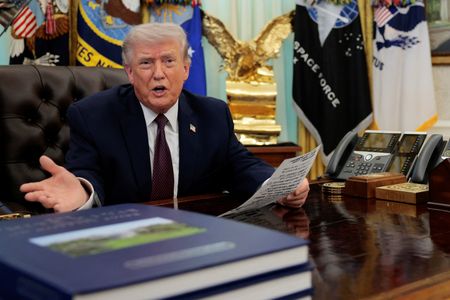
“The people were destroyed by dirty cops and by weaponization,” Trump said on NBC’s “Meet the Press” program broadcast Sunday. “Many of those people should be compensated.”
Republican Senator Lindsey Graham endorsed pursuing payouts through the Federal Tort Claims Act in a social media statement, prompting Justice Department’s Woodward to respond with what appeared to be support in a subsequently deleted post.
“We’re working on it,” Woodward wrote.
Woodward later explained to Reuters he intended to communicate that individuals believing they were government abuse victims retain a compensation pathway despite the absence of the $1.8 billion fund.
Financially compensating Trump associates has evolved from political fringe territory toward mainstream Republican strategy.
Caputo said he participated in discussions about finding methods to pay ‘weaponization’ victims dating to October 2023.
In 1956, Congress established a permanent Judgment Fund for settling federal government lawsuits.
Caputo reported that presidential allies and conservative attorneys discussed utilizing this fund for Federal Tort Claims Act payouts “ad nauseam” during the 2024 Republican National Convention. Discussion participants opposed compensating violent felons, including those who attacked police officers, according to Caputo.
The participants viewed the Judgment Fund as a “limitless” money source that would circumvent political obstacles of establishing a new administrative fund, Caputo said, though they recognized these payouts could generate controversy.
Several prominent Trump allies have already received Federal Tort Claims Act payouts. Michael Flynn, who briefly served as Trump’s national security adviser during his first term, obtained a $1.25 million settlement under the statute.
Attorney Peter Ticktin said his firm represents over 400 Capitol riot participants who have filed Federal Tort Claims Act claims. Ticktin expressed hope the government will settle cases before court proceedings, but has received no settlement plans notification.
“We’re asking for restitution in the millions of dollars,” Ticktin said, adding he trusts Trump and the Justice Department will ensure his clients receive payment.
The administrative procedure for Federal Tort Claims Act claims begins when someone files a form, designated SF-95, alleging government wrongdoing and seeking damages.
Claims generally must be submitted within two years of the incident, but January 6 defendants argue the alleged wrongdoing against them represents continuing harm. It remains uncertain how courts or the Justice Department will interpret that position.
If the government accepts the requested amount, officials can authorize payment before judicial assignment, Jaicomo explained, meaning no judge would examine the payment.
If the government refuses settlement, claimants may file lawsuits, at which point a judge would oversee the case. Ticktin has filed 10 lawsuits and plans hundreds more.
Rupa Bhattacharyya, a former Justice Department official who supervised the September 11, 2001, attack victims’ compensation fund, said department lawyers typically settle only when facing high trial loss risk, though they maintain broad settlement discretion including in January 6 cases.
“That would be a travesty because these are very defensible lawsuits,” said Bhattacharyya, who served under presidents from both parties. “It would violate the purpose and spirit of the judgment fund – but it is unlikely it would violate the text of the law.”