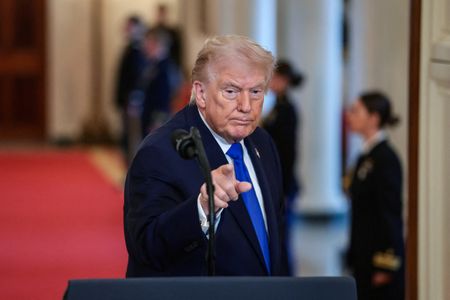

President Donald Trump prepares to take the podium Tuesday evening for his State of the Union address to Congress during what many consider a challenging period for his administration, with polling numbers dropping and growing concerns about international tensions as the fall midterm elections approach.
The nationally televised evening address marks Trump’s second such speech in the 13 months since he resumed office, providing the president an opportunity to make his case for maintaining Republican control of Congress. However, the speech occurs amid significant political obstacles both domestically and internationally.
Recent days have brought additional complications for the Trump administration, including a Supreme Court ruling that struck down his worldwide tariff program and fresh economic indicators revealing slower-than-anticipated growth coupled with rising inflation.
A congressional standoff between Republicans and Democrats over the administration’s hardline immigration policies has resulted in a partial shutdown of the Department of Homeland Security, which occurred after two U.S. citizens were fatally shot in Minneapolis. Additionally, Trump continues to deal with ongoing controversy regarding the government’s disclosure of documents connected to convicted sex offender Jeffrey Epstein.
Despite Trump’s public desire for the Nobel Peace Prize and his establishment of a “Board of Peace,” tensions with Iran over its nuclear activities appear to be escalating, with the administration deploying naval vessels to the Middle East and developing strategies that could involve regime change, according to government sources.
Tuesday’s address may provide Trump with his first major public platform to justify potential military action against Iran.
Two administration officials, who requested anonymity, confirmed that Trump plans to discuss Iran policy but declined to provide specifics.
The president will also highlight his diplomatic achievements, they indicated. The speech coincidentally falls on the fourth anniversary of Russia’s invasion of Ukraine, serving as a reminder that Trump has not yet fulfilled his campaign promise to end that conflict “in 24 hours.”
Trump is anticipated to address the Supreme Court’s tariff decision, contending that the justices made an error and presenting alternative legal mechanisms he could employ to restore most of the trade penalties.
The president responded angrily to last week’s court decision, launching personal criticisms against several justices. Should he repeat such attacks Tuesday, it could create uncomfortable moments, as several of the nine justices are expected to be in attendance.
White House staff and Republican campaign strategists, concerned about the upcoming congressional elections, have encouraged Trump to concentrate on Americans’ financial concerns. While Trump’s 2024 electoral success was largely built on promises to reduce living costs, surveys indicate voters remain skeptical of his progress.
Trump has had difficulty maintaining focus, often veering from economic topics to personal complaints during public appearances, while sometimes claiming he has already resolved economic issues.
According to one White House official, Trump intends to “claim victory on the economy,” a message that may not resonate well with Republican legislators facing reelection. He plans to argue that he inherited economic problems from his Democratic predecessor Joe Biden and that Democrats have exaggerated affordability issues, both officials stated.
The president will cite stock market increases, private sector investments, and his tax reduction legislation as proof of his economic success, the officials noted. Trump will also emphasize his strict border enforcement and deportation efforts, even though polling suggests most Americans believe his administration has been too aggressive in targeting undocumented immigrants.
“This is the one opportunity the president has where the whole world is looking at what he has to say, and this is his opportunity to summarize everything that he’s done and not go off script,” said Amanda Makki, a Republican strategist and former Florida congressional candidate.
Trump, known for improvising during speeches, indicated Monday that his remarks would be extensive. His 100-minute address last March — technically not a State of the Union but similar in format — set a record as the longest presidential speech to Congress in recent decades.
The White House officials revealed that this year’s speech was deliberately structured to accommodate spontaneous moments.
“We are planning around it,” one official explained.
During last year’s address, several Democrats disrupted Trump’s speech with vocal objections before staging a walkout. This year, more than 20 House and Senate Democrats plan to boycott the speech entirely, instead attending an outdoor gathering on the National Mall.
Senator Jeff Merkley of Oregon, among the boycotting Democrats, told reporters Monday that their alternative event would provide a more “honest description” of Trump’s presidency, contrasting it with what he called the “propaganda push” of the official speech.
Virginia Governor Abby Spanberger, whose significant November victory served as an early warning signal for Republicans ahead of the midterms, will present the official Democratic response. Democratic Senator Alex Padilla of California, who was forcibly detained and handcuffed last year after trying to question Homeland Security Secretary Kristi Noem during a press conference, will deliver the Spanish-language response.