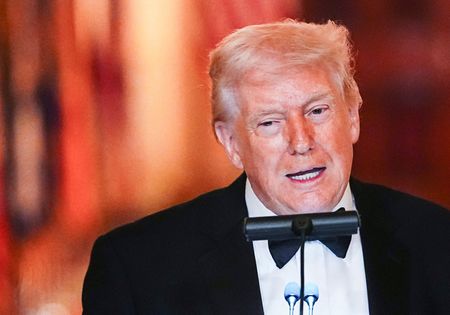

President Donald Trump has implemented new 15% tariffs using an obscure 1974 trade statute following the Supreme Court’s decision to overturn his previous import duties, but economists are questioning whether the economic emergency Trump cites actually exists.
The new tariffs took effect at midnight Tuesday, replacing the 10% to 50% duties that were eliminated when the Supreme Court ruled against Trump’s use of the International Emergency Economic Powers Act on Friday.
Trump is now invoking Section 122 of the Trade Act of 1974, a provision that has never been used before and allows presidents to impose duties up to 15% for 150 days to address “large and serious” balance-of-payments deficits and “fundamental international payments problems.”
The president’s order claims the United States faces a severe balance of payments crisis, pointing to the nation’s $1.2 trillion annual goods trade deficit, a current account deficit representing 4% of GDP, and the reversal of America’s primary income surplus.
However, economic experts are pushing back on this characterization. Former International Monetary Fund First Deputy Managing Director Gita Gopinath told Reuters the administration’s concerns are misplaced.
“We can all agree that the U.S. is not facing a balance of payment crisis, which is when countries experience an exorbitant increase in international borrowing costs and lose access to financial markets,” Gopinath said.
Gopinath dismissed the administration’s argument that America’s first negative primary income balance since 1960 signals a major payments problem. Instead, she explained this shift resulted from increased foreign investment in U.S. stocks and high-risk assets over the past decade, which have outperformed international markets during this timeframe.
Former Treasury and IMF official Mark Sobel echoed these sentiments, noting that balance of payments crises typically affect nations with fixed exchange rates. He pointed out that the dollar remains stable, Treasury yields are steady, and U.S. markets continue performing well.
Josh Lipsky from the Atlantic Council think tank agreed with this assessment, explaining that genuine balance of payments crises occur when countries cannot afford their imports or service foreign debt obligations – a fundamentally different situation from having a trade deficit.
Brad Setser, a trade expert at the Council on Foreign Relations who previously advised the Biden administration’s Trade Representative, offered a different perspective. In social media posts Sunday, Setser suggested Trump might have legitimate grounds to claim a “large and serious” balance of payments deficit exists.
Setser noted that today’s current account deficit exceeds the levels that prompted President Richard Nixon to impose tariffs during the 1971 balance of payments crisis, and America’s net international investment position has deteriorated significantly since then. This “gives the administration a real argument” for their tariff strategy, Setser wrote.
The White House, Treasury Department, and U.S. Trade Representative’s office have not responded to requests for comment regarding the Section 122 implementation.
The Trump administration’s new approach faces potential legal challenges, particularly given the Justice Department’s previous position on this statute. In court documents defending the now-struck-down IEEPA tariffs, Justice Department lawyers argued Section 122 had “no obvious application” to trade deficit emergencies, calling trade deficits “conceptually distinct from balance-of-payments deficits.”
Attorney Neal Katyal, who represented plaintiffs challenging the original tariffs before the Supreme Court, told CNBC that the administration’s contradictory stance makes the new tariffs vulnerable to litigation.
“I’m not sure it will necessarily even need to get to the Supreme Court, but if the president adheres to this plan of using a statute that his own Justice Department has said he can’t use, yeah, I think that’s a pretty easy thing to litigate,” Katyal said.
It remains unclear which parties might challenge the Section 122 tariffs in court. Sara Albrecht, who chairs the Liberty Justice Center representing small businesses in the previous tariff case, said her organization will closely watch any new legal authorities being used.
Rather than revealing litigation plans, Albrecht said their immediate priority is “making sure the refund process begins and that checks start flowing to the American businesses that paid those unconstitutional duties.”
The Supreme Court’s ruling did not specify refund procedures, instead sending the case back to a lower trade court to determine the next steps in the process.