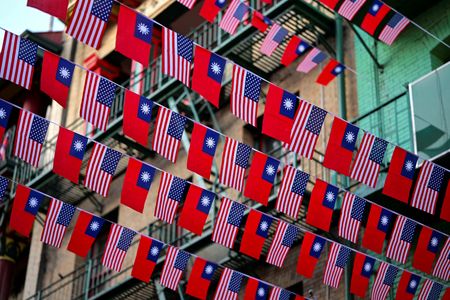

President Donald Trump announced Wednesday his plans to hold a conversation with Taiwan’s President Lai Ching-te, marking an extraordinary step for an American leader that could strain diplomatic ties with China and potentially trigger additional Chinese military exercises near the island.
This marks Trump’s second announcement in a week regarding his intention to contact Lai, eliminating earlier theories that his initial mention following last week’s meeting with Chinese President Xi Jinping was an accidental comment.
Taiwan expressed willingness for Lai and Trump to engage in dialogue, although neither Washington nor Taipei has confirmed specific timing for such a conversation.
Addressing the potential Trump-Lai discussion, China’s foreign ministry stated Thursday that the United States must “handle the Taiwan issue with extreme caution and stop sending wrong signals to the separatist forces of Taiwan independence.”
The following explains why Beijing might strongly oppose such communication.
CHINA’S STANCE ON TAIWAN
Beijing considers Taiwan its most crucial and delicate matter, involving Chinese sovereignty and territorial integrity that outsiders should not question or meddle with.
China regards Taiwan as unfinished business from the Chinese civil war, during which the defeated Republic of China government escaped to the island in 1949 after losing to Mao Zedong’s communist forces, who established the People’s Republic.
Beijing declares Taiwan a Chinese province without legitimate claims to statehood and has not ruled out military action to achieve control, while stating preference for “peaceful reunification.”
China describes Taiwan as its “core of core interests” and an uncrossable red line, consistently condemning high-level interactions between foreign officials and Taipei as meddling in Chinese domestic matters.
Both Chinese and Taiwanese administrations do not officially acknowledge each other, and China declines to address Lai as “president.”
CHINA’S PREVIOUS RESPONSES TO U.S.-TAIWAN ENGAGEMENT
Beijing conducted significant military exercises around Taiwan in 2022 following then-U.S. House Speaker Nancy Pelosi’s Taipei visit, and has organized multiple other military drills responding to American engagement with Taiwan.
China’s most recent major military maneuvers near the island occurred in late December. Earlier that month, the Trump administration authorized an $11 billion weapons sales package to Taiwan, representing its largest ever.
TAIWAN’S PERSPECTIVE
Taiwan operates as a flourishing democracy whose leadership firmly dismisses Beijing’s sovereignty assertions. Taiwan maintains it is an independent nation named the Republic of China, the island’s official designation, with rights to international engagement and democratic self-determination.
Lai has consistently proposed discussions with China but faced rejection. Beijing labels him a “separatist.”
AMERICAN POSITION
America ended formal diplomatic relations with Taipei in 1979, choosing Beijing instead, but remains obligated under the Taiwan Relations Act to supply the island with defensive capabilities. America officially maintains neutrality on Taiwan’s sovereignty through Washington’s “One China” policy.
In 2022, the State Department incorporated language regarding the Six Assurances, referencing six Reagan-era security commitments to Taiwan that America declassified in 2020.
These assurances from 1982, previously kept confidential, include statements that America has not established a timeline for ending weapons sales to Taiwan, nor agreed to prior consultation with Beijing regarding such sales, or to modify the Taiwan Relations Act governing American policy toward the island.
China has consistently demanded America cease weapons sales to Taiwan.
TRUMP’S PREVIOUS TAIWAN CONTACT
In late 2016, President-elect Trump conducted a 10-minute conversation with then-President Tsai Ing-wen. China responded with measured criticism, filing a diplomatic protest and accusing Taiwan of pursuing a “petty action.”