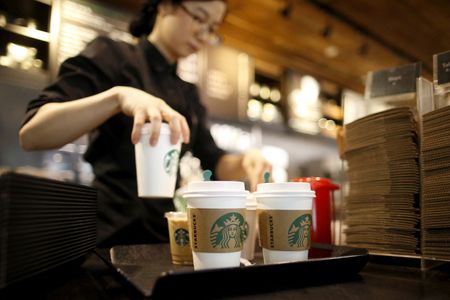

A South Korean government minister announced his department will cease providing products from businesses that trivialize the nation’s democratic past, following widespread criticism of a Starbucks Korea promotional campaign that referenced a deadly 1980 military assault on democracy advocates.
The coffee company introduced its “Tank Day” promotion on the anniversary date of the May 18 Gwangju uprising, when military forces deployed troops and armored vehicles to crush mass demonstrations calling for democratic reforms.
“Conduct that makes light of that history or consumes it as commercial material is an issue that can never be taken lightly,” Yun Ho-jung wrote on X late on Thursday, expressing deep regret over what he called Starbucks Korea’s “anti-historical conduct” and saying the Ministry of the Interior and Safety would no longer offer products from companies that made light of the history and value of democracy or used it as commercial material.
This week, Shinsegae Group, which operates Starbucks locations in South Korea under license, terminated the coffee chain’s local chief executive due to the promotional campaign, stating it was unsuitable.
When contacted regarding the voucher decision, Shinsegae pointed to Tuesday’s public statement of remorse issued by Group Chairman Chung Yong-jin.
According to Yun, government departments including the Interior Ministry typically distribute gift certificates such as coffee vouchers to individuals participating in surveys, competitions and civic engagement activities.
He called on other institutions and citizens to adopt his ministry’s approach.
The Interior Ministry handles government operations along with emergency and safety oversight.
Minister of Patriots and Veterans Affairs Kwon Oheul also criticized Starbucks in an X post late on Thursday, saying his ministry would strengthen monitoring to prevent the spread of false information related to the uprising.
Military forces under the dictatorship of Chun Doo-hwan are believed to have killed or caused the disappearance of hundreds during the Gwangju protest suppression. Numerous aspects of the incident remain unclear, including the identity of who authorized troops to fire on demonstrators.
In his statement this week, Shinsegae Group Chairman Chung Yong-jin recognized the suffering the promotional campaign had inflicted.
“I deeply bow in apology as the representative of the group,” Chung said. The marketing “deeply hurt the public, the bereaved families, and the victims of the May 18 demonstration.”
The controversy has sparked consumer boycott movements on social media and prompted police complaints against Chung, according to Seoul law enforcement.
Data from WISEAPP shows Starbucks holds the top position among food and beverage chains in South Korea based on estimated customer numbers during the six-month period ending in February.