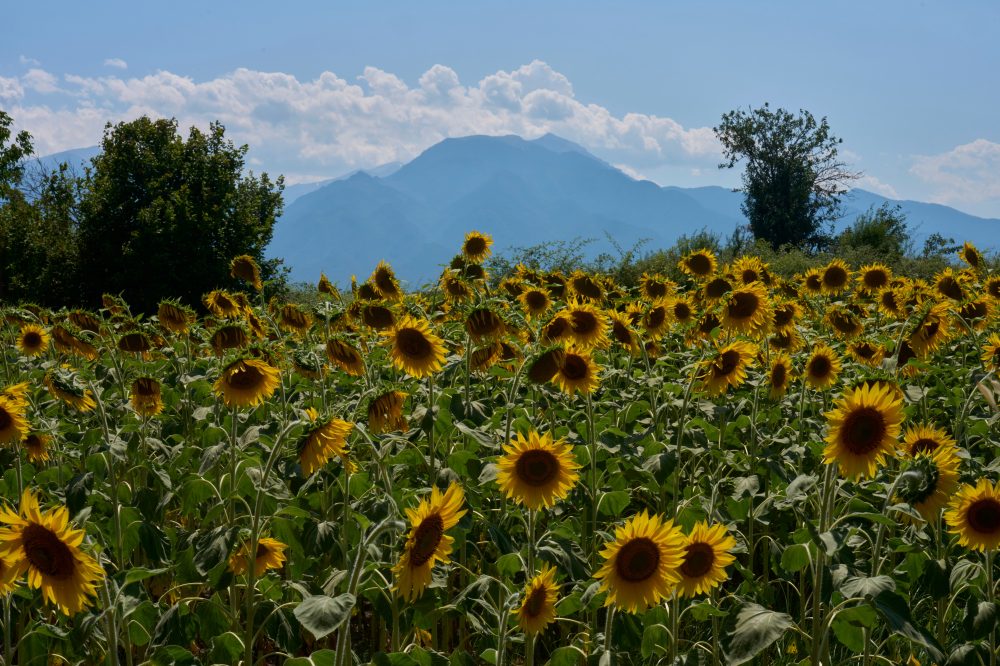

LITOCHORO, Greece — Crowned with snow for much of the year and rising 2,918 meters (9,573 feet) from a base nearly at sea level, Mount Olympus has stirred human imagination for thousands of years. In ancient Greek belief, this towering, mist-draped peak was where Zeus, ruler of the gods, held his throne. Now, modern Greeks are hoping to see their country’s highest mountain earn a place on UNESCO’s prestigious World Heritage List.
The nomination for Mount Olympus — put forward as a mixed cultural and natural site — is scheduled to be considered when the World Heritage Committee holds its annual meeting in Busan, South Korea, running through July 29.
“Olympus is our life. It is the place we grew up in,” said Evagelos Geroliolios, mayor of Dion-Olympus, whose offices are based in Litochoro, the mountain’s principal town. “It is the place we see every day, but at the same time, it is also a place which carries with it myth, history, biodiversity, extraordinary beauty and a very great cultural weight.”
Few places hold as prominent a role in ancient Greek mythology as Mount Olympus. Legend holds that Zeus established his court atop the mountain after a 10-year conflict with his father, Cronus, that ended the rule of the Titans.
Interest in the mountain could get an additional lift this week with the theatrical release of Christopher Nolan’s “The Odyssey,” a new cinematic adaptation of Homer’s epic poem. In the film, the mountain serves as the residence of Zeus and the Olympian gods who shape the wanderings of Odysseus.
Archaeological digs on one of the mountain’s lower peaks have revealed an open-air sanctuary, with the earliest artifacts tracing back to the Hellenistic period, spanning from 323 B.C. to 30 B.C. Greece’s original UNESCO nomination suggests this sanctuary may be the very one referenced by the ancient philosopher and historian Plutarch, who wrote in the 2nd century about processions to an Olympus peak for animal sacrifices offered to Zeus.
The mountain’s religious significance did not fade with the rise of Christianity. A chapel on the peak known as Prophet Elias, standing at 2,803 meters, is thought to be the highest-elevation chapel in the Christian Orthodox world. The mountain’s Enipeas Gorge contains the ruins of a monastery established in 1542, and about a 20-minute walk away lies the Holy Cave of St. Dionysios — a chapel set within a natural cave from which a small spring flows, believed to carry holy water.
Beyond its mythological and religious heritage, the mountain’s slopes — which stretch nearly to the shoreline — shelter a rich variety of plant and animal life, including species found nowhere else. It is this rare combination of cultural history, ancient myth, natural scenery, and biodiversity that residents hope will earn Olympus its designation as a World Heritage site.
“It is a place we love. It is a place that many people from all over the world visit to see, to live, to experience. We want to protect it,” Geroliolios said. He added that inclusion on UNESCO’s list would be “something very big that goes beyond not just local boundaries, but national boundaries. It is something that concerns the entire world. It is very important.”
Greece first set the process in motion back in 2014, when it added Mount Olympus to its Tentative List — the required first step before any formal UNESCO nomination can be submitted. Countries typically use the Tentative List to identify sites they plan to formally nominate within the following five to ten years.
The full nomination process involves a preliminary review, followed by submission of a comprehensive nomination file. That file is then evaluated over 14 months by advisory bodies, including the International Council on Monuments and Sites (ICOMOS) and the International Union for Conservation of Nature. Their findings are then brought before the World Heritage Committee, where delegates from 21 countries cast votes on each nominated site.
Success is not guaranteed for Greece’s bid. A draft version of the Busan meeting’s agenda indicates the committee is likely to refer the nomination back to Greece and request more detailed information before moving forward.
Even so, those who live near the mountain remain hopeful that its extraordinary combination of cultural and natural assets will ultimately secure it a spot on the list — and with it, stronger protections for the mountain itself.
Mayor Geroliolios acknowledged that a World Heritage designation would come with added responsibility, saying it “places some greater obligations on our part to protect this environment.”
Environmental concerns are also top of mind for mountain guide Babis Marinidis, who serves as president of the Alpine Club of Litochoro. He noted that a UNESCO designation would likely draw even more visitors to the area, raising a pressing question: “How many people can this mountain, this ecosystem, bear?”
Marinidis pointed out that although much of Olympus has been a designated national park for decades and regulations exist, many visitors openly disregard them — routinely ignoring signs prohibiting swimming or camping. The steady increase in foot traffic has prompted local officials to explore entrance fees and visitor registration systems. “I used to be against that,” Marinidis said. “But now with so many people, I believe some limit must be imposed.”
The mountain draws hikers and climbers from around the globe, drawn by its mythological legacy and dramatic terrain. Reaching the summit does not require advanced technical climbing skills, but the mountain demands serious respect. Unpredictable weather and dangerous terrain have taken many lives over the years. Most recently, a 64-year-old Greek hiker died on July 11 after collapsing on a trail. In May, rescue teams recovered the body of a 25-year-old Spanish man several days after he went missing while attempting to summit in snowy conditions.
“You need to be careful,” said 32-year-old hiker Triantafyllos Giannospyros, who was visiting the mountain for the first time. Safety should always be a priority, he said, but added: “With care and with good organization, it isn’t something you should be afraid of.”
Stavroula Vourou, who operates a hotel in Litochoro — the town from which many hikers begin their ascent — offered a similar perspective. “Everyone sets off to go up and conquer a mountain that needs respect,” she said. “You respect this mountain, it respects you too.”