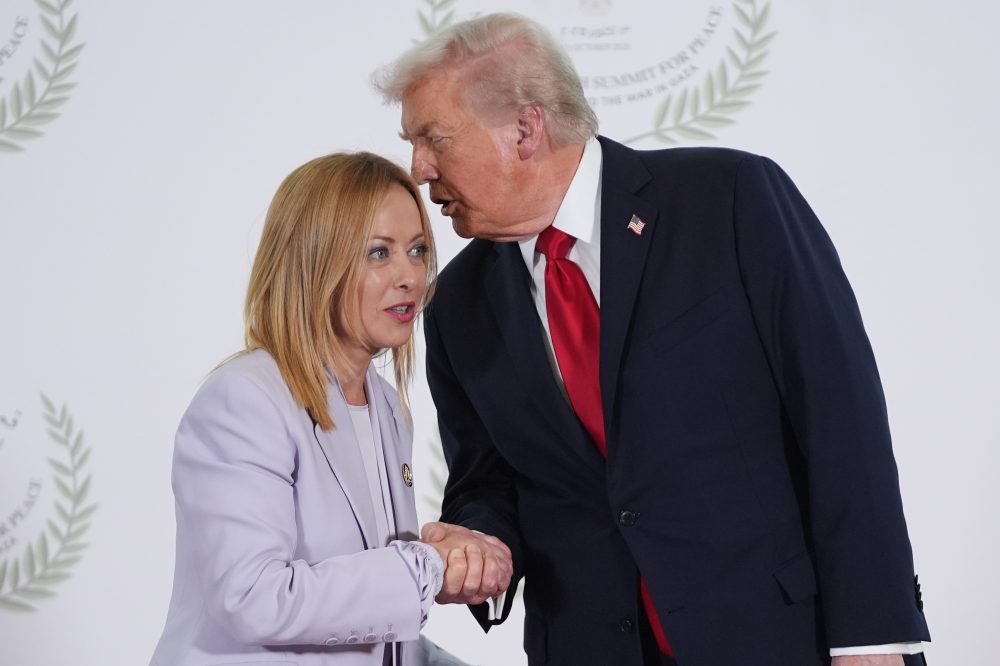

MILAN (AP) — Italian Prime Minister Giorgia Meloni was once viewed as Europe’s strongest connection to U.S. President Donald Trump. That relationship now appears to be crumbling.
Following his controversial remarks about Pope Leo XIV, Trump has now targeted Meloni, previously among his most supportive European partners, after she denounced his papal comments as “unacceptable” and declined to support the ongoing U.S.-Israel military action against Iran.
“I thought she had courage,” Trump stated during an interview with Italy’s prominent newspaper Corriere della Sera. “I was wrong.”
While Meloni has not issued a direct response to Trump’s criticisms, political observers suggest the confrontation could work in her favor as she navigates recovery from a significant referendum loss last month and attempts to minimize backlash from the widely unpopular Iran conflict, which has contributed to rising energy costs.
“I actually think this is a godsend for her,” explained Nathalie Tocci, a Johns Hopkins SAIS Europe professor and director of the International Affairs Institute. “Trump has become completely toxic across Europe, across much of the world, including Italy.”
Trump escalated his criticism on Wednesday, acknowledging their relationship had deteriorated. “She’s been negative,” Trump informed Fox News. “Anybody that turned us down to helping with this Iran situation, we do not have the same relationship.”
As the sole European Union leader who received an invitation to Trump’s second inauguration, Meloni was positioned to capitalize on her strong connections with him following his return to power 15 months ago. The two leaders appeared naturally aligned, sharing nationalist philosophies and similarly tough positions on immigration issues.
However, Italy has not escaped the impact of Trump’s trade policies, and critics question what benefits she has gained from the relationship. When asked about recent communication between them, Trump informed Corriere, “No, not in a long time.”
Following an awkward Oval Office meeting a year ago where she sidestepped direct confrontation with Trump regarding tariffs, tensions have escalated over the Iran military campaign. Meloni has declared Italy will not join the conflict, and the nation recently denied U.S. military aircraft permission to utilize a crucial Sicilian air base.
Meloni’s recent statement describing Trump’s papal criticism as “unacceptable” represents her most direct public rebuke of the president to date.
“It’s been building up over time, not so much because she is moving away from him but because he has become increasingly unhinged,” Tocci observed.
Adolfo Urso, a cabinet minister from Meloni’s far-right Brothers of Italy party, insisted the dispute would not undermine U.S.-Italy relations.
“Italy and the United States are allied countries and maintain their relationship and alliance within international institutions, starting obviously with the Atlantic Alliance,” he stated on Radio 24, noting that religious moral guidance “cannot crack relationships consecrated in alliances signed a few decades ago.”
Mariangela Zappia, who leads the ISPI think tank and previously served as Italian ambassador to the United States, attributed Trump’s “hot-blooded” response to broader frustrations with Europe beyond just Italy. Apart from lacking support for the Iran campaign, Trump recently lost a key ally when Viktor Orbán suffered an electoral defeat in Hungary’s weekend elections.
Nevertheless, she emphasized that Trump’s personal attacks on Meloni should not be interpreted as undermining the broader alliance.
“Europe absolutely considers the United States its historic ally, but in some way wants to be involved in the decisions that are taken,” Zappia noted.
Trump, meanwhile, is discovering “this European Union is not easy to dismantle,” she added. “We are different, we react differently. Some are clearly anti-Trump, some are pro-Trump but in the end, destroying the European project, separating us on the things on which we see as our future, that is very difficult.”
Meloni has worked to rebuild support following her referendum defeat, which effectively became a test of her leadership capabilities. She conducted a rapid two-day visit to three Gulf nations to secure Italy’s energy supplies amid a deepening crisis, though she returned without concrete agreements.
On Tuesday, she announced Italy would not automatically extend a defense pact with Israel, following an incident where warning shots struck an Italian convoy participating in U.N. peacekeeping operations in southern Lebanon—a decision analysts view as politically motivated rather than strategically significant.
“The Gulf tour was a way to show public opinion that she was being proactive. The fact it didn’t actually lead to anything is beside the point,” Tocci explained. The Israel decision “substantively is rather meaningless because there is not much in this agreement but symbolically it helps because Israel has become just so unpopular in Italian public opinion.”
Despite her damage control efforts following the referendum loss, Roberto D’Alimonte, a professor at the LUISS school of government, anticipates a challenging final year and a half of her term before 2027 elections, primarily due to economic consequences from the Iran conflict.
“People want to see their gas bills go down, not just see Meloni talk about gas. What matters are the bills you get every month,” he concluded.