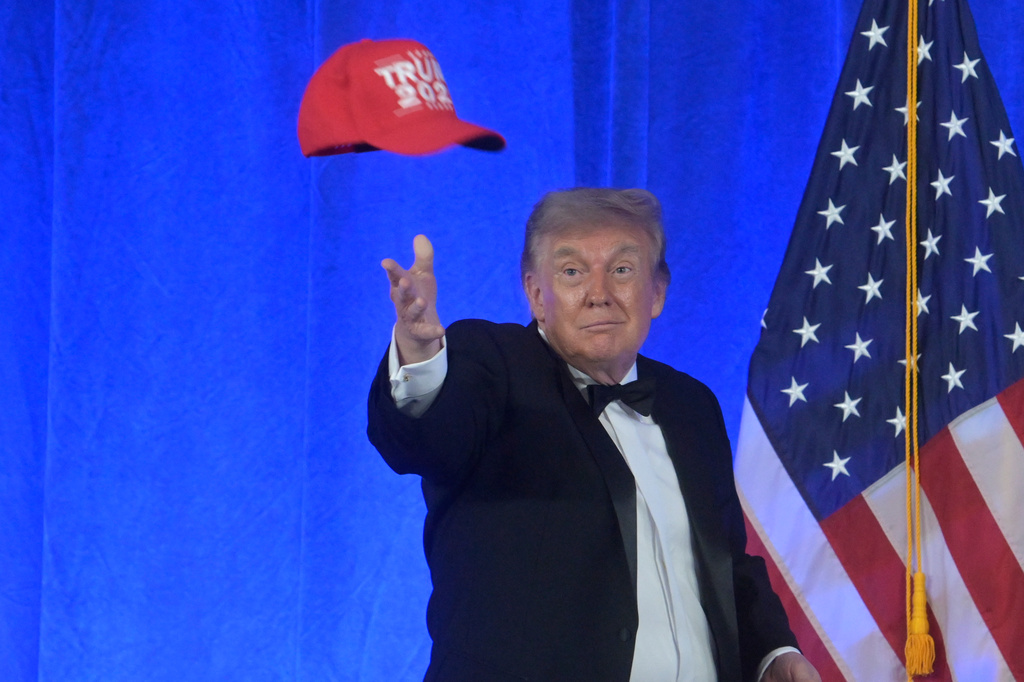

President Donald Trump is heading to suburban Detroit on Monday to champion his economic record and stand behind his sweeping tariff policies — even as those same policies have taken a toll on businesses in the pivotal swing state, with midterm elections drawing closer.
Trump’s stop is at a General Motors facility in Milford, a site that serves as a testing and development ground for new vehicles. The visit comes as early voting is already underway for Michigan’s August 4 primary, which features heated nomination battles within both major parties.
On the Republican side, Mike Rogers is running unopposed in the Senate primary, while the race for governor pits Trump-endorsed Rep. John James against Perry Johnson, a businessman-turned-politician who has previously run failed campaigns — including a 2024 presidential bid. Johnson has been working to cast himself in Trump’s image despite not receiving the president’s backing, and is even hosting a “Trump Tailgate” event outside the GM facility.
The Democratic Senate primary between Rep. Haley Stevens and progressive Abdul El-Sayed has attracted national interest. The winner will face Rogers, who narrowly lost to Democratic Sen. Elissa Slotkin in 2024.
Michigan was among the battleground states Trump flipped in 2024 after it had supported Democrat Joe Biden in 2020. However, the state’s economy — particularly its auto industry — has felt the impact of Trump’s tariffs on imported vehicles and parts.
A new wave of steep import taxes is now hitting dozens of U.S. trading partners. Trump has specifically targeted Canada with tariffs reaching as high as 50% on a broad range of goods, including automobiles.
Trump’s visit is focused on Oakland County, which covers much of Detroit’s northern suburbs. The area was once reliably Republican but has been shifting toward Democrats, having backed Biden over Trump in 2020 and Vice President Kamala Harris over Trump in the following election cycle.
The White House says Trump will highlight job creation in manufacturing and foreign investment flowing into the United States, making the case that his leadership has strengthened the auto sector.
“The President pledged to put Michigan workers back to work, and he’s doing it,” White House spokesperson Liz Huston said in a statement.
Michigan’s economy is deeply tied to Canada, however, and the new tariffs — combined with persistently high inflation, rising gas prices, and the ongoing and unpopular war in Iran — have stoked fresh economic anxiety throughout the state.
This comes at a moment when voters nationwide were already expressing growing frustration with Trump’s management of the economy.
Jason Roe, a former executive director of the Michigan Republican Party who once tried to distance the party from Trump’s “Make America Great Again” movement in 2021, said the visit is as much about securing James’s nomination as it is about the tariffs. But he also warned that Trump tying himself closely to top Republicans could backfire in the general election, describing it as “kryptonite to November voters.”
Trump, who ran on a promise to reduce the cost of living, has seen his approval ratings decline. That means pocketbook issues could become a burden for Republicans working to maintain their hold on Congress when Election Day arrives on November 3.
“We’re happy to have the president here, campaigning with Republicans. We think it highlights the fact that the only thing they care about is Donald Trump and refuse to stand up to him,” said Curtis Hertel, chairman of the Michigan Democratic Party. “It’s good for us every time the president is here because he’s incredibly unpopular.”
The Supreme Court struck down a significant portion of Trump’s tariff actions, but his administration has sought workarounds — including arguing that tariffs on Canada are justified because that country has been discriminating against American exports such as automobiles.
The latest round of Canadian tariffs followed Trump’s anger over Canada retaliating with its own levies on U.S. goods in response to Trump’s initial tariffs. That first round was launched after Trump accused Canada of not doing enough to stop fentanyl smuggling into the United States.
This marks Trump’s third visit to Michigan during his second term. In January, he toured a Ford plant in Dearborn and spoke to the Detroit Economic Club, defending tariffs even as auto industry leaders argued they were driving up costs. That pushback was part of the reason Trump later extended rebates to domestic automakers on some tariffs tied to imported parts.
Trump also held a rally in Warren to mark the first 100 days of his second term, where he largely revisited grievances from the 2024 campaign.
The latest trip also coincides with friction between the U.S. and Canada over the opening of a new bridge connecting Detroit and Windsor, Ontario. Canada held its own ceremony on Friday celebrating the opening of the $4.7 billion Gordie Howe International Bridge, bypassing a planned joint event with U.S. officials after Trump announced the new Canadian tariffs.
An earlier joint ceremony had been scheduled for June but was cancelled after Trump suggested the U.S. wanted a “better” deal on the bridge, which both nations co-own. A subsequent agreement on toll-sharing was supposed to pave the way for a rescheduled joint celebration — but the new tariffs ended those plans as well.