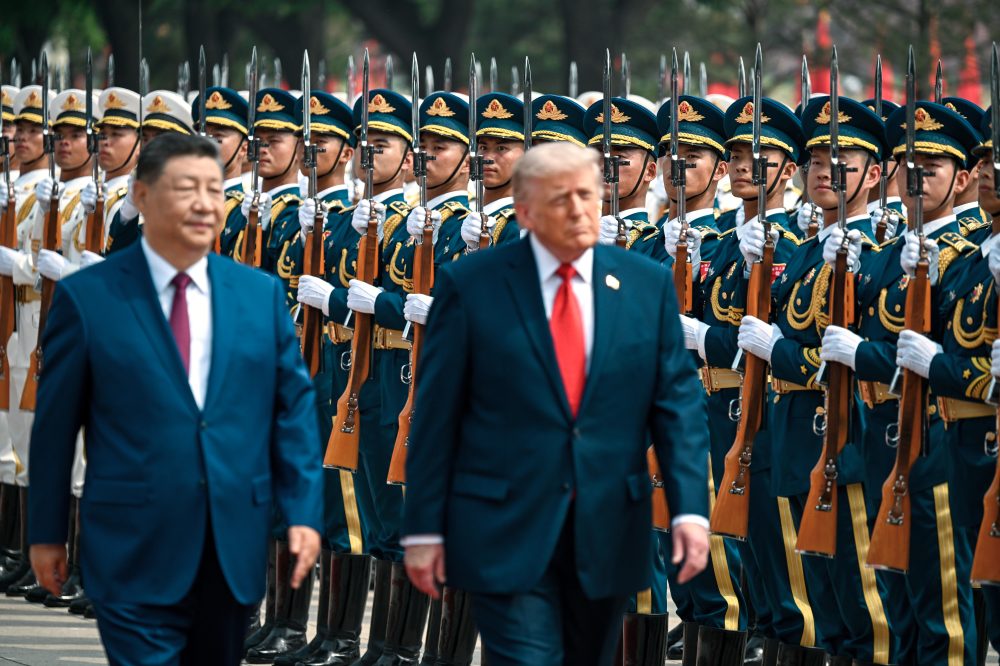

President Trump concluded his Beijing visit on Friday with a final private meeting at Chinese leader Xi Jinping’s official residence before departing for Washington.
The two leaders spent Thursday addressing contentious topics including the Iran conflict, trade relations, technology issues and Taiwan.
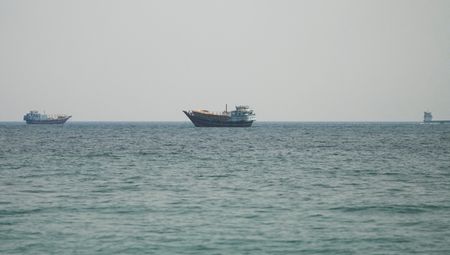
Trump revealed that Xi informed him China is willing to help broker an end to the conflict and reopen the Strait of Hormuz. Since China purchases the most Iranian oil, Trump hopes Xi will leverage this relationship to pressure Iran into accepting U.S. conditions. Trump also mentioned that Xi promised China would not supply Iran with military equipment.
Throughout this visit, Trump has maintained an optimistic view of U.S.-China relations. However, this perspective faces challenges when confronting the most difficult issues between the two nations, including Taiwan, the Iran conflict and trade disputes.
During their summit filled with ceremony and diplomatic courtesy, Xi cautioned Trump that disagreements over Taiwan, a self-governing island that Beijing considers its territory, could lead to U.S.-China confrontations or conflict. Trump approved an $11 billion arms package for Taiwan in December but has not proceeded with delivery. Secretary of State Marco Rubio later warned Thursday that China attempting to seize Taiwan by force would be “a terrible mistake.”
Trump also emphasized trade matters and agreements for China to purchase more agricultural goods and passenger aircraft, establishing a board to resolve their disagreements and prevent another trade war like the one sparked last year following Trump’s tariff increases.
The president’s convoy traveled to Zhongnanhai, the Chinese central leadership complex adjacent to the Forbidden City in Beijing.
The compound’s gardens hosted Trump and Xi for an official photograph commemorating Trump’s visit, followed by a working tea session.
The leaders also planned a private lunch before Trump’s Friday afternoon departure to Washington.
Last year, the Trump administration announced it would begin canceling visas for certain Chinese students, including those connected to the Communist Party or studying in sensitive areas.
When questioned about this policy during a Fox News interview, Trump stated, “I frankly think that it’s good that people come from other countries and they learn our culture, and many of them want to stay here.”
Approximately 270,000 Chinese students attended U.S. colleges and universities during the 2023-2024 academic year, representing nearly a quarter of all international students.
Trump referenced a figure of 500,000 Chinese students in the interview and commented, “if you want to see a university system die, take a half a million people out of it.”
“It’s something I’m always looking at. But it’s a very insulting thing to tell a country, we don’t want your people in our schools,” he explained.
Adjacent to Beijing’s Forbidden City sits a secretive complex surrounding two artificial lakes created for imperial enjoyment.
Zhongnanhai, meaning “middle and southern seas,” represents China’s power center as Chinese President Xi Jinping’s primary residence and central government headquarters.
Zhongnanhai draws comparisons to the White House, the Kremlin or South Korea’s Blue House. However, unlike other presidential residences, Zhongnanhai rarely serves as the primary location for diplomatic visits.
China’s leadership reserves the highly protected grounds exclusively for their closest allies and carefully chosen dignitaries.
Russian President Vladimir Putin, whom Xi has described as his closest friend, visited Zhongnanhai at least twice, in 2024 and 2025.
Xi also invited former U.S. President Barack Obama to Zhongnanhai in 2014, where the two leaders enjoyed an evening walk and dinner.
Elon Musk’s 6-year-old son appeared Thursday at the Great Hall of the People wearing Chinese-style clothing and carrying a tiger bag that became an internet sensation in China.
The small, tiger-head crossbody bag comes from artisanal brand YASTEE, which collaborates with embroiderers in southern China to create handcrafted items.
According to local media, a bag similar to the one Musk’s son wore requires several days to make and decorate by hand.
The bag became viral on Chinese social media and sold out within hours on the company’s online platforms.
In his interview with Sean Hannity of Fox News, the president said he invited them to join his meeting with Xi at the Great Hall of the People despite their participation not being planned.
Trump explained the American business executives were in the building “and I said I think I can get them in five minutes.”
Trump declined to identify which executives participated but said they introduced themselves and spoke briefly, appearing to impress Xi. He noted most had never met the Chinese president.
“He actually said that was very good. That was a good idea,” Trump said regarding Xi’s reaction.
Trump, whose delegation included the CEOs of Mastercard and Visa, said he also discussed with Xi expanding U.S. credit card companies’ access to the Chinese market.
“I said, ‘What about using Visa in China?’” Trump mentioned in his Fox News interview. “For some reason they were blackballed and maybe that’ll come off.”
China permits foreign cards to connect with instant payment apps like Alipay and WeChat Pay. However, physical card usage remains limited primarily to international hotels, luxury shopping centers, and select upscale restaurants.
Visa and Mastercard have long sought greater access to Chinese consumers and businesses in the world’s second-largest economy.
Trump inquired about releasing Jimmy Lai, the 78-year-old former newspaper publisher and pro-democracy activist serving a 20-year sentence in Hong Kong, during his meeting with Xi, Secretary of State Marco Rubio revealed in an NBC News interview Thursday.
“We would like to see him released. We would be open to any arrangement that would work for them, as long as he’s given his freedom,” Rubio stated.
Lai published Apple Daily, a tabloid that criticized Chinese and Hong Kong government officials.
“He’s all business,” Trump told Sean Hannity of Fox News in a recorded interview following Thursday’s meeting with the Chinese leader. “There’s no games. There’s no talking about how nice the weather is.”
Trump described Xi as “a very smart person” and said they maintain “a good relationship.”
“He’s all about China,” Trump observed.
The president suggested during the Fox News interview that Iranian officials initially “said very strongly” that the U.S. could send teams to collect hundreds of pounds of enriched uranium believed buried beneath nuclear sites severely damaged by U.S. military strikes last year.
However, he said Iran later withdrew from the agreement.
“They agreed to it. They take it back. They agree, you know it’s back and forth,” he explained.
Iran’s willingness to surrender enriched uranium represents a crucial point in negotiations to end the conflict.
Trump has consistently maintained Tehran is prepared to do so, but Iran has largely dismissed such claims.
Trump added during the interview that Iran claims only the U.S. and China possess sufficient technology to extract the enriched uranium, given its deep underground location.
Trump and Xi planned additional discussions Friday.
They scheduled time together at Xi’s official Beijing residence before Trump returns to Washington.
Secretary of State Marco Rubio told NBC that “there’s going to be some agricultural purchases” resulting from this visit.
U.S. soybean farmers suffered significant losses during Trump’s trade war with China and have pressed him to convince Beijing to increase purchases of their crops.
China is expected to meet its commitment to buy 12 million metric tons (13.2 million tons) of U.S. soybeans this year, though this falls well short of the 25 million to 30 million metric tons (27.5 million to 33 million tons) purchased previously.
China, the largest foreign purchaser of U.S. soybeans, completely stopped buying them last year after Trump raised tariffs on all Chinese products. Following Trump’s October meeting with Xi, the White House announced China agreed to purchase 12 million metric tons.
The American Soybean Association hopes Trump can negotiate an agreement for an additional 8 million metric tons (8.8 million tons) by August 31.