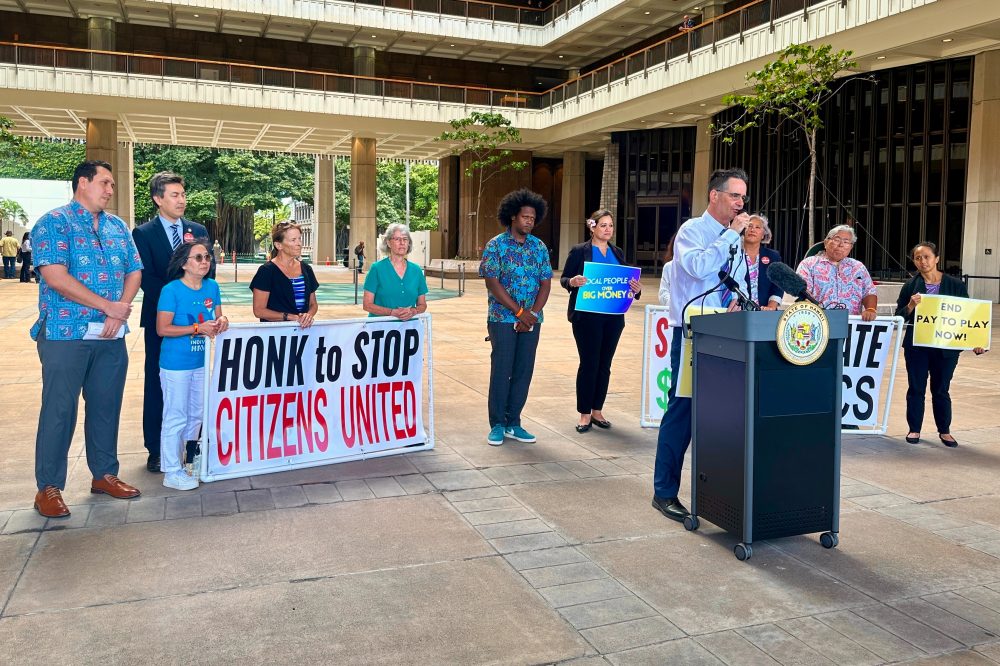

HONOLULU (AP) — Hawaii’s Democratic governor enacted groundbreaking legislation Thursday designed to curtail corporate political influence and anonymous “dark money” organizations that have poured unlimited funds into elections following a landmark 2010 Supreme Court decision.
The legislation, set to become effective July 1, 2027, changes how corporations are classified to prevent their involvement in election spending. Meanwhile, volunteers in Montana are collecting petition signatures to potentially place a comparable measure before voters this November.
The Supreme Court’s decision in Citizens United v. Federal Election Commission eliminated restrictions on corporate and union political expenditures, provided they avoid direct campaign contributions. The case originated when Citizens United, a conservative organization, sought to air television advertisements for its anti-Hillary Clinton documentary during her 2008 presidential campaign.
Both major political parties have benefited from this decision. According to campaign finance monitoring organization OpenSecrets, outside political spending in 2024 federal elections exceeded $4 billion — nearly twelve times the amount spent in 2008.
A portion of these funds originated from dark money organizations that face no donor disclosure requirements, with the Brennan Center for Justice recording an unprecedented $1.9 billion in such spending during 2024. This type of funding has also influenced various state-level contests.
Hawaii Attorney General Anne Lopez’s office, led by the Democratic official, expressed opposition to the state’s new measure, contending it would prove challenging and expensive to defend through litigation.
“Hawaii is taking a brave and bold step to get corporate and dark money out of America’s politics,” stated Tom Moore, senior fellow at the Center for American Progress, the organization that developed the legal framework underlying the legislation. “It will send a powerful message that will be heard loud and clear across the Pacific and across the mainland.”