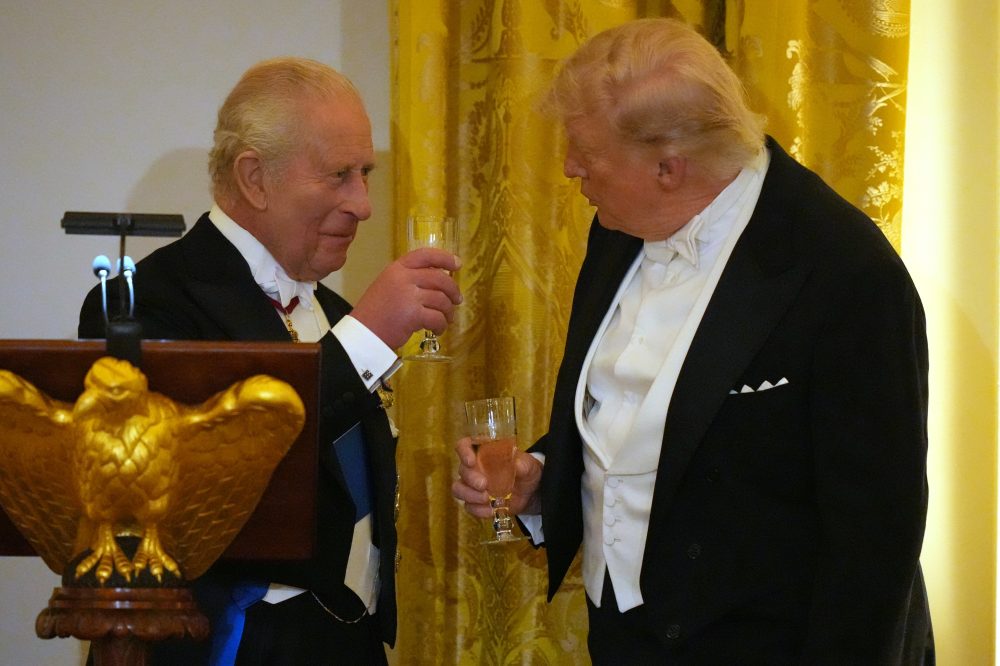

LONDON (AP) — When it comes to diplomatic missteps, this one wasn’t the worst imaginable.
During Tuesday evening’s state dinner celebrating King Charles III and Queen Camilla’s visit, President Donald Trump broke established protocol by sharing details from a confidential discussion he’d had with the British king earlier that day. Trump revealed that Charles had expressed agreement with his stance that Iran must never obtain nuclear weapons.
“We’re doing a little Middle East work right now … and we’re doing very well,” Trump addressed the dinner guests. “We have militarily defeated that particular opponent, and we’re never going to let that opponent ever — Charles agrees with me, even more than I do — we’re never going to let that opponent have a nuclear weapon.”
Although Trump’s position on Iran likely resonates with many British citizens, his public disclosure created unease among political observers in the United Kingdom.
Such behavior simply violates British customs.
Traditional protocol dictates that private discussions with the monarch should remain confidential. This rule exists both to keep the king removed from political controversies and because the sovereign cannot publicly defend himself or clarify statements if misrepresented.
“Generally, as a matter of protocol, I think I would expect discussions between heads of state to be sort of behind the scenes, in those closed meetings, for those to be sort of kept private,” said Craig Prescott, an expert on constitutional law and the monarchy at Royal Holloway, University of London. “And, you know, this was something that the U.K. government wanted to avoid.”
Considerable anxiety preceded the king’s American visit, particularly given Trump’s open displeasure with U.K. Prime Minister Keir Starmer for not backing U.S. military actions in the Iran conflict.
This royal visit, like others, represents a meticulously planned diplomatic mission undertaken at the British government’s behest, with hopes that positive relations between Charles and Trump — who appears fascinated by royal traditions — might help mend strained ties.
However, Trump’s unconventional leadership style and tendency to disregard established norms raised questions about potential inappropriate remarks or actions.
Fortunately, the king’s reported views appeared consistent with current U.K. governmental policy.
“The King is naturally mindful of his government’s long-standing and well-known position on the prevention of nuclear proliferation,” Buckingham Palace stated, providing context for the president’s comments.
Prescott noted that “in a sense, this was always the issue, just what Trump would do or say — would he put the king in an embarrassing position.”
“You always had that sort of issue of what he would post on social media,” he continued. “And I think, you know, this could have been much, much worse.”
Earlier, Charles addressed a joint Congressional session before the state dinner. The monarch received multiple standing ovations during his remarks, which honored enduring U.S.-British relationships while acknowledging disagreements on NATO, Ukraine support, and climate action.
From the British government’s perspective, the visit now moves to less risky territory as the royal couple departs Washington for New York, where they’ll focus on the city’s creative sectors rather than political matters.
The visit’s most challenging phase may have concluded, Prescott suggested.
“If this is the only controversy arising out of this phase of the state visit, I think overall this has been an enormous success for the king and the British government, because the king was able to make some quite pointed remarks in Congress and it hasn’t really yielded any sort of negative reaction from the president.”
“In a sense,” he added, “you get the feeling that the king (has) rather charmed Washington with his speech to Congress and, you know, his very witty speech at the state banquet.”