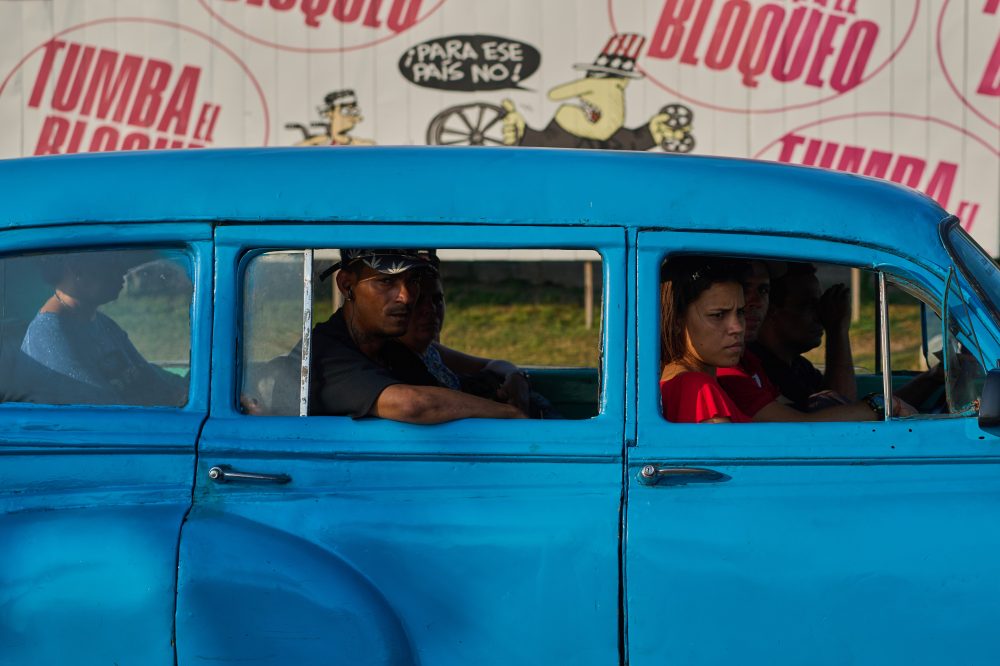

HAVANA — Cuban citizens gathered around tables throughout the island nation this month to participate in their government’s petition drive aimed at defending national independence while challenging the United States amid growing diplomatic friction.
Citizens 16 years and older have been participating in the ‘My signature for the Homeland’ initiative that President Miguel Díaz-Canel introduced in recent weeks.
While critics of the government-sponsored effort question why residents would wait in lines to sign petitions when food shortages and economic hardship continue spreading throughout Cuba, advocates describe the campaign as a message to Washington that ordinary Cubans desire peace but refuse to surrender in the face of recent invasion rhetoric.
‘Anything for the revolution,’ stated Rodolfo Ruiz, 64, who operates a small business selling sunglasses and various goods from his Havana residence. He explained that he participated in the signing last week due to President Donald Trump’s continued statements about Cuba, ‘so that he may hear and know that we are willing to defend our sovereignty.’
‘Watch out, Trump. Think before you invade Cuba, think carefully. The people are prepared,’ Ruiz said.
This past January, Trump issued an executive directive declaring that the ‘policies, practices, and actions of the Government of Cuba constitute an unusual and extraordinary threat,’ a characterization that Cuban leadership has consistently dismissed.
Trump has described the Caribbean nation as a ‘failing nation’ and mentioned the possibility of a ‘friendly takeover.’
‘We may stop by Cuba after we’re finished with this,’ he said in mid-April, referring to the war in Iran.
At the same time, U.S. Secretary of State Marco Rubio — whose parents were Cuban immigrants who departed before the revolution — has advocated for ‘new people in charge’ of Cuba.
‘It is absurd for the State Department to claim that Cuba — a relatively small, developing country subjected to a brutal economic war — could pose a threat to the world’s greatest military, technological, and economic power,’ Cuban Foreign Affairs Minister Bruno Rodríguez wrote in a post on X on Wednesday.
Díaz-Canel has expressed his opposition to military conflict but emphasized that Cuba must prepare to prevent such action, and if required, overcome it.
Havana resident Delfina Hernández declared she would unite with fellow Cubans to resist a U.S. energy embargo, an intensification of existing American sanctions and what many describe as the ‘imperialist threat.’
During three days last week, the community facility she operates in Havana with her spouse received signature forms and welcomed residents who wanted to sign them. Hernández signed first.
‘Cuba is something very sacred to us,’ she said. ‘We are well-armed, and the people of Cuba will fight to the very end. We are going to hit them — and with everything we’ve got.’
However, social media backlash emerged quickly, with campaign opponents arguing that the ‘homeland’ has failed to provide for their needs. Some suggested the government should permit citizens to sign petitions supporting democratic choices like selecting their president.
The patriotic initiative launched on April 19 and coincides with Cuba’s commemoration of the 65th anniversary of its April 1961 Bay of Pigs triumph over approximately 1,500 Cuban exiles supported by the CIA who unsuccessfully attempted to topple Fidel Castro’s newly established Communist administration.
Alberto Olivera, a visual artist and Hernández’s spouse, wondered how Cuba could threaten the U.S.
‘If it’s a failed revolution, then leave us alone,’ he said. ‘What do they care?’ Hernández added.
Olivera acknowledged that Cubans face unaddressed challenges, noting that he has experienced hunger personally, but maintained that the ‘pressure cooker’ strategy by the U.S. would prove unsuccessful.
‘If I’m a failed state, why are you seeking me out?’ he asked.
The Trump administration has insisted that Cuba free political detainees, enact significant economic changes and alter its governing structure — demands Cuba has refused, stating its willingness to engage in dialogue and cooperation in specific areas while advocating for ending a U.S. energy embargo that has worsened the island’s difficulties.
Both nations have acknowledged recent discussions, though specifics remain confidential.
While diplomatic tensions continue, Cuba’s administration is collecting signatures at employment sites and communities throughout the island of approximately 10 million residents, keeping quiet about the total number gathered.
Officials stated in a release that the signatures aim to denounce ‘the U.S. blockade and economic war against Cuba,’ which they labeled a ‘genocidal act,’ and to reject military aggression threats while defending ‘the inalienable right of Cubans to live in peace.’