
BEIJING (AP) — President Donald Trump began Thursday’s activities marking the most intensive phase of his China visit, engaging in a summit anticipated to showcase elaborate ceremonies and symbolic gestures while offering limited prospects for significant advances on critical matters including trade disputes, U.S.-Taiwan relations, or the conflict in Iran.
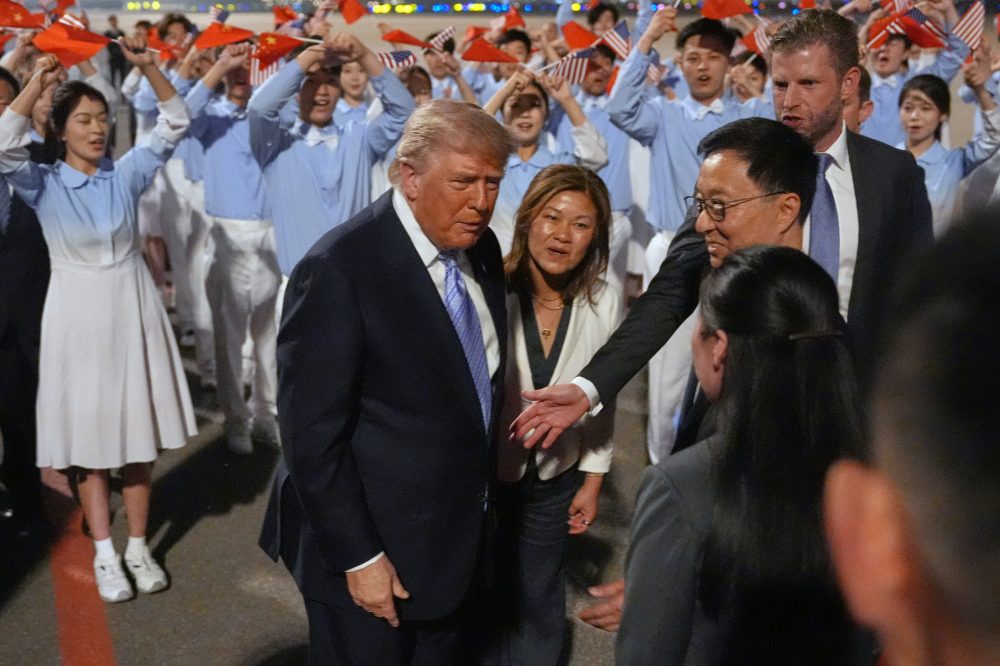
Trump’s arrival Wednesday evening featured an ornate welcoming ceremony, with his convoy passing beneath numerous American and Chinese flags while skyscrapers displayed illuminated Chinese text proclaiming “Beijing Welcome.” Following the reception, the Republican leader proceeded to his accommodations without scheduled public appearances.
Chinese leader Xi Jinping was scheduled to conduct meetings with Trump Thursday at the Great Hall of the People, which serves as a legislative headquarters for the communist administration and hosts significant cultural and social gatherings on Tiananmen Square’s western edge.
Their bilateral discussions will precede Trump’s visit to the Temple of Heaven — a 15th-century religious site representing the connection between celestial and earthly realms. Both leaders will participate in a formal state dinner.
Friday’s agenda includes planned working sessions over tea and lunch between Trump and Xi.
White House representatives have maintained that Trump’s journey aims to achieve tangible outcomes, indicating potential announcements regarding trade matters, possibly including Chinese agreements to purchase American soybeans, beef, and aircraft. Administration officials also seek to establish a Board of Trade with China for addressing commercial disputes between the nations.
However, both governments have not provided specific details about potential outcomes from the three-day diplomatic mission, particularly as Beijing’s strong economic connections to Iran may create complications.
The president’s Beijing visit occurs while Iran continues influencing his domestic priorities and raising concerns about potential U.S. economic weakness during the election period preceding November’s midterm elections — where Republicans aim to retain Congressional control.
The U.S. and Israel’s conflict with Iran has resulted in the practical shutdown of the Strait of Hormuz, leaving oil and natural gas vessels stranded and causing energy costs to surge, threatening worldwide economic stability.
Extended time with Xi — particularly amid spectacular settings — will provide substantial opportunity for Trump to address multiple challenging subjects. These encompass Iran and trade issues, along with Taiwan and potential three-nation nuclear weapons agreements involving Washington, Beijing, and Russia.
Nevertheless, advancement beyond diplomatic courtesies — and extensive mutual praise between Trump and Xi, who have publicly exchanged effusive compliments for years — may prove difficult to achieve.
“Neither side will make much progress on the two major foreign policy issues,” predicted Jim Lewis, a tech policy fellow at the Center for European Policy Analysis. “Trump will press the Chinese to help him on Iran. They’ll be unwilling. The Chinese will press Trump to make concessions on Taiwan. We’ll see what we get out of that.”
In Washington, war politics became more complex Wednesday when Senate Republicans again prevented Democratic legislation aimed at ending Iranian hostilities — though Alaska Republican Sen. Lisa Murkowski opposed her party, becoming the third Republican senator voting against continuing the conflict.
China purchases the most Iranian oil globally, yet Trump has minimized suggestions that he will pressure Xi to increase efforts against Iran regarding strait reopening — despite White House officials indicating he will privately advocate this position to China’s leader.
The president also states that U.S. economic pressures will not weaken American negotiating positions with Iran during the current fragile ceasefire. When asked while departing the White House whether ordinary Americans’ financial stability influences Iranian negotiations, Trump replied, “Not even a little bit.”
“I don’t think about Americans’ financial situation. I think about one thing: We cannot let Iran have a nuclear weapon,” Trump stated, suggesting that “every American understands” this stance.
The administration has struggled maintaining consistent messaging regarding inflation and warfare.
Vice President JD Vance emphasized at Wednesday’s news conference that Trump remained “laser focused” on inflation while disputing Trump’s statements that U.S. economic concerns were irrelevant to war resolution.
“Well, I don’t think the president said that,” Vance responded when questioned about the remarks. “I think that’s a misrepresentation of what the president said.”
Taiwan’s situation remains prominent, given China’s displeasure with U.S. weapons sales to the self-governing island that Chinese authorities consider part of their territory.
The Trump administration approved an $11 billion weapons package for Taiwan while delaying delivery. Trump has also shown increased uncertainty regarding Taiwan — raising questions about potential reduced support for the island democracy.
Taiwan leads global chip manufacturing, creating components vital for artificial intelligence development. Trump has pursued trade agreements with Taiwan to encourage domestic chip production.
Trump personally contacted Nvidia’s Jensen Huang, inviting him aboard Air Force One during an Alaska refueling stop en route to Beijing — joining numerous CEOs from technology, defense, finance, and agriculture sectors in the delegation. Additional officials include Secretary of State Marco Rubio, Treasury Secretary Scott Bessent, Defense Secretary Pete Hegseth, along with Trump’s son Eric and daughter-in-law Lara Trump.
Elon Musk, the SpaceX leader who previously directed Trump’s federal workforce reduction efforts, also traveled to China.
The U.S. and China established a trade agreement last year that reduced mutual tariff threats. White House sources report ongoing discussions and shared interest in extending this arrangement, though announcement timing during Trump’s visit remains uncertain.
Trump indicated he will request Xi provide American companies increased Chinese market access, encouraging his counterpart to “‘open up’ China so that these brilliant people can work their magic.” He also seeks extending agreements allowing continued Chinese rare earth mineral exports to the U.S., encouraging China to avoid limiting global supplies in response to Trump’s threatened tariffs.
Senior American officials have stated Trump will propose U.S., China, and Russia signing agreements limiting each nation’s nuclear weapon stockpiles — a concept Beijing has previously questioned.