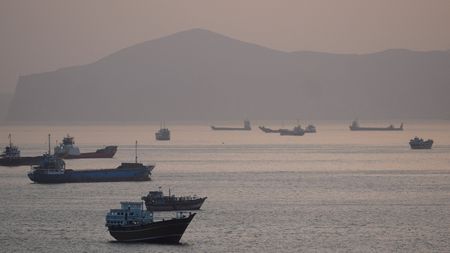

President Donald Trump announced Monday that the United States will launch a military operation to escort commercial ships safely through the Strait of Hormuz, where hundreds of vessels and thousands of crew members have been trapped for more than two months during the ongoing U.S.-Israeli conflict with Iran.
The announcement came on the same day that maritime security officials reported another tanker was struck by unidentified projectiles in the strategic waterway, though all crew members were reported safe from the incident that occurred 78 nautical miles north of Fujairah in the United Arab Emirates.
Trump offered limited details about the rescue mission, which he said would begin immediately to assist ships and their crews who have been “locked up” in the crucial shipping lane and are running short on food and essential supplies.
“We have told these Countries that we will guide their Ships safely out of these restricted Waterways, so that they can freely and ably get on with their business,” Trump wrote on his Truth Social platform.
According to the International Maritime Organization, hundreds of vessels and approximately 20,000 seafarers have been unable to pass through the strait during the conflict.
U.S. Central Command announced it will deploy 15,000 American military personnel, more than 100 aircraft operating from land and sea bases, along with naval vessels and unmanned aircraft to support the mission. The operation seeks to “restore freedom of navigation for commercial shipping” through the strait, CENTCOM officials stated.
“Our support for this defensive mission is essential to regional security and the global economy as we also maintain the naval blockade,” said Admiral Brad Cooper, the CENTCOM commander.
Iran has effectively shut down nearly all shipping traffic through the Gulf except for its own vessels for more than two months, causing energy prices to surge worldwide. Several ships attempting to navigate the Strait have reported coming under fire, while Iran has seized multiple other vessels. Last month, the United States implemented its own blockade preventing ships from leaving Iranian ports.
The Trump administration has been working to build an international coalition with other nations to protect shipping in the strait. CENTCOM described the latest initiative as combining “diplomatic action with military coordination.”
Officials did not immediately clarify which nations the U.S. operation would assist or provide specific details about how the mission would function. The White House did not respond to requests for additional information.
Trump warned that any attempts to interfere with the U.S. operation would “have to be dealt with forcefully.”
Meanwhile, diplomatic efforts continue as Iran announced Sunday it had received an American response to its latest peace proposal, one day after Trump indicated he would likely reject the Iranian offer because “they have not paid a big enough price.”
When questioned by reporters Sunday evening, Trump said negotiations were proceeding “very well” but declined to provide further details.
Iranian state media reported that Washington delivered its response to Iran’s 14-point proposal through Pakistan, and that Tehran is currently reviewing the American position. Neither Washington nor Islamabad immediately confirmed the response.
“At this stage, we do not have nuclear negotiations,” Iranian Foreign Ministry spokesperson Esmaeil Baghaei was quoted as saying by state media, apparently referring to Iran’s proposal to postpone nuclear discussions until after the war ends and both sides agree to lift their respective shipping blockades.
On Saturday, Trump stated he had not yet examined the specific language of Iran’s peace proposal but was inclined to reject it.
The United States and Israel paused their bombing campaign against Iran four weeks ago, and American and Iranian officials conducted one round of discussions. However, efforts to arrange additional meetings have been unsuccessful so far.
Iran’s proposal to defer nuclear talks until a later phase appears to conflict with Washington’s consistent demand that Iran accept strict limitations on its nuclear program before the war can conclude.
Washington is demanding that Tehran surrender its stockpile of more than 400 kilograms (900 pounds) of highly enriched uranium, which the United States claims could be used to manufacture a nuclear weapon. Iran maintains its nuclear program is for peaceful purposes but has expressed willingness to discuss certain restrictions in exchange for sanctions relief. Iran had previously agreed to such limitations in a 2015 agreement that Trump withdrew from.
While Trump has repeatedly stated he is not rushing toward a resolution, he faces domestic political pressure to end Iran’s control over the Strait of Hormuz, which has blocked 20% of global oil and gas supplies and driven up U.S. gasoline prices. Trump’s Republican Party risks voter backlash over rising prices in November’s midterm congressional elections.
According to Iranian media, Tehran’s 14-point proposal includes removing U.S. forces from surrounding regions, ending the blockade, releasing frozen assets, providing compensation, lifting sanctions, concluding the war on all fronts including Lebanon, and establishing a new oversight mechanism for the strait.