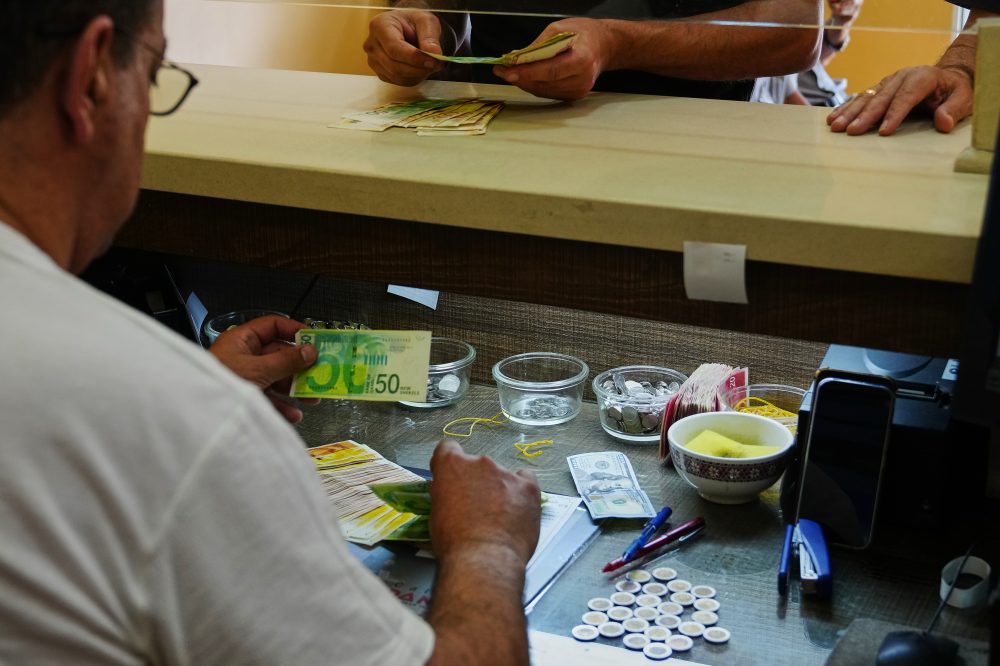

RAMALLAH, West Bank (AP) — Imagine pulling up to a gas station, reaching for your wallet, and being told the attendant won’t accept your cash — not because there’s a problem with your money, but because the station’s bank has literally run out of room to store it.
That scenario is playing out across the Israeli-occupied West Bank, where Palestinian banks have accumulated far more Israeli shekels than they can handle. Rather than a shortage of money, the territory is facing the opposite problem: a massive cash surplus that is grinding commerce to a halt.
At the center of the crisis is a standoff between the Bank of Israel and the Palestinian Monetary Authority, which regulates Palestinian financial institutions. Israel places a ceiling on how much physical currency it will accept back from the West Bank’s banking system. Palestinian officials argue that limit hasn’t kept up with economic growth and is being used as a tool to keep the territory in a perpetual state of financial distress.
Mohammad Manasra, the deputy governor of the Palestinian Monetary Authority, told the Associated Press that the situation has left financial institutions without the ability to function normally. “The banks have been shackled” in their ability to deal with the crisis, he said. “What is being practiced in the West Bank is economic warfare.”
In a typical economy, a central bank accepts physical currency from commercial banks and credits them electronically, allowing those banks to process payments, make loans, and handle customer transfers. But the West Bank operates under a different set of rules. Palestinians have no authority over monetary policy governing the shekel, and the territory has depended on Israeli financial systems for decades under agreements reached in the 1990s.
More shekels flow into the West Bank than can flow out. Workers employed by Israeli businesses and settlements are paid in cash. Palestinian citizens of Israel frequently cross into the West Bank to buy goods like cigarettes and fuel, bringing even more currency with them. That money piles up inside Palestinian banks, where it sits idle — earning no interest and unable to be converted into loans, investments, or electronic payments.
Israel’s current cap allows the West Bank banking system to return 18 billion shekels — roughly $5.9 billion — per year to the Bank of Israel. But banks are now taking in an estimated 30 billion shekels annually, according to Moayad Afaneh, an economist who has advised the Palestinian Authority.
Israeli officials have previously cited concerns about money laundering, tax evasion, and terrorism as reasons for limiting how much cash they accept back. The Bank of Israel said in a statement that it follows the current government’s policy on shekel transfers, and noted that fewer Palestinians have worked in Israel since the Gaza war began, which has reduced the flow of cash into the West Bank.
The office of Israeli Finance Minister Bezalel Smotrich did not respond to requests for comment, but in September 2025, Smotrich threatened to use “all of the tools” at his disposal to block the formation of a Palestinian state, including what he described as “economic strangulation.”
Since Hamas-led militants launched their attack in October 2023, triggering the war in Gaza, Israel has enacted a series of measures that have weakened the West Bank economy. Most work permits for Palestinians employed in Israel were revoked, eliminating a key income source. Tax and customs revenues collected on behalf of the Palestinian Authority have been withheld, leaving the Authority unable to fully pay public sector workers — including teachers and hospital employees — for more than a year.
As vault space runs short, banks are paying to store and insure cash they cannot move. They have begun turning away deposits from businesses and households, which are then left scrambling to safely store their own money. Fears of looting during Israeli military raids — which have become more frequent — have pushed more Palestinians to deposit cash in banks to protect it from potential confiscation, worsening the bottleneck, Afaneh said.
Manasra said the cash overflow is “directly affecting the government’s ability and the private sector’s capacity to continue providing services to major industrial sectors and the Palestinian people.” He pointed out that most of the West Bank’s fuel and electricity comes from Israel or Israeli utilities, and when banks are overloaded with physical cash, they lack the electronic funds needed to process those essential payments.
A 2022 International Monetary Fund study found that excess cash had cut Palestinian banks’ profits by roughly 20%. Afaneh said that figure is likely considerably higher today.
Inside the Ramallah offices of the Al-Huda Group — a company that runs filling stations, convenience stores, grocery outlets, home improvement shops, car washes, and other businesses — clerks feed banknotes through counting machines that stack the bills into neat bundles. The company takes in tens of millions of shekels each month.
Hussni Jaber, the executive manager of Al-Huda Group, said the inability to deposit that cash has made routine business operations more complicated and costly. Some businesses have resorted to taking out loans or purchasing foreign currencies just to make electronic payments to suppliers, all while spending more to securely store their excess cash on-site.
When suppliers go unpaid, some gas stations are forced to stop pumping fuel altogether. The Palestinian Authority referenced the issue when gas stations temporarily closed on a recent Saturday. Last month, gas station owners — including the 22 locations operated by Al-Huda — staged a coordinated 30-minute strike across the West Bank to draw attention to the crisis. So far, it has produced little response.
Jaber warned that if the problem isn’t resolved, West Bank businesses will eventually lose the ability to import fuel, food, and medical supplies from Israel and other countries. “All sectors will collapse if the cash problem is not resolved,” he said.