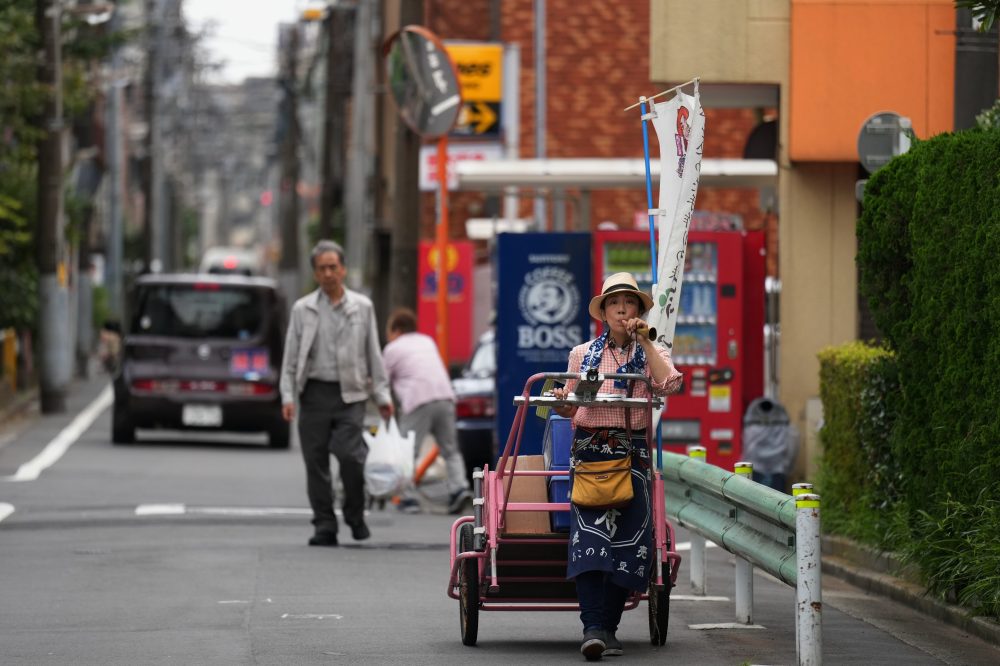

TOKYO (AP) — Three times a week, Akiko Sugaya pushes a pink cart through the narrow, winding streets of eastern Tokyo, tooting a small brass bugle and wearing a straw hat as she hawks tofu — the protein-packed soybean staple beloved across much of Asia.
But selling soybean curd in its many forms is only part of what drives her. For Sugaya, this is something far greater than a job. It’s a calling.
Beyond being a purveyor of nutritious food, she functions as an informal community watchdog, keeping an eye on the elderly residents she visits along her route through Tokyo’s Ojima neighborhood — a mostly residential area of modest homes interspersed with stretches of larger apartment buildings.
She knows her customers’ routines the way a family member might, and they know hers. Over the years, she has lost several elderly regulars who passed away alone — a growing reality in Japan, which ranks among the countries with the oldest populations on earth.
“More than once I was the first one to find their bodies,” Sugaya said, speaking from a small shop she also operates on a busy commercial street in the neighborhood.
She explained that access is rarely a barrier in the area. “In an area like this, some people just leave their doors unlocked,” she said. “Or I can get access by asking the landlords.”
In smaller homes along the street, warning signs are easy to spot — newspapers piling up outside or laundry left unattended. Larger apartment complexes, however, make it much harder to notice when something might be wrong.
Sugaya has been making her rounds for 23 years, and the work has given her as much as she’s given her customers. She says she was bullied growing up and lost several jobs before discovering that delivering quality food could feed her own sense of purpose as much as it nourished others.
“Selling tofu on a cart made me think I am OK to be myself,” she said. “I used to be repeatedly put down, but through cart-selling I built up my self-esteem.”
“I was still nervous with women around my age,” she added. “But I felt safe when surrounded by the elderly whose smiles are warm and kind.”
One of her regular visitors is Shinji Saito, who stops by her shop every day. Saito, who has epilepsy, describes Sugaya’s welcoming nature as “magical.”
She also represents a fading tradition. There was a time when vendors routinely walked neighborhood streets offering ramen, sweet potatoes, vegetables, and other goods. That era has largely given way to delivery apps and smartphone orders.
“Delivery of newspapers or tofu, what used to be part of our daily lives, have been replaced by delivery apps or smart phones,” Sugaya said. “One can easily spend a day without having any verbal conversation with others.”
“When you go to a convenience store, you hit a button on a screen and don’t even say hello to anyone. It leaves you empty,” she added.
Her three-hour afternoon walks take her through a labyrinth of streets where sales are sometimes sparse but conversations are plentiful. One customer comes out to buy tofu and ends up chatting about her mischievous cat and a wild vine growing in the garden. Another reminds Sugaya that her kind of work is becoming a lost art.
Regular customer Toshi Niiyama, who calls Sugaya by her nickname “Ako-chan,” said she purposely holds off buying tofu elsewhere just to wait for her arrival. “Even when I’m in need of tofu, I tell myself I’d better wait for Ako-chan,” Niiyama said. “We used to have someone coming to sell vegetables, but he stopped coming.”
Sugaya has no intention of following suit.
“I go this way on Mondays, that way on Saturdays and that way on Thursdays,” she said. “I go even if it’s raining because my customers expect to see me — or just because they want to have a talk.”