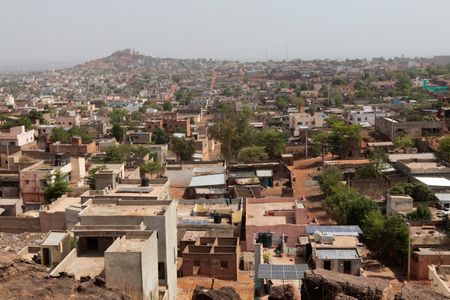

Mali’s military leadership is confronting serious doubts about its ability to maintain control following coordinated insurgent strikes that occurred two days ago, which targeted the primary military installation near the capital and resulted in the death of the defense minister.
The weekend offensive demonstrated what experts and diplomatic sources characterized as extraordinary cooperation between al-Qaeda’s West African branch and a rebel organization led primarily by Tuareg fighters, casting further doubt on the government’s claims of restoring stability.
Here’s an overview of the primary militant organizations operating within this landlocked Sahel region country:
JAMA’AT NUSRAT AL-ISLAM WAL-MUSLIMIN (JNIM)
Born from a Tuareg ethnic rebellion that captured large portions of northern Mali in 2012, the al-Qaeda-linked Jama’at Nusrat al-Islam wal-Muslimin (JNIM) was established in 2017 through the consolidation of multiple extremist organizations.
The organization is commanded by Iyad Ag Ghaly, a Tuareg leader who previously headed the Ansar Dine militant faction that captured Timbuktu in northern Mali during 2012 and established Islamic law there. His second-in-command is Amadou Koufa, a Fulani leader who directs the Macina Liberation Front.
JNIM militants have maintained operations within 50 kilometers (30 miles) of Bamako for almost a year, although experts believe the organization lacks sufficient military strength to actually capture the city and seems more focused on weakening government authority.
This destabilization strategy was evident in a fuel embargo that JNIM declared in September, made feasible after the group moved into southern Mali and expanded western operations. This represents part of JNIM’s broader strategy of surrounding urban areas.
JNIM had previously struck Bamako before Saturday’s joint offensive. In September 2024, the group attacked key locations including the airport and an elite police training facility, where numerous students lost their lives.
In 2022, the organization targeted the military installation in Kati, located 15 kilometers from the capital.
Intelligence estimates suggest the group commands approximately 6,000 fighters. It maintains operations in Burkina Faso and Niger, and took credit for an October attack that killed a soldier in central Nigeria, marking its first confirmed operation in Africa’s most populated nation.
According to analysts, JNIM seeks to establish Islamic rule throughout the Sahel region.
AZAWAD LIBERATION FRONT (FLA)
Mali has confronted ethnic Tuareg uprisings since shortly after achieving independence in 1960.
The nomadic Tuareg people, who inhabit areas across the Sahara including northern Mali, are pursuing an independent territory they call “Azawad.”
In 2012, the National Movement for the Liberation of Azawad (MNLA) conquered the northern territories of Kidal, Gao and Timbuktu, but their movement was subsequently overtaken by Islamic extremist organizations.
Mali subsequently requested French intervention to combat the Islamic militant groups.
Mali negotiated a peace agreement with Tuareg separatists in 2015, but in 2024 the military government, which seized power through coups in 2020 and 2021, abandoned the accord. Relations with Tuareg separatists deteriorated after the government removed French troops and U.N. peacekeepers while partnering with the Russian mercenary group Wagner.
In July 2024, Tuareg forces ambushed a convoy carrying Malian troops and Wagner operatives in the north, asserting they eliminated 84 Russians and 47 Malian soldiers.
Ukraine suggested it had assisted the Tuareg rebels in executing the attack through intelligence sharing, prompting Mali to sever diplomatic relations with Kyiv. Ukraine subsequently denied media claims it was supplying drones to the Tuaregs, and an FLA representative informed Reuters the group had not received outside support for the attack.
The present form of the Tuareg coalition, the Azawad Liberation Front (FLA), was formally established in November 2024.
ISLAMIC STATE IN THE SAHEL PROVINCE (ISSP)
Islamic State in the Sahel Province (ISSP) operates as an Islamic State affiliate and, similar to JNIM, conducts operations in Mali, Burkina Faso and Niger. It separated from Al-Mourabitoun, one of the organizations that currently comprises JNIM, in 2015.
The organization gained global attention through the deaths of four American soldiers, alongside four Nigerien troops, in the Niger community of Tongo Tongo in October 2017.
That event brought examination of the relatively unknown U.S. military deployment in Niger during a period when many Americans questioned U.S. engagement in overseas conflicts and Nigeriens opposed the increasing foreign military presence in their country.
ISSP serves as JNIM’s primary competitor. Fighting between these two organizations starting in 2019 has caused over 2,000 fatalities.
ISSP’s commander, Adnan Abu Walid al-Sahrawi, was eliminated in a French drone operation in August 2021 in northern Mali.
During the previous year, ISSP intensified attacks in western Niger, killing over 127 individuals in five separate operations and demonstrating authorities’ inability to safeguard civilians, according to Human Rights Watch’s September report.
The organization pursues the establishment of an Islamic caliphate across the Sahel and is viewed as less inclined to develop relationships with local populations compared to JNIM.