
ACWORTH, Ga. — Georgia Representative Mike Collins, seeking to challenge Democratic Senator Jon Ossoff this November, proudly describes himself as a champion for President Donald Trump and his “Make America Great Again” agenda.
While this message typically resonates with Republican primary voters, some supporters express reservations before Tuesday’s primary election.
During a recent campaign event, Gary Waldrep, a local party committee chairman, questioned Collins about his strategy to attract “middle-of-the-road” voters who might be alienated by Trump.
This concern highlights Republican worries about their prospects in Georgia, where Democrats have shown electoral success in recent Senate races and Ossoff is no longer viewed as the vulnerable target he once appeared to be.
“I watch the polls just like everybody else,” Waldrep said. “I know it’s going to be close.”
Collins faces competition from Representative Buddy Carter and Derek Dooley, an attorney and former college football coach endorsed by outgoing Georgia Governor Brian Kemp. With Trump remaining neutral in the race, a June 16 runoff appears likely, which would consume additional time and resources before Republicans can concentrate on challenging Ossoff.
Should Ossoff be defeated, Democrats would have virtually no path to a Senate majority. He represents the only Democratic senator seeking reelection in a state Trump captured two years earlier.
While Trump has won Georgia in two of his three presidential campaigns and Republicans maintain control of the Atlanta statehouse, Ossoff and Senator Raphael Warnock have claimed three combined Senate victories over the past six years, each defeating Trump-aligned Republican opponents.
For this election cycle, Kemp declined Senate Republican leadership’s requests to challenge Ossoff and refused to support either Collins or Carter. Instead, he recruited Dooley, a longtime family friend and son of legendary coach Vince Dooley, encouraging Georgia Republicans to consider the newcomer candidate.
“My goal is here is to win our Senate seat back,” Kemp said Friday as he introduced Dooley at a gun store in Douglasville. “We need a political outsider to do that.”
Dooley, 57, stated in a recent interview that minimal policy differences exist among the candidates, “and so electability is everything.” His television advertisements attempt to appeal to both Trump’s base and moderate voters.
“I’m gonna work with President Trump, but for you,” he tells voters in one spot.
Collins, 58, serves his second House term while operating a trucking business and claims to have a “grassroots operation out there pounding the pavement across this state.”
The House member benefits from representing a district east of Atlanta, placing him within the state’s primary media market. He authored the Lakin Riley Act, named for a Georgia nursing student killed by a man also charged for being in the U.S. illegally. Trump signed the legislation last year, requiring immigrants accused of certain crimes to be detained without bond.
“I have proven that I can deliver for the state of Georgia,” Collins said in Acworth. “I can even do it with bipartisan legislation. And I never compromise my conservative values.”
Collins maintains an aggressive social media presence that has enhanced his reputation as a Trump-style provocateur while generating controversy. Among his most disputed posts was sharing a 2024 video showing University of Mississippi students, predominantly white males, harassing a Black woman.
“Ole Miss taking care of business,” Collins wrote.
Carter, serving his sixth term, represents a Savannah-area district in a less populated region of Georgia that rarely serves as a foundation for statewide campaigns. He has reduced advertising spending in recent weeks before the primary, indicating potential financial constraints.
The 68-year-old pharmacist has focused on a House ethics investigation examining whether Collins misused taxpayer funds by employing his former chief of staff’s girlfriend — now his campaign adviser — for work she allegedly never performed.
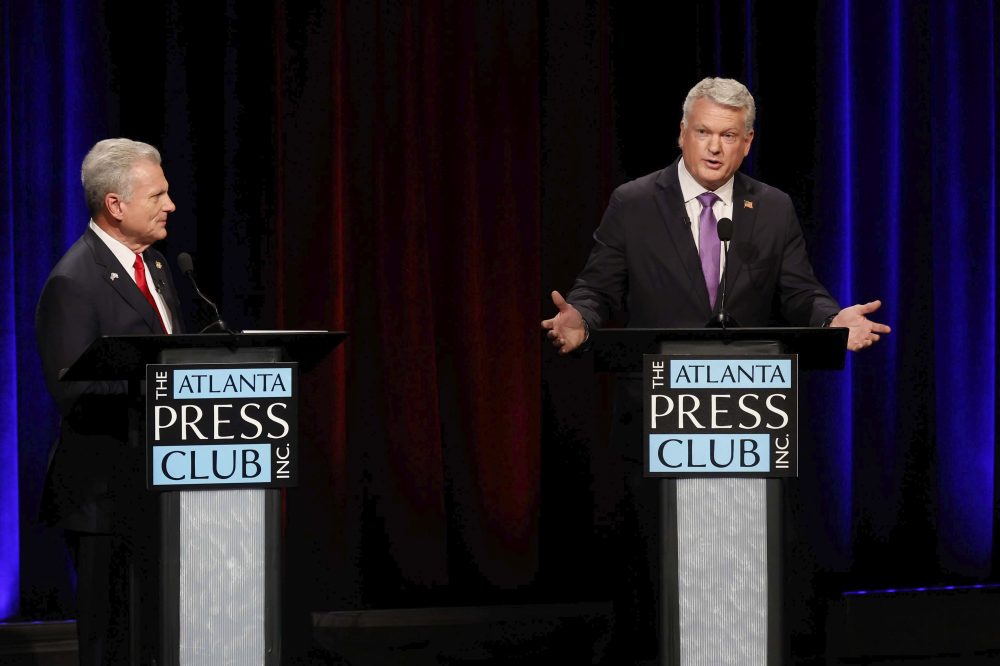
“If taxpayers can’t trust you to properly steward their money, how can they trust you to be a U.S. senator?” Carter asked Collins in a recent debate.
“Buddy,” Collins shot back, “I can tell through the voice that you know how the polling is going out there.”
Meanwhile, Dooley attempts to leapfrog his more seasoned opponents.
“I come from a whole different world than they come from,” he said. “Both of those guys represent everything that I’m running against. I want to change how Washington does its business, and I want people up there for the right reasons.”
Kemp cited several first-term Republican senators who lacked prior elected experience, including Ohio’s Bernie Moreno, Montana’s Tim Sheehy and Pennsylvania’s Dave McCormick.
“If you look around the country where Republicans have been successful beating Democratic incumbents, it has been political outsiders that have been victorious,” Kemp said.
The advantage, Dooley explained, is that “you’ve got to have somebody that’s going to stay on offense” without having a record to defend.
“It comes down to who can beat Jon Ossoff,” he said.
However, Trump has not provided a primary endorsement and Collins has struggled to match Ossoff’s fundraising success. Through April 29, Collins had collected $3 million from donors and contributed $650,000 of his personal funds. Ossoff has raised over $57 million and maintained $31 million in available cash as of April.
This situation has created opportunities for other candidates, with Carter and Dooley hoping to push Collins into a June 16 runoff.