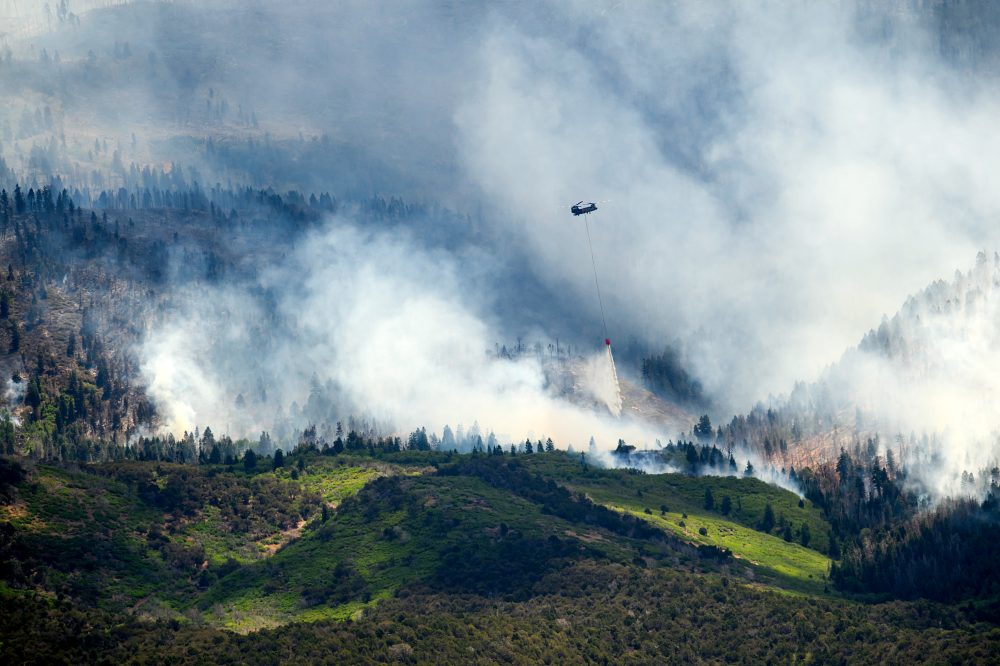

The deaths of three federal firefighters in a Colorado wildfire are shining a harsh light on the Trump administration’s newly created federal fire agency and its decision to revive a long-abandoned policy requiring all wildfires to be put out as fast as possible.
One of the three firefighters who died was employed by the newly formed U.S. Wildland Fire Service — an agency established this year without the typical congressional approval process by pulling personnel from four Interior Department agencies. The fallen firefighters were part of an elite, helicopter-based crew that became trapped on Saturday in a rapidly spreading wildfire near the Utah border while fighting the blaze on the ground.
Authorities report that the group was among five firefighters who attempted to protect themselves by deploying emergency shelters — tent-like devices designed to shield against flames — as the fire overtook their position. Two firefighters survived but were hospitalized with burn injuries.
The merging of thousands of firefighters into a single agency has created confusion among some personnel about their chain of command and job responsibilities, according to former government officials familiar with the situation.
The administration’s push for “full suppression” of all new fires represents a dramatic departure from a trend that had been building over decades — one that recognized fire as a useful land management tool capable of clearing out old vegetation that acts as fuel and reducing the risk of catastrophic blazes fueled by a warming climate.
The policy shift has also proven financially beneficial to private aerial firefighting companies that profit from the faster, more aggressive response to new fires.
Federal officials have not yet disclosed the specific circumstances that led to the firefighters being overrun, including what their mission objective was at the time.
“The question is, why were they attacking that fire in the first place?” said Timothy Ingalsbee, a former federal firefighter and cofounder of the advocacy organization Firefighters United For Safety, Ethics and Ecology. “What was actually at risk? If it was a bunch of shrubs on remote mountaintops, what was the real risk that justified putting those firefighters at risk?”
The fires broke out across the western United States over the past week following months of dry conditions and historically low snowpack in some regions.
Operating under a directive from Interior Secretary Doug Burgum, the Wildland Fire Service is required to pursue full suppression “for every wildfire under its management,” federal officials confirmed in a statement to the Associated Press.
“Any wildfire that represents a threat to life, property, infrastructure or the environment should be extinguished as quickly as possible,” the statement read. “Our experienced fire managers retain the authority to select the safest and most effective tactics based on conditions on the ground.”
Critics, however, argue the administration is attempting to fix a system that was already working. The four agencies from which the new fire service drew its personnel — the Bureau of Land Management, Fish and Wildlife Service, Bureau of Indian Affairs, and National Park Service — had a track record of successfully extinguishing 98% of the fires they managed.
Steve Ellis, who retired as a deputy director of the Bureau of Land Management and now chairs the National Association of Forest Service Retirees, said the new agency and its policy will not solve the problem of catastrophic wildfires driven by dense forests, growing populations in fire-prone areas, and extreme weather tied to climate change.
“Severing forest management and forest managers from fire suppression will make firefighting less safe and put communities at greater risk,” Ellis said.
The other two firefighters killed in Colorado were employed by the Department of Agriculture’s Forest Service, which manages the majority of wildfires across the country and is also operating under a full suppression directive. The Trump administration had originally sought to bring Forest Service firefighters into the new consolidated agency, but Congress blocked that portion of the plan.
Under the current administration, federal officials have been deploying aircraft to fire scenes more rapidly after ignition, according to Austin Moeller, a senior aerospace analyst with Canaccord Genuity Group, an investment firm.
“Anyone that has an air tanker benefits from this more aggressive contracting activity,” Moeller said.
One company that stands to gain significantly is Bridger Aerospace, a Montana-based aerial firefighting firm founded by U.S. Sen. Tim Sheehy. Before winning his Senate seat in 2024, Sheehy had hired lobbyists in an unsuccessful effort to get the Montana Legislature to establish a statewide fire service similar to the one now created at the federal level. Within a month of taking office, he introduced legislation to formally codify the consolidation of federal firefighters into a single agency.
Sheehy’s spokesman, Tate Mitchell, said the senator stepped away from his company during the 2024 campaign and placed his Bridger assets into a blind trust. Mitchell also said that while the idea for the new fire agency originated with President Trump, Sheehy supports it.
“One of Senator Sheehy’s top priorities in the Senate is using his experience to stop the catastrophic fires destroying American communities and he won’t apologize for it,” Mitchell said.
Bridger describes itself as one of the country’s leading aerial firefighting companies. Its CEO, Sam Davis, has said the company’s fleet of Super Scooper aircraft, surveillance planes, and fire observation technology make it “uniquely positioned” to benefit from the renewed emphasis on aggressive fire suppression.
The new full suppression policy is reminiscent of a 1935 rule known as the “10 a.m. rule,” which required fire agencies to extinguish all new fires by 10 a.m. the following day. Michael Dudley, a retired director of fire, aviation and air management at the Forest Service, said that old approach is largely responsible for the overgrown forests seen today.
Wildfires naturally clear out dead and small vegetation, Dudley explained. But as agencies became increasingly effective at putting fires out, forests continued to grow denser with accumulated fuel — meaning that when fires do break out now, they have far more material to burn and are much harder to control.
Scientists who study wildfire behavior say the goal of stopping every fire is simply unrealistic. Some of the most destructive recent blazes spread too quickly, burned in too-remote locations, or started from multiple ignition points simultaneously — making full suppression impossible.
“The narrative that if we just try harder, we’re gonna make these fires go away isn’t true,” said David Calkin, a former Forest Service wildfire researcher. “The fire paradox is not beatable: The more you make fire go away, the more fuel accumulates. The more fuel accumulates, the harder it is to make fires go away.”
Firefighters within the consolidated agency are now working under Wildland Fire Service Chief Brian Fennessy, who previously served as chief of California’s Orange County Fire Authority since 2018. Dudley noted that the reorganization has left many personnel uncertain about their roles.
“There’s a level of confusion as everyone’s trying to sort out responsibilities and who’s in charge and who do you report to,” Dudley said.
An Interior Department spokesperson described Fennessy as highly respected, with decades of experience managing some of the nation’s most complex fire situations in densely populated southern California.
Luke Mayfield, a founder of the group Grassroots Wildland Firefighters, said he believes the consolidation will ultimately benefit firefighters, but acknowledged that significant work remains before the new agency is fully operational.
“Everyone was aware of the potential fuel and fire conditions we face this fire season,” Mayfield said. “Those conditions are surfacing and have resulted in firefighter fatalities with weather conditions that won’t let up in the near future.”