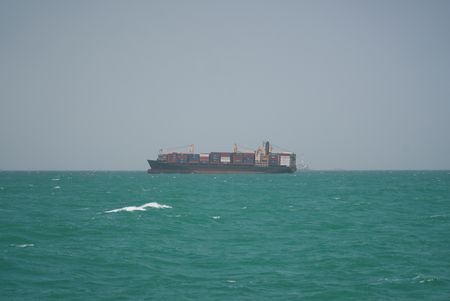

Thousands of seafarers continue to endure harsh conditions aboard vessels trapped in the Gulf as Iran strengthens its grip on the Strait of Hormuz, a crucial global oil shipping route.
Approximately 20,000 maritime workers remain stranded on roughly 2,000 ships in the Gulf, with many unable to disembark and facing shortages of food and fresh water while living in fear of potential attacks in what has become a war zone.
Recent interviews conducted by Reuters with affected sailors have revealed the severe hardships and anxiety they face daily, with a maritime workers’ federation warning of desperate circumstances.
“The only thing we do here is plan how to spend the night and pray to God that we do not get hit during an attack,” said Indian sailor Salman Siddiqui during a phone call from his trapped vessel last month.
For almost three months, these maritime workers have lived in isolation with small groups of crewmates, confined to cramped living spaces, shared dining rooms, and blistering hot decks under the scorching sun.
The waterway was shut down by Tehran after U.S.-Israeli military actions against Iran commenced on February 28. With thousands of ships now trapped and peace talks at a standstill, Iran continues to strengthen what amounts to an effective maritime blockade.
On Wednesday, the Persian Gulf Strait Authority, an organization established by Iran to handle transit requests, released a map reinforcing Tehran’s territorial claims over extensive waters surrounding the strategic chokepoint.
Vessel operators attempting to free their ships and valuable cargo must work through a complex web of fees and approvals established by Iran, according to a Reuters investigation.
“Seafarers’ vulnerability and exposure is more, let’s say, extreme because of the war,” explained Mohamed Arrachedi, network coordinator for the Arab World and Iran at the International Transport Workers’ Federation.
Arrachedi outlined numerous problems including delayed wages, refusal to assist with sailor repatriation, insufficient supplies, and constant fear of missile and drone attacks. He noted that some seafarers have contacted him while crying.
Since the conflict began, the ITF has received contact from over 2,000 Gulf sailors requesting assistance or guidance with various issues including abandonment, wage delays, and supply shortages, according to Arrachedi.
From the Saudi port of Dammam, approximately seven large vessels could be seen anchored offshore – an unusually high number under normal circumstances. As a supply boat approached a tanker amid strong winds, crew members shouted across the water while loading large bags of medical supplies.
Mohit Kohli, captain of a large freight ship caught in the Gulf when hostilities erupted after departing Singapore, said when he initially learned the Strait might close he “could not even fathom that this was remotely possible.”
While his German-owned vessel secured safe anchorage near Dammam, just over a week into the conflict, the crew began witnessing and hearing missiles and drones that Iran was launching at Gulf nations.
“The crew who was usually loud and happy were now silent. Meals got shorter. Conversations were more guarded,” he explained, describing the ship’s atmosphere during a Reuters interview this month following his return to India.
Kohli and his fellow crew members were fortunate to be on a vessel whose operators arranged for replacement crew, he noted.
Many sailors endure far worse conditions, Arrachedi explained. In cases he’s handling, some sailors haven’t received their modest salaries of $100 to $200 monthly since last year, and ship operators refuse repatriation assistance or only provide it if workers surrender back wages.
Some mariners report surviving on just one daily meal of rice or lentils and having only brief internet access to reach family members or request outside assistance, Arrachedi added.
“They need a collective intervention because they are key for our economies, for the supply chains, but also because they are active seafarers and they are civilians,” he stated.
Gulf nations are making efforts to support sailors by enabling supply deliveries and crew transfers.
“Seafarers stuck on a vessel in uncertain waters, the most important thing in the world is knowing that there is a shore open to reach,” said Suliman Almazroua, president of the Saudi Ports Authority.
The authority has assisted hundreds of vessels with resupplying food, fresh water, fuel, and medical supplies, while helping more than 500 sailors transfer from their ships, Almazroua said, describing thank-you messages from sailors he’s helped evacuate as the most fulfilling aspect of his work.