
Frightened by blasts that have rocked their neighborhoods in Tehran and major urban centers, thousands of Iranian families have evacuated to rural areas, seeking safety in remote villages during ongoing strikes by Israeli and American forces.
Among those who fled is 22-year-old Pouya Akhgari, now staying with relatives in a mountain village in Zanjan province, roughly 120 miles from his Tehran residence. While snow blankets the rural landscape, he passes time watching entertainment programs and occasionally traveling to nearby larger communities.
Though his current location remains untouched by attacks, contacts back in the capital describe constant explosions around them.
“It just feels so chaotic. I thought it’d be very short but it’s dragging on,” he told The Associated Press by a messaging app. “If it goes on like this, we’ll run out of money.”
United Nations refugee officials report that approximately 100,000 residents abandoned Tehran during the conflict’s opening 48 hours, representing a significant portion of the metropolitan area’s 9.7 million population. Officials believe the actual number of displaced persons is considerably higher, though comprehensive data from subsequent days and other affected cities remains unavailable.
A 39-year-old attorney experienced a full day of explosions rattling her residence in Ahvaz, located 500 miles southeast of Tehran. The following day, March 2nd, she departed with her siblings and their families – including their pets Coco and Maggie – heading to their family’s strawberry cultivation operation in a distant small community.
The woman and others contacted by AP requested anonymity to avoid potential retaliation, and she declined to identify their current location.
Their temporary refuge lacks military installations, providing a sense of relative security. However, Iran’s southern regions have experienced some of the heaviest bombardment. She noted that a neighboring community witnessed an explosion when strikes targeted a Revolutionary Guard ammunition facility belonging to the country’s most influential military organization.
She remains concerned about potential attacks on a fitness center used by Guard personnel located several hundred meters from their agricultural property. Air strikes have targeted numerous athletic facilities throughout Iran, apparently because Guard forces frequently utilize such locations for meetings. While the gym’s distance would likely protect them from direct impact, she acknowledged, “but all the same, the danger exists.”
With no one reporting to jobs and children separated from their schools, families occupy themselves by walking their dogs, engaging in board games, and harvesting strawberries.
The tranquil natural surroundings help create distance from the conflict – clouds drifting over verdant hills and neighboring goats calling at dusk. The attorney described the birth of puppies to one of their farm dogs, Maya, as the most uplifting moment.
Nevertheless, uncertainty pervades their daily existence.
“From morning to night, we talk about what is happening, our worries, how everything gets more expensive every day, about how far our money will stretch,” she said.
“If this situation continues, we will have problems meeting basic needs.”
The American-Israeli military operation has delivered significant damage to Iran’s governing structure, eliminating Supreme Leader Ayatollah Ali Khamenei and senior military commanders. The campaign has specifically focused on Revolutionary Guard and paramilitary Basij forces, the organizations responsible for defending the clerical Islamic Republic and suppressing anti-government demonstrations, including recent January protests.
Leadership control continues under Ayatollah Mojtaba Khamenei, the former supreme leader’s son, who assumed the top position this week. Guard and Basij organizations have maintained their local operational networks thus far.
During infrequent trips from the farm into town, the lawyer observed increased weaponry among street-patrolling Basij members.
“They are waiting for the slightest movement” showing dissent, she said.
Previously an activist opposing mandatory head covering requirements – she faced brief detention in the past – and had abandoned wearing hijab years earlier, she now covers her hair when leaving home to avoid provoking Basij forces.
The community traditionally supports the government, she explained, with many residents holding state employment or Guard membership. Religious and patronage connections remain strong in rural regions particularly, since the Islamic Republic extended essential services to Iran’s countryside and smaller communities.
Despite this, she has observed increasing dissatisfaction even locally. Substantial crowds participated in January’s anti-government demonstrations, and compliance with official mourning observances for Khamenei has been limited, with few residents wearing black clothing as authorities requested.
One father described how explosions caused his 6½-year-old son to shake with terror before they evacuated their Tehran home.
“You place him between you and your wife in bed, hoping he might feel safer,” he said, but the child continued screaming during sleep. They determined departure was necessary.
While driving through the capital, they witnessed roadside vehicles with windows destroyed by blasts. Departing the city at the Alborz Mountain foothills north of Tehran, they observed smoke columns rising from various city sections into the cloudy sky.
“The scene made the city look frightening,” he said.
On the western highway from Tehran, heavy with traffic, explosions shook their vehicle, terrorizing his son. Eventually they reached family accommodations in a small mountain village northwest of the capital, overlooking the Caspian Sea.
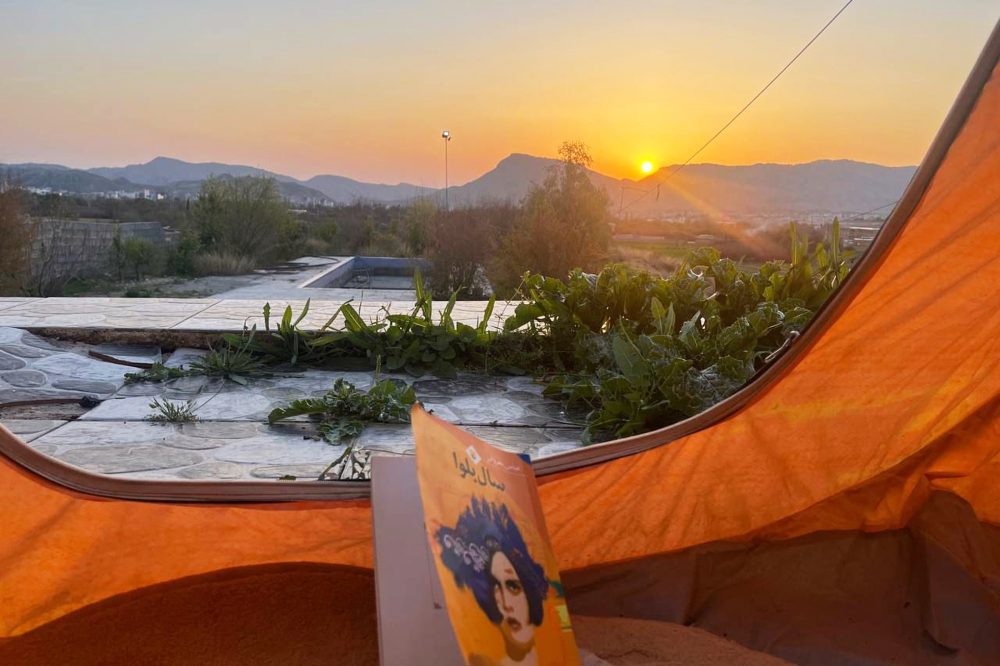
They now spend days in the house, surrounded by rice cultivation fields, with snow-covered peaks visible in the distance. Daily, he and his wife take their son for walks.
“Boys have so much energy, and in a village, there is not much fun for him,” he said. Evenings bring visits from his wife’s parents, who also evacuated Tehran.
Throughout the disruption, local residents demonstrate “remarkable kindness,” he said.
At the neighborhood bakery, he encountered a lengthy line. When the baker recognized him as an outsider, he was called forward and the baker attempted to refuse payment for bread.
“The others in line were very friendly, asking whether I had a place to stay and whether I needed anything,” he said.
Evacuation remains impossible for everyone.
A 53-year-old Tehran man explained he cannot relocate his elderly parents and must remain home. The psychological pressure is overwhelming, he said.
“At night, I go down to the parking garage, sit inside my car and scream out loud,” he said. “I pray for calm and for quieter days.”