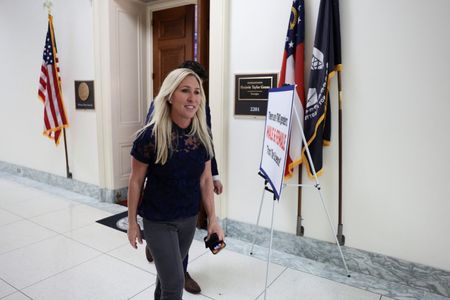

Voters in Georgia are casting ballots Tuesday in a special congressional election to fill the seat vacated by controversial Republican Marjorie Taylor Greene, with the outcome serving as an early indicator of former President Donald Trump’s political influence in one of the state’s most conservative areas.
Former district attorney Clay Fuller has received Trump’s backing for the position representing four counties in northwest Georgia. However, he faces competition from Colton Moore, a former state senator with far-right views who describes himself as “Trump’s #1 Defender” and is attempting to appeal directly to the former president’s most devoted supporters.
The crowded field of 17 contenders makes it unlikely anyone will secure an outright majority in what’s anticipated to be a contest with limited voter participation, leading to a runoff scheduled for April 7 between the two highest vote-getters. Democratic candidate Shawn Harris is also competing and has been working to attract disenchanted Trump supporters.
National political observers are paying close attention to this contest because it provides an early indication of Trump’s hold on his political base in a region that has served as a cornerstone of his Make America Great Again coalition. A decisive victory for Fuller would demonstrate Trump’s ongoing political clout, while a disappointing result might suggest his influence is diminishing among MAGA supporters.
“This is an interesting case to see how powerful Trump’s hold over the party is in that particular district,” said Kerwin Swint, a political science professor at Kennesaw State University who lives in the district at stake.
According to Swint’s analysis, the most probable scenario involves Harris leading the initial vote count without achieving a majority, while the dozen Republican contenders divide their party’s support between Fuller and Moore for the second runoff position. Swint noted that Harris would face steep odds in a runoff against any Republican candidate due to the district’s deeply conservative character.
The 14th Congressional District of Georgia encompasses a predominantly working-class region stretching from Atlanta’s outer suburbs northward to the Tennessee state line. This area gained national prominence when Greene won decisively in 2020 and rapidly emerged as one of MAGA’s most vocal and recognizable figures nationwide.
Following Greene’s departure in January after a bitter disagreement with Trump, district residents are now considering the Republican Party’s future direction and determining how much say the former president should have in selecting her replacement.
Trump made a campaign appearance last month in Rome, a key city within the district, where he brought Fuller onto the stage to endorse him as his preferred candidate. Despite this backing, the race remains unpredictable, with some Trump supporters expressing their desire to make an independent choice.
Moore maintains confidence in his ability to prevail without Trump’s official endorsement, pointing to his aggressive promotion of Trump’s unfounded assertions about the 2020 election being fraudulent and his attacks on perceived political opponents as evidence of his appeal to MAGA loyalists.
During a recent interview, Moore claimed that substantial “DC swamp money” has poured into the district to support Fuller through television advertising and other means. He suggested that some “low-information voters” might support Fuller solely because of Trump’s endorsement.
“But the activists, the people who are most likely to get out and vote, they know we were Trump’s number one defender in Georgia,” said Moore.
The special election winner will hold the position until the end of 2026 but must immediately begin campaigning for the complete two-year term beginning in January 2027, starting with a May primary that could feature many of the same candidates competing once again.
That subsequent race will be part of November’s general election, when voters will decide control of all 435 House seats and one-third of the Senate’s 100 positions.
Tuesday’s election occurs just days after joint U.S. and Israeli military action against Iran, a development that some White House officials privately believe could create political challenges for Trump and Republicans when voters have indicated greater concern with domestic priorities such as cost of living and healthcare access.