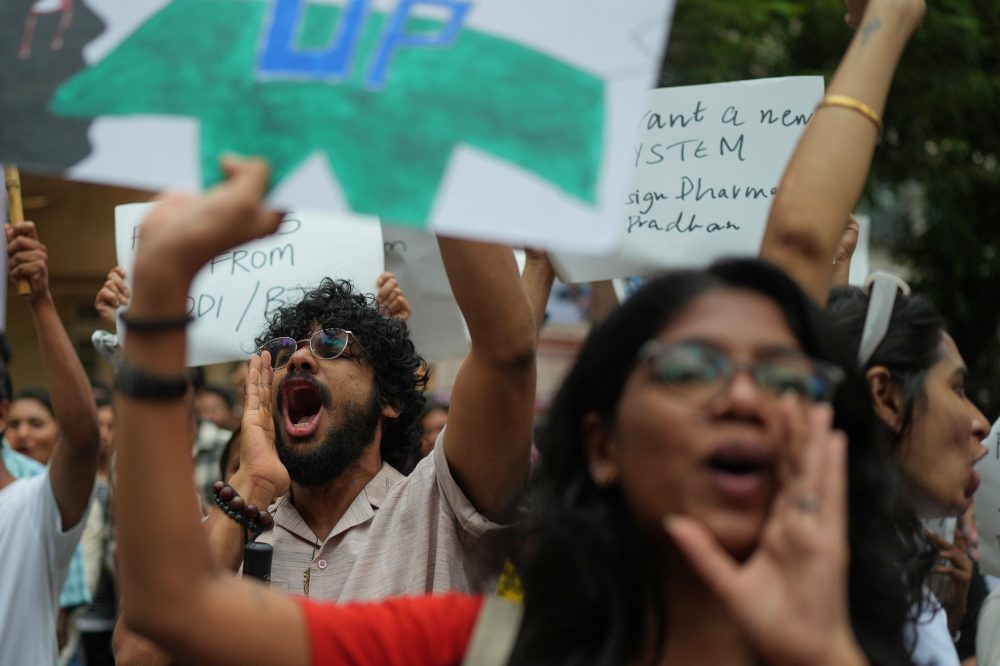

NEW DELHI (AP) — Thousands of demonstrators supporting India’s youth-driven Cockroach movement assembled Monday in an attempt to march on Parliament, calling for the education minister to step down — even as police refused to authorize the protest.
A heavy police presence surrounded the barricaded gathering area at Jantar Mantar in central New Delhi, setting the stage for a potential standoff just a short distance from Parliament as protesters pushed forward with their plans.
The crowd was a mix of students, working professionals, and families — some with small children in tow. Many came prepared for a lengthy day, carrying backpacks stocked with food and water, while others waved Indian flags. Officers used loudspeakers to urge the crowd to leave, but demonstrators responded with chants directed at the education minister and Prime Minister Narendra Modi.
The Cockroach Janta Party was born in May after the country’s Supreme Court chief justice, during an unrelated court proceeding, compared certain unemployed young people to “cockroaches.” Rather than taking offense, supporters reclaimed the term, building a satirical movement that has since attracted millions of followers across social media platforms.
The movement picked up steam following a series of leaks involving high-stakes entrance exams for medical school admissions and government employment, which fueled widespread public outrage. It gained even more attention after activist Sonam Wangchuk, who had been on a hunger strike, was taken to a hospital by police on Saturday.
Self-described “cockroaches” have maintained a presence at Jantar Mantar for the past month, with members of various student organizations joining Wangchuk’s hunger strike. Large crowds have also rallied at universities and in cities across the country. Their demands include the resignation of Education Minister Dharmendra Pradhan, an overhaul of the exam system, and financial compensation for families of students who died by suicide following the exam leaks.
Prior to the march, Wangchuk stated he would only end his nearly three-week hunger strike under two conditions: if the government formally acknowledged responsibility for failures in the education and exam systems, or if protesters were permitted to reach Parliament and legislators committed to raising the issues in both legislative chambers.
Delhi Police maintained that the march lacked proper authorization and that security restrictions around Parliament were necessary to preserve public order during the monsoon legislative session, which opened Monday.
The protests have emerged as one of the more significant public challenges to Prime Minister Modi’s Hindu nationalist government during its current third term, drawing backing from opposition political figures, human rights advocates, and some Bollywood celebrities. Many demonstrators argue that opportunities to voice dissent have narrowed under Modi’s administration, which has faced criticism for cracking down on public demonstrations through arrests of activists and, in certain cases, forceful police responses.
Top officials in Modi’s government have pushed back firmly against the movement. Education Minister Pradhan has gone so far as to accuse the protesters of working against the country’s interests, while other cabinet members have acknowledged student grievances but ruled out any formal dialogue with movement leaders.
Jyoti Rajput, a yoga teacher who joined the protests, explained her reasons for showing up: “This rotten system refuses to take action.”
“It cannot see the pain of students, and that’s why so many people have joined this movement,” she added.