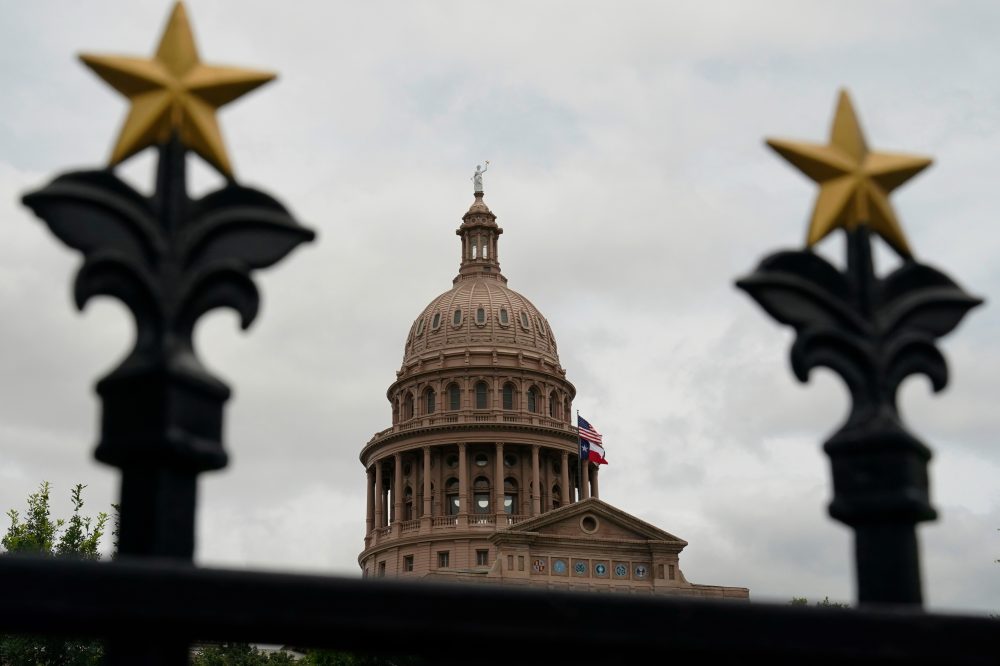

WASHINGTON (AP) — Republican leaders in Texas have crafted a new congressional district map designed to give their party an advantage in upcoming midterm elections. However, the success of this strategy remains uncertain as it depends heavily on whether supporters who backed President Donald Trump in recent elections will continue voting for other GOP candidates when his name isn’t on the ballot.
The redesigned electoral map aims to help Republicans capture five seats currently held by Democrats, a goal originally outlined by Trump. Should this plan succeed, Democratic representation in Texas would shrink dramatically from the current 13 districts to just eight out of the state’s total 38 congressional seats.
To achieve this objective, Republican mapmakers employed a redistricting technique known as “cracking,” which involves distributing Democratic-leaning voters throughout multiple districts where Republican-leaning voters hold numerical advantages. This approach makes it more challenging for Democratic candidates to build winning coalitions in individual congressional contests.
However, the calculations underlying this strategy are far from straightforward. Accurately forecasting voter behavior and turnout patterns presents significant challenges, and miscalculations can lead to unexpected results.
Political analysts typically examine the most recent general election results when making these predictions. This method relies on the premise that recent voting data provides the clearest indication of current voter sentiment and preferences.
The redrawn map would likely deliver those five targeted seats to Republicans if Texas voters maintain the same patterns they displayed during the 2024 presidential contest — meaning Trump supporters continue backing Republican candidates while Kamala Harris voters remain loyal to Democrats. Based on this scenario, districts such as the newly configured 28th and 34th, currently represented by Democrats, would switch to Republican control.
Nevertheless, individual elections are significantly influenced by broader political circumstances at the time. Factors such as incumbent party popularity and economic conditions play crucial roles in voter decision-making.
Regarding 2024, those factors favored Republicans, as the party experienced nationwide success, particularly Trump’s strong performance. Analysis by the Associated Press indicates that if 2026 voters replicate their 2024 presidential voting behavior, most congressional races wouldn’t be particularly competitive. Only four districts would feature margins closer than 15 percentage points.
Conversely, when applying results from a more Democratic-friendly election to these new districts, the outlook becomes considerably less certain. If voters return to their 2020 presidential voting patterns, Republicans would face greater difficulty securing all five targeted seats.
Using 2020 presidential results instead of 2024 data reveals significant shifts in several areas. Border districts with substantial Hispanic populations move from narrow Republican advantages to slight Democratic leads. Meanwhile, Dallas-area districts transition from strongly Republican to more competitive, though still GOP-favoring territory. Under 2020 voting patterns, nine districts would have margins within 15 points.
Some seats remain likely Republican pickups regardless of which election year serves as the model. For example, a Dallas-area district currently represented by Democratic Rep. Marc Veasey has been redrawn to include significantly more Republican-leaning voters, making it difficult for Democrats to retain even under 2020-style voting patterns.
Rather than campaign for reelection in his substantially altered district, Veasey has announced his retirement from Congress.
“The city of Fort Worth has no Democratic representation,” Veasey commented regarding the new district boundaries.
“It’s going to be sad,” Veasey continued. “I feel terrible.”
The critical uncertainty centers on whether voters who supported Trump in 2024 will maintain their Republican loyalty during midterm elections. While the entire country shifted rightward in 2024 compared to 2020, certain demographic groups showed more pronounced movement than others. Hispanic voters, who comprise significant portions of border communities and major Texas cities, supported Trump at notably higher levels than they had previously.
However, there are concerning indicators for this redistricting strategy, especially in areas with large Hispanic populations. Despite Trump’s substantial margin improvements along the southern border, voters in those same areas reelected Democratic incumbent Representatives Henry Cuellar and Vicente Gonzalez to Congress. Both legislators are seeking reelection in their reconfigured districts.
The ultimate success of Texas’ new congressional map depends on resolving a fundamental question: whether 2024 represented a lasting political realignment or simply the peak of Republican gains among crucial voter groups. While upcoming primaries won’t definitively answer this question, they will provide initial indicators of whether the map’s designers made the correct assumptions.