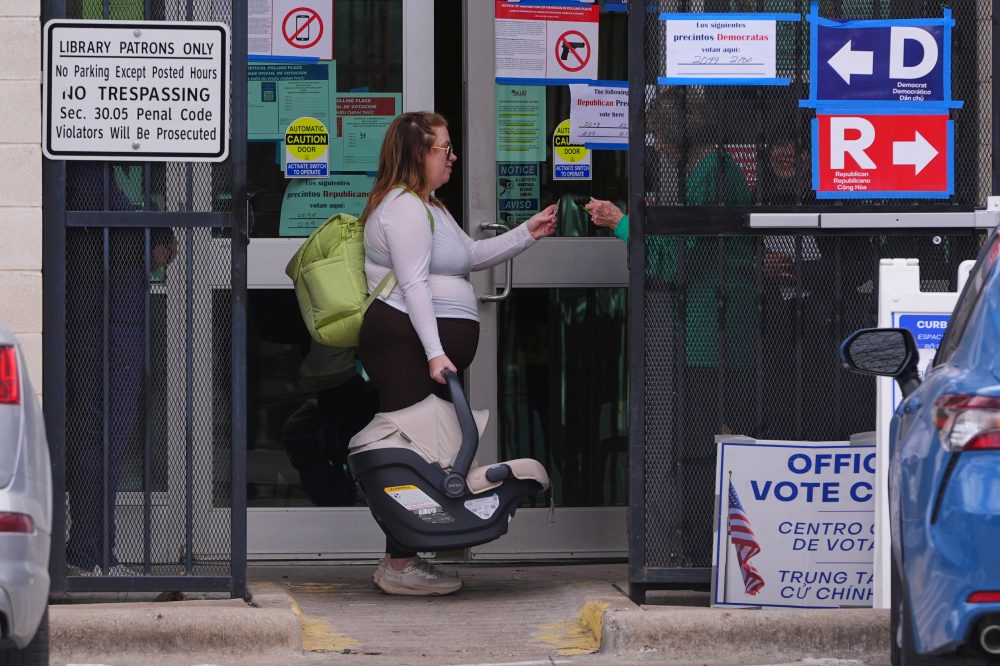

Hundreds of Texas voters faced significant confusion and were redirected from polling sites during Tuesday’s primary election after recent modifications to voting procedures created widespread problems in two major counties.
A Dallas County judge mandated that polling locations extend their hours by two additional hours beyond the standard 7 p.m. deadline, responding to what was described as “voter confusion so severe” that it overwhelmed and crashed the county election department’s website. This emergency order came following a request submitted by the area’s Democratic Party.
The source of the confusion stemmed from changes to long-standing voting practices in Dallas and Williamson counties. For several years, residents in both locations had enjoyed the convenience of casting ballots at any polling site within their county boundaries. However, this primary election marked a shift after local Republican organizations chose not to participate in the countywide voting arrangement. According to state regulations, both major political parties must consent to countywide voting for the system to operate.
As a result, voters throughout both counties were restricted to casting their ballots exclusively at their designated home precincts on Tuesday.
The two Democratic candidates competing in the U.S. Senate primary race criticized the impact these changes had on voter participation and demanded extended polling hours.
“Both Dallas and Williamson county voters have grown accustomed to countywide voting, including on election day,” stated the campaign of U.S. Rep. Jasmine Crockett. “This effort to suppress the vote, to confuse and inconvenience voters, is having the intended effect as people are being turned away from the polls.”
State lawmaker James Talarico’s campaign expressed being “deeply concerned” about numerous reports of voters arriving at polling sites only to be redirected elsewhere.
The situation became even more complex because voting locations might vary based on a person’s party registration, explained Nic Solorzano, who speaks for the Dallas County Elections Department.
“We’re seeing a lot of people that are going to their vote centers that they usually go to … and not realizing they can’t do that anymore. They have to go to their precinct-based location,” Solorzano stated.
Officials had not immediately clarified whether the judge’s extended hours decision affected all voting precincts or applied only to Democratic polling locations.
Tuesday marked the beginning of the 2026 midterm election cycle in Texas, alongside North Carolina and Arkansas. Apart from the Texas complications and a technical issue with electronic poll books in one rural North Carolina county that delayed statewide results by one hour, voting proceeded relatively smoothly.
Dallas College student Tomas Sanchez experienced the confusion firsthand when he arrived at his campus voting location to participate in the Democratic primary. Officials informed him he was operating under a “mistaken impression” and needed to travel approximately 6 miles to his assigned precinct near his residential neighborhood.
“This is something that we were really concerned about, honestly,” Solorzano acknowledged. He noted that after almost seven years of allowing voters to cast ballots anywhere within the county, “then we kind of had to retool our entire operation to go back to precinct-based voting for Election Day.”
County election officials had attempted to prepare voters through various communication methods, including posting signs, broadcasting advertisements, and distributing text messages and mail notifications about the changes. On election day, former poll workers were positioned outside voting sites with tablets to assist people in locating their correct polling places.
Although Solorzano indicated his department wasn’t maintaining official counts of redirected voters, local Democratic leaders described the numbers as substantial.
Dallas Democratic Party executive director Brenda Allen reported that her organization received hundreds of calls from voters across party lines seeking help finding their correct precincts. She pointed out that congressional district boundaries in the county had also been redrawn during Texas’ recent redistricting process, and new precinct boundaries weren’t finalized until December, providing minimal time for voter education.
“Lots of reports of people being turned away, hundreds of people unable to vote. Both parties are affected by this,” Allen commented. “It’s not great.”
Similar problems occurred in Williamson County, located in the suburbs north of Austin, where the local Democratic Party headquarters was overwhelmed with calls, according to executive director Madison Dickinson.
“We’re having significant problems with the precinct-level voting,” she reported, adding that Republican voters were also confused by the modifications and contacted the Democratic Party seeking assistance.
Republican organizations maintained a lower profile regarding the changes on social media, though the Dallas County Republican Party did share a link directing voters to their assigned polling locations. The Williamson County Republican Party did not provide comments when contacted.