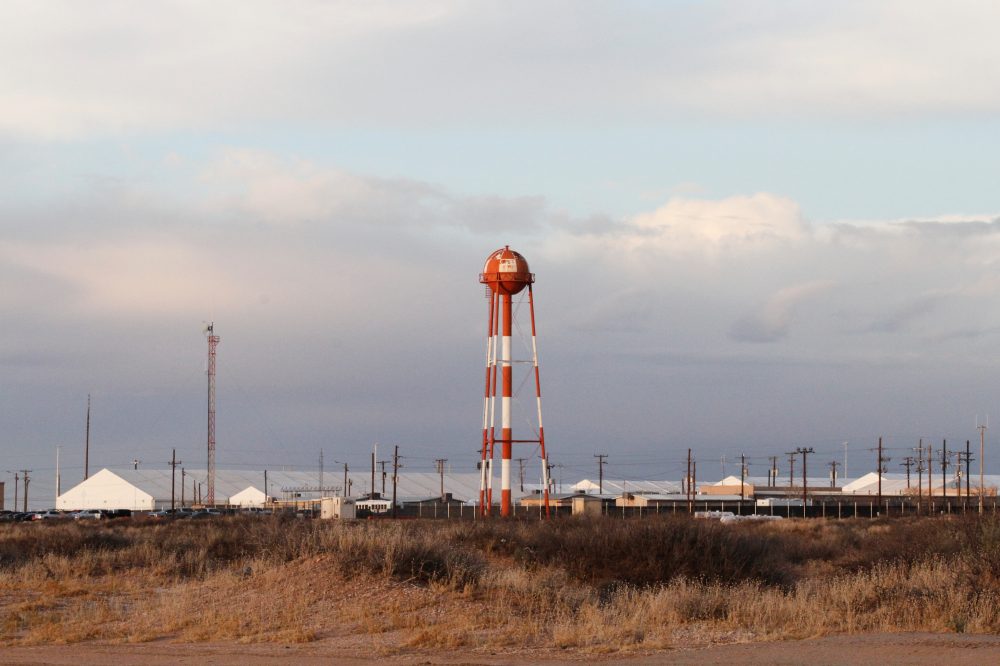

Federal inspectors have uncovered 49 safety violations at the United States’ largest immigration detention center, revealing conditions that put detainees at risk of excessive force, illness, and other dangerous situations.
The Immigration and Customs Enforcement Office of Detention Oversight conducted the congressionally required inspection during a three-day period in February at Camp East Montana located in El Paso, Texas, according to a report ICE published online this week.
The inspection documented 49 deficiencies, defined as violations of detention standards or policies, spanning areas such as force and restraint procedures, security protocols, medical treatment and additional concerns. This marked the first inspection report released by the oversight office since Camp East Montana was rapidly constructed and began operations last summer.
The violation count at this facility stands out dramatically compared to other detention centers. No other inspection conducted by the oversight office this year has found more than 13 deficiencies.
“This report is scathing. Camp East Montana gets an F,” said attorney Randall Kallinen, who represents the family of a 36-year-old detainee who died there in January — one of at least three deaths since its opening. “It’s very dangerous. Not only are the detainees in danger of excessive force, they are also in danger of improper or negligent medical care and mental health care, as well as danger from other detainees.”
These findings emerge as ICE’s parent organization, the Department of Homeland Security, has halted plans to purchase warehouses designed to accommodate 7,000 or more immigrants in single locations. According to ICE data from February 5, Camp East Montana operates as the largest detention facility, holding approximately 3,000 detainees daily, most of whom are men without criminal convictions.
The inspection occurred before ICE decided last month to remove the primary contractor, Acquisition Logistics LLC, following intense criticism regarding Camp East Montana’s conditions. Despite having no prior experience in detention operations, the company received a contract valued at up to $1.3 billion to construct and manage the facility. Both the company and its president, Ken Wagner, did not respond to requests for comment.
A more seasoned contractor, Amentum Services, assumed control of Camp East Montana operations on March 12. Federal records indicate their nearly $453 million no-bid contract for detention, transportation and medical services extends through September 30.
Detainees typically remain at Camp East Montana for days or weeks while awaiting deportation or transfer to other facilities.
U.S. Representative Veronica Escobar, an El Paso Democrat who has visited and spoken with detainees at the facility multiple times, described the inspection results as “a drop in the bucket of what is so profoundly wrong with that facility.” She noted detainees have repeatedly reported medical neglect and other issues.
Escobar stated conditions remain unchanged and questioned whether poor conditions are intentionally maintained to encourage detainees to accept voluntary deportation.
“ICE is completely uninterested in really creating any change or holding the contractor accountable,” she said.
An ICE spokesperson indicated the new contract will deliver enhanced medical care, increased on-site personnel and stronger ICE oversight.
The inspection report revealed multiple safety failures during Acquisition Logistics’ management period. Facility staff failed to document whether they performed mandatory checks designed to prevent self-harm and suicide attempts, issues that 911 records show have been significant problems at the location.
Acquisition Logistics declined to share staffing level information with ICE, preventing officials from determining whether personnel numbers were adequate for maintaining security, the report stated. In one case, a detainee escaped when no staff member was assigned to monitor perimeter fencing.
Inspectors discovered tools and equipment were “unsecured and unaccounted for throughout the facility” and staff did not maintain proper ammunition inventory records.
Security personnel who used or observed the use of force and restraints like handcuffs sometimes failed to complete required written reports, according to the findings.
Supervisors also neglected to document their observations, staff members failed to record or preserve video footage in certain instances, and the facility did not conduct post-incident reviews to evaluate whether chemical agents or other force methods were appropriately used.
Medical personnel failed to isolate a detainee showing tuberculosis symptoms, an airborne disease, and did not inform ICE about the case.
The facility also responded slowly to twelve medical care grievances filed by detainees, taking six to 14 business days to address complaints, the report noted.
Despite these issues, the report assigned the facility an “acceptable/adequate” rating and recommended ICE collaborate with the new contractor “to resolve the deficiencies that remain outstanding.”
The report disputed one frequent detainee complaint regarding insufficient food portions. It stated the food service program, operated by subcontractor Disaster Management Group, provided dietitian certification confirming the “average daily caloric provision of the menu” satisfied federal guidelines.