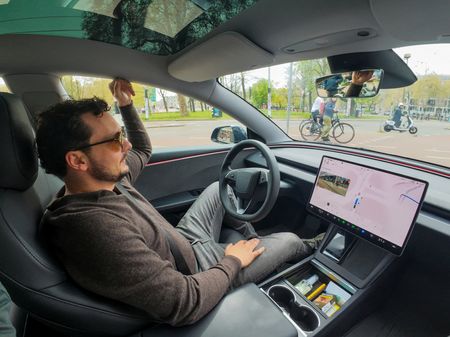

AMSTERDAM – While cruising through Amsterdam’s tight canal-lined roads surrounded by countless cyclists, it takes a moment to notice something unusual about Kees Roelandschap’s charcoal Tesla: his hands aren’t touching the steering wheel.
Tesla received unexpected authorization this month in the Netherlands to deploy its monitored full self-driving (FSD) technology, marking Europe’s initial approval for autonomous city driving that may pave the way for additional semi-autonomous cars across the continent.
The development has sparked debate. Supporters like Roelandschap praise it as revolutionary progress that could enhance road safety, while cyclists and government officials remain torn between skepticism and hope as these vehicles begin appearing on Dutch roadways.
“I’ve driven multiple different versions in the U.S. But to be able to experience it firsthand here in the Netherlands — that’s unreal,” Roelandschap told Reuters while sitting in the vehicle traveling through Amsterdam.
“I think this should be approved everywhere in Europe because it will lead to increased safety,” he stated, noting that the European-approved system seemed to include stricter safety measures compared to its American counterpart.
Tesla’s FSD technology can handle steering, braking and acceleration without manual control, although drivers must stay alert and prepared to take over. The European Union plans to review approving this technology continent-wide in May, despite ongoing safety investigations in the United States.
AUTONOMOUS VEHICLES ‘WILL MAINTAIN PROPER SPACING’
Throughout Amsterdam’s busy streets, where streetcars, delivery trucks and automobiles navigate alongside heavy bicycle traffic, e-bikes, oversized “fatbikes” and an increasing number of compact electric vehicles, public response has been varied.
“Cyclists are flowing through traffic, swarming around, going left and right, crossing each other,” explained Esther van Garderen, director of the Dutch Cyclists’ Union, emphasizing that the Netherlands presents distinctive challenges for autonomous driving.
“We’re not fully assured that these self-driving cars will understand the (road) behaviour.”
During a city council session following the approval, Amsterdam transportation official Melanie van der Horst stated the city wasn’t consulted during the regulatory approval and would carefully observe the implementation. She noted that having a supervising driver means “we don’t need to panic” and the technology might enhance safety.
“(However) I can definitely imagine that this raises quite a few concerns and reactions,” she commented.
Traffic fatalities in the Netherlands rose 6% to 759 in 2023, with vehicle-cyclist and vehicle-pedestrian collisions driving the increase, according to government data from CBS.
“I think safety will be much better because the (self-driving) cars will keep their distance,” commented local resident Paul ten Cate.
“I think it will actually be nicer for cyclists to have self-driving cars around,” he added.
‘I REMAIN SKEPTICAL’
This launch occurs as Tesla relies on driver-assistance features to boost declining European sales, hurt by CEO Elon Musk’s controversial political statements that have turned away some buyers. Tesla leads electric vehicle sales in the Netherlands, with approximately 100,000 Model 3 and Model Y vehicles currently on Dutch roads.
Recently, Amsterdam has actively discouraged automobile use while promoting cycling and mass transit by blocking streets, increasing fees, eliminating parking spots and establishing 30 km per hour (19 mph) speed restrictions on most roads.
Nina Smiljanic, riding her electric bike with her leashed dog running beside her, said she could envision the technology functioning well on single-direction highways, but questioned its effectiveness in crowded Amsterdam.
“Here in the streets, with all the tourists doing unpredictable things, I think the AI still needs to adapt,” she observed. “Maybe in America or on the highway it’s fine, but here I’m not convinced yet.”
While demonstrating his Tesla’s capabilities, Roelandschap showed how the vehicle first issued an alert and then gradually stopped with emergency flashers activated after he looked down at his lap instead of the road for an extended period — a safety feature designed to prevent driver distraction.
“I have yet to notice or encounter a difficult road situation here. We have a lot of cyclists trying to overtake us, cyclists coming towards us, cyclists coming from the left. What’s dangerous here?”