
CAIRO (AP) — A professional engineer takes cover beneath a park bench while military aircraft thunder above. A competitive athlete battles sleepless nights as detonations echo through the darkness. With internet service completely disabled, Tehran’s residents depend on word-of-mouth communication to learn about ongoing warfare and destruction from aerial attacks.
Intense bombing operations by U.S. and Israeli forces targeting Iran’s capital have now stretched into their second week, leaving citizens traumatized and overwhelmed. Across Tehran’s landscape — from its historic center to affluent northern neighborhoods — explosive strikes pound the metropolis around the clock without any advance alerts or public warning infrastructure.
“The psychological pressure is real,” said the athlete, who lives in a northern area of the capital. He was among a half dozen Tehran residents reached by The Associated Press, all of whom spoke on condition of anonymity out of fear for their safety.
Cherished national landmarks face serious threats. Smoke surrounded the towering Azadi Square gateway, widely recognized as the city’s contemporary symbol, following nearby bombardments. The historic Golestan Palace from the 1800s, a treasured cultural monument, suffered shattered windows from blast impacts. Meanwhile, government security personnel have expanded their street patrols to suppress any potential public demonstrations.
Weekend Israeli attacks on Tehran’s petroleum storage facilities created especially severe psychological trauma for local residents. Following the explosions, massive blazes erupted while poisonous black smoke choked the atmosphere — though rainfall in subsequent days provided some relief.
“I could barely breathe and had to go buy an inhaler,” a 54-year-old Tehran resident who is a human-rights activist said. “People are worried it will affect their drinking water.” As she spoke to AP, a blast went off in the background.
In a later voice note on Tuesday, the activist said, “Last night the situation was really bad. Fighters as well as drones had taken over the whole sky. East, west, they hit everywhere they could. Today you see a lot of residential places that were damaged. It’s really painful.”
Regional tensions continue escalating as Iran launches repeated missile and drone assaults against Israeli territory, American military installations, and neighboring Persian Gulf nations.
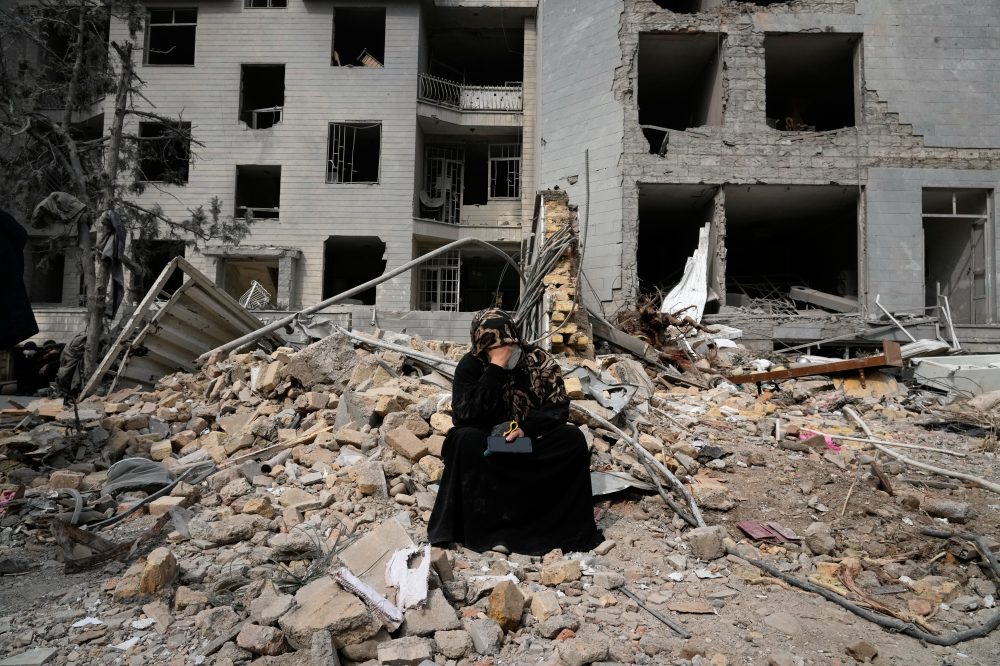
The coordinated U.S.-Israeli aerial offensive has targeted thousands of locations throughout Iran, primarily focusing on military installations and Revolutionary Guard paramilitary facilities. Iranian Red Crescent officials report extensive damage to civilian infrastructure, including medical centers, educational institutions, universities and residential buildings. Iranian authorities have not released updated casualty figures beyond the previously announced toll exceeding 1,200 deaths.
A 33-year-old engineer described the aftermath of the oil depot strikes as an “end-of-times scene.”
Iranian citizens struggle to obtain war updates, he explained, as internet connectivity has remained largely severed since initial strikes began February 28th. The engineer estimates only a small fraction of the population maintains limited online access through virtual private networks.
He relies on telephone calls with friends to learn bombing locations. Other citizens exchange strike information during tense gatherings in private homes and coffee shops.
Complete Israeli and American control of Tehran’s airspace enables attacks at any time without warning. The engineer recalled hearing fighter jets while walking his neighborhood street, followed by a nearby explosion that sent him diving under a park bench for protection.
A university student reported growing anxiety even among residents living far from obvious government and military installations.
“Every moment, without any warning sirens or announcement, some part of the city is under attack,” he said, describing some streets as full of broken glass from surrounding buildings.
Tehran, typically a bustling metropolis housing over 9 million people, now experiences unsettling quiet between bombing runs. While many retail stores and grocery markets remain operational, the traditional marketplace has closed and numerous streets sit empty as residents shelter at home. Families apply tape to windows preventing flying glass and retreat to interior rooms when hearing strike sounds.
A teacher residing in northern Tehran’s Vanak district learned that her friend’s eastern Tehran residence sustained damage from a nearby explosion that destroyed windows, broke plumbing fixtures and twisted the building’s garage door frame. Upon receiving this news by phone, “I was in a very bad shock,” the teacher said.
The teacher spends most time at home, accommodating family members who evacuated another Tehran area because they lived near Basij positions — the feared volunteer militia wing of the Revolutionary Guard. She paces continuously and attempts repeatedly to access internet services.
“I try to keep myself calm and tell myself, ‘This is the price we have to pay for getting rid of the Islamic Republic,’” she said.
U.S.-Israeli operations have concentrated heavily on Revolutionary Guard, Basij and police installations — the primary enforcement apparatus of Iran’s Islamic Republic that crushed earlier protests this year, resulting in thousands killed and tens of thousands imprisoned. This week, strikes targeted roadblocks and security checkpoints operated by Basij forces, with at least 18 locations hit Wednesday, predominantly in Tehran, according to Armed Conflict Location and Event Data, a U.S.-based monitoring organization.
Friday brought a massive explosion to a central Tehran plaza during a large pro-government rally.
Authorities appear to maintain control despite ongoing attacks. Residents report increased security force and Basij presence on city streets. One resident provided AP with video footage showing a Basij procession of motorcycles and vehicles displaying flags through her northern Tehran neighborhood. Local mosques broadcast pro-government messages, she noted.
During Monday evening state television programming, Ahmad-Reza Radan, the commander-in-chief of the Islamic Republic’s security forces, warned that anyone taking to the streets in protests will be seen “as enemies, and we will deal with them as we would with the enemy. All our guys are ready to fire.”
Government officials have also mobilized supporters for street demonstrations, particularly following the announcement of Iran’s new supreme leader, Ayatollah Mojtaba Khamenei. He replaces his father, Ayatollah Ali Khamenei, who died in Israel’s initial war strikes.
The younger Khamenei’s appointment signals continued hardliner control over Iranian leadership. He released his first public statement Thursday but has not made any public appearances.
Many Iranians remain traumatized from government crackdowns following massive anti-government demonstrations in January.
A 27-year-old nurse reported that her hospital’s surgical department continues treating protesters with severe injuries.
She characterized U.S. and Israeli attacks on Iranian leadership and security apparatus as “revenge” for protester killings and expressed satisfaction seeing security forces targeted.
However, the extensive damage from aerial campaigns concerns some Iranians hoping for the Islamic Republic’s collapse.
“It’s no longer about weakening the government. It’s gone toward weakening the people of Iran,” said the activist, who has been imprisoned in the past. “Do you really want to turn us into a scorched country, something the Islamic Republic couldn’t do itself?”